
What We Can Learn From Urban Wildlife
The animals living in our cities are defying the odds
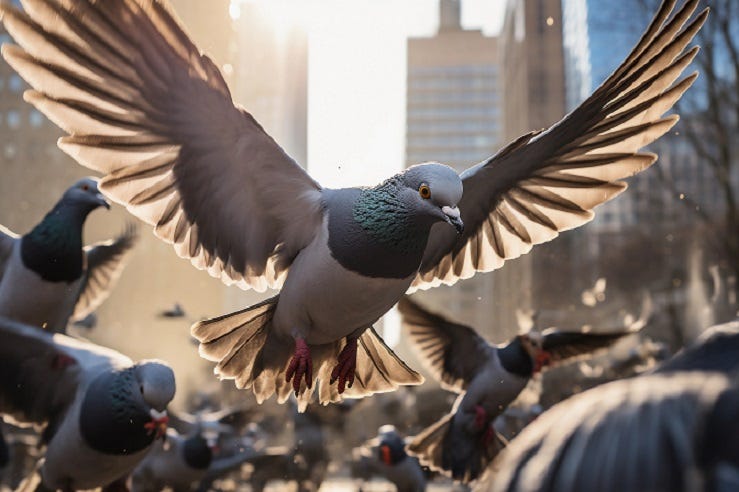
Nearly 4.5 billion people–56% of the world’s population–currently live in urban centers. People flock to cities for economic opportunities, access to healthcare and education, and other cultural and interpersonal amenities.
Animals are also increasingly becoming urban dwellers. As our cities grow due to their swelling human populations, more land is needed for urban areas, leading naturally to the loss of wildlife habitats. Some scientists project that land lost to urban expansion in the coming years will affect more than 30,000 animal species.
That’s a sobering number, and demands that we plan our cities to allow for wildlife conservation. Inspiringly, however, many animal species are already infiltrating and successfully adapting to our cities.
A new PBS nature program titled Wild Metropolis highlights the success stories of a wide array of animal species. In Amsterdam, grey herons learn to visit city fish markets for food; elephants in Sri Lanka learn to live alongside a well-traveled highway; rats have adapted so thoroughly that they now live almost exclusively in cities.
For a long time, we’ve thought humans, with their large brains and planning abilities were at the top of the heap. But these urban animal success stories should leave us with at least one question.
What can humans learn from animals?
The often-incredible adaptability of animals–like grey herons adapting to eat at night when fewer humans are around–should be the first trait humans seek to emulate.
Make no mistake. It’s not easy to increase your own adaptability. It’s so difficult, in fact, that there’s actually a named phenomenon known as the “adaptability paradox” — when we most need to learn and change, often in high-stress and high-stakes situations, we’re actually most likely to “react with old approaches” that’ve worked for us in the past.
Our changing climate and societal structures are providing new challenges for humans, and, like animals, we have to overcome our resistance to change. One way to foster adaptability is to work on your focus. To the best of our knowledge, many animals aren’t performing long-term mental planning. They are, instead, helping their long-term survival by focusing on the goals in front of them: They need food. They need to care for their young. They need to escape harm.
As you move through the world, start to focus on what you can do rather than on all the things you can’t. These will be highly personal decisions. Can you find and make healthier food that may translate to better overall health? Can you help your kids learn important life skills? Can you leave five minutes earlier so you don’t have to speed on the highway? All of these small changes can start to provide the small survival boosts that animals regularly achieve simply by adapting to their changing surroundings.
Humans need to more adequately study the imaginations of animals, but many of the survival techniques they’ve developed in the cities are very imaginative. A lizard species in Puerto Rico is learning to climb urban structures rather than trees; mice are learning to eat fast food leftovers; blackbirds are changing their calls in response to noise pollution.
Of course physical and evolutionary changes such as growing bigger and grippier toe pads in the lizards and more forgiving digestive systems in the mice make animals more adaptable. But it took a bit of imagination for that first mouse to try fast food, and adaptation success followed. Put simply, we can foster a habit of trying new things.
Without a doubt one of the new things humans might be best served by trying is to look for more ways to cooperate with one another. For many years our dominant cultural goal has seemed to be that of the “zero sum” game–a “situation in which one person or group can win something only by causing another person or group to lose it.” There’s no doubt this game is played within the animal kingdom as well; between predators and their prey, for the most obvious example, one animal increases its life span by consuming another.
But thousands of species also help one another survive through cooperation and symbiosis. Cleaner fish remove harmful parasites from other fish. Ostriches and zebras help one another avoid predators because ostriches have superior vision and can see threats, while zebras can raise the alarm when they hear threats with their more sensitive hearing.
Urban wildlife species aren’t only learning to cooperate with other animals, but also with humans. An African bird called the greater honeyguide is famous for helping its human counterparts locate honey. The birds draw the attention of humans to bees’ nests, and humans, when they harvest the honey, leave behind the beeswax–which is the honeyguides’ preferred food.
Urban wildlife is increasingly making the most of numerous challenging situations. It’s time for us to be inspired by the animals, and to increase our adaptability, imagination, and desire to cooperate so that we can be as successful in navigating our quickly changing world.


