
PRINCE PHILIP, FUNERAL
What We Can Learn From Prince Philip’s Funeral.
There is big comfort in small funerals.
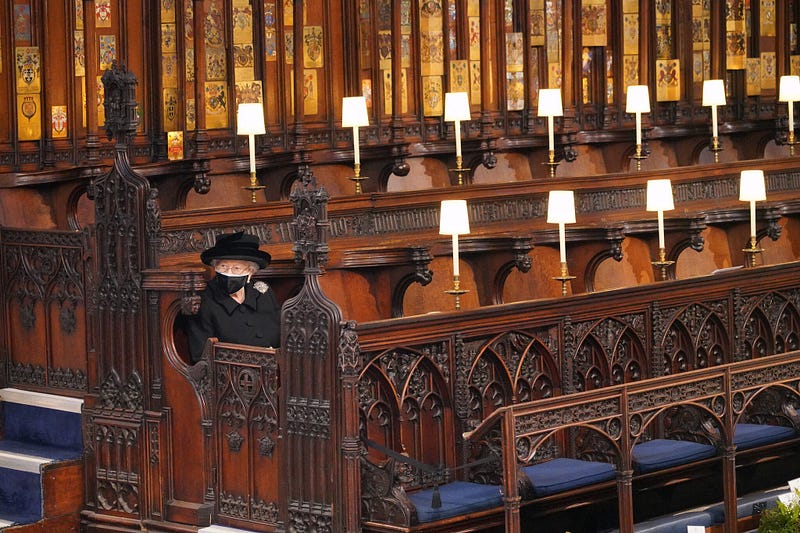
On April 9th Prince Philip, Duke of Edinburgh, husband of Queen Elizabeth II of the United Kingdom and the longest-serving royal consort in British history, died at the age of 99.
Being such a prominent figure for more than 70 years, I expected his funeral to be one of grandeur and spectacle. But I was taken aback by the simplicity of the ceremony.
There were no world leaders or other royalty in attendance. Coronavirus meant the originally estimated 800 guests had to be whittled down to 30. The final few to bid him adieu comprised of his closest family and friends.
Images of the solemn Queen sitting socially distanced from her family within the towering cathedral made many emotional. But I felt this solitude must have been immensely comforting to the Queen.
She could be alone with her thoughts and grieve her husband’s loss. She could just be a grieving wife and not the Queen.
I cannot imagine what young Prince Harry and Prince William had to endure 2 decades earlier. Just kids, they had to walk behind their beloved mother’s coffin with more than a million hysterically sobbing people gawking at them.
Two thousand people attended Diana’s funeral ceremony in Westminster Abbey. The list included Presidents, heads of state, celebrities, actors, and other royalty.
The whole world grieved like they had lost their own. But it was those young children’s mother in that coffin. It was their biggest loss. They were robbed of their right to be alone and grieve as they wished. They had to put on a brave front in front of the public as they heartbreakingly bid a final farewell to their mother.
Prince Philip’s funeral took me back to my brother’s funeral a year ago. There was a total of 7 people at his funeral. It was a month before Corona rampaged the world and brought it to a standstill. There were no Covid-19 restrictions at the time.
So why were there only 7 people? It was my mother’s wish. Some of my brother’s friends and relatives wanted to fly down for the funeral. But my mother didn’t want to see anyone on this worst day of her life.
She wanted privacy to mourn alone. She and my dad had just journeyed 40 hours and reached a day before the funeral.
Jetlagged, sleep-deprived, deep in shock and grief, she was in no mood to make small talk with anyone. She also wanted to be spared from any insensitive comments of people.
I communicated her wishes to everyone and thankfully most of them respected that. Some grumbled and complained. What’s the big deal? Why are they being so secretive?
I could understand their desire to say farewell to my brother and pay their respects but on this day my mother’s need took precedence.
Go ahead and be selfish when your loved one is no more. This is not the time to please anyone. You and your family’s needs come first. Do as you wish. This is your loss first and foremost.
My brother’s coffin was a closed casket as his body was found a week after his death and it was not in viewable condition. We never got to see him or touch him one last time. This made the whole experience more surreal. Yet in the stillness of that tiny church, I could feel his photons bouncing around.
It was my mother’s stoic composure that pained me more. She didn’t shed a tear and even volunteered to do the Bible reading, her voice never once wavering. She wanted this to be her last tribute to him.
As for me, I felt numb and emotionless looking at that rented casket. I tuned out for much of the mass. I talked to my brother on and off, telling him we were there for him and he was at peace now.
We posed for some final photos with the casket. As we were ready to leave, the funeral director pulled me aside. He said he could open the casket and show only my husband and I that my brother was really inside. I at once jumped at the opportunity to see him.
With everyone outside the room, he unlocked the casket and opened it. There were 2 layers of heavily scented thick white blankets. When he lifted that there lay a blue body bag. He wouldn’t open that. I couldn’t make out the shape of a body so had to ask him where the head was. He pointed.
I still didn’t believe him. So I took a deep breath in and smelled my brother’s decomposing body. That scent will forever be etched in my mind. That was the only proof I had of some sort that my brother lay in that bag.
Those final moments you have with your loved one are highly personal and intimate. I cannot imagine my parents and I experiencing those moments with people surrounding us.
I don’t think anyone could have consoled or comforted us on that day. All words were just empty words to us. Condolences, they meant nothing. We didn’t want anyone’s pity or sympathy. We just wanted to be left alone with our pain on that day.
Jam-packed funeral services and hour-long eulogies don’t dent the pain. Grief is a very solitary journey. The pain of the bereaved doesn’t reduce when Presidents show up to the funeral or a 21-gun salute is fired. On the contrary, the crowds and the chaos just compound the agony.
It’s a few weeks or months after the funeral when the anesthetic effect of the shock wears off. The numbness slowly disappears and you begin to feel the full impact of the loss. Sadly that’s the time few show up.
If you really want to pay your respects to the family, check on them in the months after the funeral. That’s when grief truly begins.