
What We Can Learn From Crazy Roman Emperors
3 Cautionary lessons from Roman Emperors who went insane
30 seconds spent on this article really helps with Medium’s algorithm. Please bear that in mind before you bounce! :)
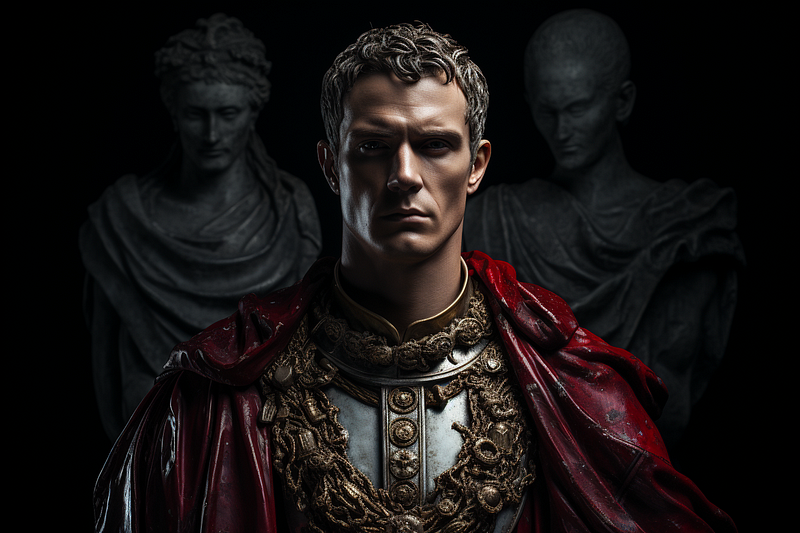
The Roman Empire is something that’s always captured our imaginations. It’s hard to imagine such a dominant and innovative civilization existing so long ago. Inventions we still use today like cement, public postal services, and sewer systems are all thanks to the ingenuity of this ancient empire. Spanning Europe, western Asia, the Mediterranean islands, and even northern Africa, the full scope of the Roman empire is staggering to think about.
But it wasn’t all sunshine, roses, and aqueducts. And that’s largely due to a number of leaders that were megalomaniacs or outright insane!
It’s honestly terrifying to think about being a citizen under any of these crazy emperors. Their tales are filled with intrigue, incest, political maneuvering, and insanity.
Let’s take a look at some of the worst, Nero, Caligula, Commodus, Elagabalus, Caracalla, Honorius, and Tiberius and see what cautionary tails we can extract from their cray cray.
1. Nero (54–68)
It is famously said that Nero played the fiddle as Rome burned.
This is very unlikely true, seeing as the fiddle wasn’t even invented at that time (the class of fiddle instruments wasn’t even invented until the 11th century)
However, it is true that Rome burned under his watch, and many suspected Nero had caused the fire to make room for his Golden Palace and pleasure gardens.

The resulting legends just go to show Roman citizens’ perceptions of Nero’s insanity and indulgent lifestyle.
What we do know, is that Nero killed his mother, wife (who was also his stepsister), and stepbrother, as well as many, many others.
Lesson: Beware of Self-Indulgence
Nero is famous for never wearing the same outfit twice, and spending lavishly on buildings and even statues of himself. He is remembered for living an exceptionally indulgent and extravagant lifestyle.
Nero’s reign serves as a reminder of how important it is to not place personal interests over others, especially in excess.
If a friend is treating you to dinner, don’t order the most expensive steak and 5 glasses of wine while your host orders modestly. If someone at work brings in donuts, don’t hoard a bunch and leave none for your coworkers.

It seems like common sense, but so often we see people put themselves before others to the detriment of their reputation. Remember that often times appearances of indulgence and excess can rub people the wrong way and ultimately lose their support.
2. Caligula (37 – 41)
Caligula, often regarded as one of the craziest emperors, provides an example of absolute power corrupting… well, absolutely. His reign is remembered for erratic behavior, cruelty, and megalomania.
It is said that Caligula was so cruel that he put people to death simply for forgetting his birthday. He only ruled for 4 years before being murdered by his own guards at the young age of 28.
Caligula started out being unanimously loved by, “all the world, from the rising to the setting sun.” Rome loved their young emperor and he seemed to have nearly unanimous support. But then something changed… he got deathly ill and it is said after that, he was never the same. He returned from his sick bed a crazed tyrant, even ordering those close to him be put to death (oftentimes in front of their loved ones).
He clashed heavily with the Roman Senate even delivering a hostile speech that accused the Senate of treason and disloyalty.
A legend often used as proof of Caligula’s madness is when he named his racehorse a consul. In reality, this was actually probably a prank to show the Roman senators how meaningless he thought their job was.
His feud with the senators grew and he was ultimately responsible for over 30 of their deaths. However, he was protected because he had the backing of the common people and the army, including the Praetorian Guard.
When Caligula insulted the Praetorian officer Cassius Chaerea, he quickly lost their loyalty. His own guards stabbed him to death, then killed his wife and daughter to end his bloodline.
Lesson: Don’t insult those loyal to you
Caligula had a lot of enemies but ultimately it was turning on those loyal to him that caused his downfall.
If you are part of a team, whether in sports or in the office, don’t throw your teammates under the bus.
It might make you look good in the moment, but ultimately losing the loyalty of those close to you will have much longer lasting consequences.
You can wage war on your enemies, but if someone is on your side, treat them right.
Elagabalus (218–222)
Elagabalus was a teenage emperor with a penchant for religious and sexual experimentation.
Just 14 years old when he became emperor, Elagabalus brought the Black Stone of Emesa with him from Syria. This stone was “the most holy object of the cult of the Syrian god El-Gabal.” It had always been kept in a temple in Emesa, so when Elagabalus brough it with him to Rome and built a temple for it on Palatine hill, people were outraged.
That concern only grew as Elagabalus forced senators and other high ranking Roman citizens to attend sacrifices to El-Gabol and made them watch as he danced around the stone.
To make matters worse, Elagabalus then married a Vestal Virgin, which prior to this event, would have meant the immediate death sentence.
His sexual exploits soon became famous as accounts state Elagabalus would prostitute himself by propositioning people in the palace by approaching them in the nude. He is also said to have even prostituted himself in local taverns and brothels.
In the end, even his grandma plotted to have him killed and Elagabalus was eventually murdered by his soldiers as he hid in the toilets. He and his mother were beheaded and dragged through the streets before being thrown into the Tiber river. He was only 18 at the time of his death.
Lesson: don’t force your beliefs (and self) on other people
Elagabalus came into a Roman society that had a long history of values and traditions and completely disregarded them. He forced others to follow his religion against their will and disrespected their traditions.
His sexual appetites were shocking even to the Romans… who by all accounts were not exactly a sexually repressed society!
We can learn from Elagabalus by not forcing our own beliefs on others and not mixing sex with business.
Final Thoughts
As I was researching this article I realized there was no shortage of crazy Roman Emperors.
Commodus, Caracalla, and Tiberius, the list goes on and on. I picked the top 3 for the sake of time, but it really is fascinating to read about just how crazy and cruel many of Rome’s emperors were.

Perhaps it had something to do with selecting leaders based on lineage and not credentials. But that is a debate for another article.
The craziness of Roman Emperors transcends time! Even though they ruled such a long time ago, there are still many lessons we can learn from their mistakes.
So let’s take some lessons from their eccentric and disastrous reigns, and make sure we don’t follow them off the deep end.
Startup Lab
Want to stay up to date on Startup Lab articles? Please consider Subscribing for updates here Following us here Or using our referral link to sign up for Medium here


