What was the Arab-Israeli War of 1948?
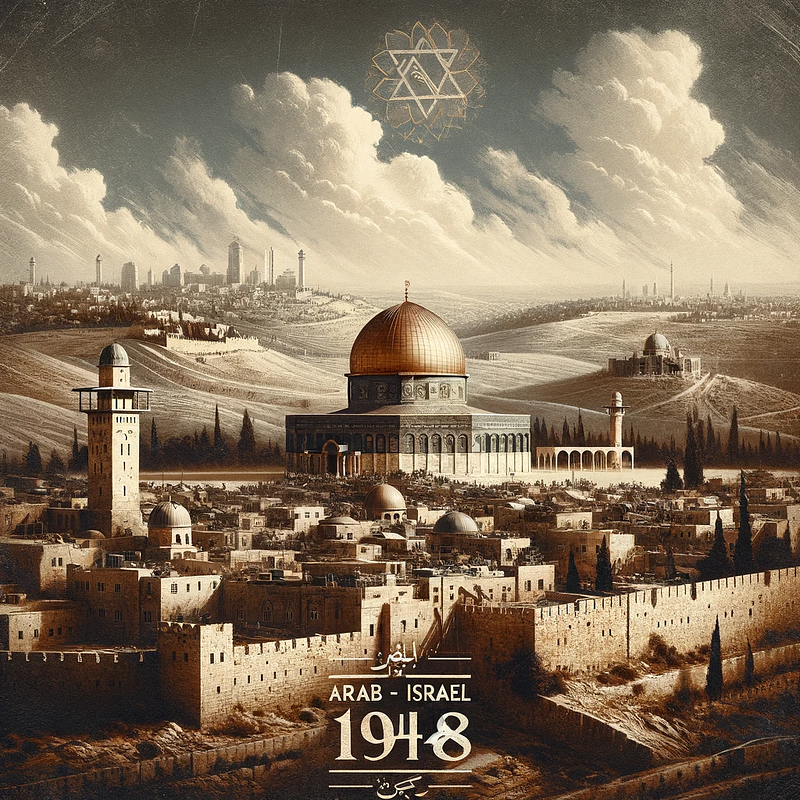
The Arab-Israeli War of 1948, also known as the Israeli War of Independence or the Nakba (Catastrophe) by Palestinians, was a defining conflict in the Middle East, fundamentally altering the region’s geopolitics and leading to the establishment of the State of Israel.
Background and Onset of the War:
The conflict originated from the longstanding Arab-Jewish tensions in Mandatory Palestine, dramatically intensified by the United Nations partition plan of November 1947.
This plan, which proposed dividing Palestine into separate Jewish and Arab states, was accepted by the Jewish leadership but vehemently rejected by the Arab side. The immediate aftermath of the UN resolution saw escalating violence between Jewish and Arab communities in Palestine.
Declaration of the State of Israel:
The situation reached a critical juncture on May 14, 1948, when David Ben-Gurion, the head of the Jewish Agency, proclaimed the establishment of the State of Israel.
This declaration came just ahead of the expiration of the British Mandate over Palestine. The new state was quickly recognized by the United States and the Soviet Union, among others, but was met with hostility from the Arab nations.
The Arab Invasion:
On May 15, 1948, armies from Egypt, Jordan (then Transjordan), Syria, Lebanon, and Iraq invaded the territory of the newly declared State of Israel, marking the formal beginning of the Arab-Israeli War.
The Arab states, rejecting the idea of a Jewish state in Palestine, intended to prevent its establishment and secure the region as an Arab state.
Course of the War:
The war can be divided into several phases:
- Initial Phase (May-June 1948): The Israeli forces were initially on the defensive but managed to prevent significant inroads by the Arab armies.
- First Truce (June-July 1948): A UN-mediated ceasefire temporarily halted the fighting. During this time, both sides reorganized and re-armed, with Israel significantly increasing its military capacity.
- Second Phase (July-October 1948): Following the breakdown of the truce, Israeli forces launched a series of offensives, gaining considerable territory beyond the boundaries set by the UN partition plan.
- Second Truce and Further Israeli Advances (October 1948-July 1949): Another ceasefire came into effect in July 1949. Subsequent Israeli operations further expanded their control, particularly in the Negev and Galilee.
Consequences of the War:
The war had profound and lasting effects:
- Establishment of Israel: Despite facing invasion, Israel managed not only to survive but also to expand its territory.
- Palestinian Exodus: The war led to the displacement of a large number of Palestinians, estimated at around 700,000, who fled or were expelled from their homes. This created a major and ongoing Palestinian refugee problem.
- Armistice Agreements: In 1949, Israel signed separate armistice agreements with Egypt, Jordan, Lebanon, and Syria, which ended the official hostilities and established the armistice lines, often referred to as the Green Line.
- Territorial Losses for Arabs: The Arab states failed to achieve their objective of a unified Arab Palestine and suffered significant territorial losses.
- Regional Tensions: The war entrenched the Arab-Israeli conflict, sowing seeds of further wars and hostilities in the region.
Legacy:
The Arab-Israeli War of 1948 is a foundational event in the Middle East’s history, shaping the region’s political landscape and contributing to ongoing Israeli-Palestinian and Arab-Israeli tensions. Its legacy continues to influence the politics, societies, and narratives of the Middle East, making it a central reference point in any discussion about the region’s conflicts.


