
What to do when you’re a Bug in a Jar

Lately I’ve really been feeling like I’m “under the microscope” or that I’m a bug in a jar”, a curiosity for others to wonder about, even an object of amusement or a focus of droll entertainment. So I’ve come up with a strategy that works for me, which I remember by the acronym –
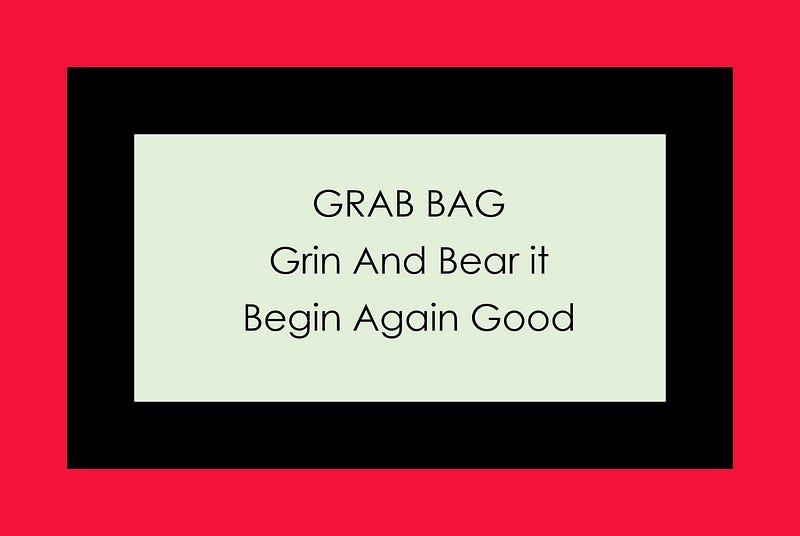
GRAB BAG
Grin
And
Bear it &
Begin
Again
Good
First of all, human beings especially in workplaces, form alliances with certain other work colleagues, and quickly form opinions and perspectives about non allied work associates. Call it stratification if you like or ranking others in terms of things like not only work purpose value, but character traits like trustworthiness and oh yes … that’s about it.
In my workforce career over 35 years, I have concluded that the main issue has been team members not trusting each other to be human beings, closely aligned with people not being respectful to everyone they meet. Last time I looked, human beings were living entities that go through a physical and non-physical growth process, and who learn from literal teachings and subtle learning (from themselves and others), and who live through moment to moment experiences, and as human beings, have different innate character traits and personalities and masks or personas.
I trust those who I work with to work to the best of their human ability, and would like to trust them to get to know others, not superficially but deeply, and to respect everyone. The former embraces the last two, or the latter 2 are sub-sets of the first. Maybe I am too trusting sometimes, but don’t get me wrong. I think that most people have good intentions and that they are helping others to the best of their ability and experiences, but it seems to me (at least in workplaces where I live) that would-be team members sometimes don’t even trust each other to do the simplest thing or to think or do what they are employed to do well at all.
Maybe I’m wrong and it’s more a “control” thing, with others competing with you or not actually wanting you to do well, but I think that I am right — that TRUST is a big issue these days. Trust means NOT micro-managing someone, but having the interpersonal skills and the patience and intelligence to observe, train or coach, and to guide someone and provide feedback, using the “student’s” or trainee’s or friend’s or loved one’s (or enemy’s) or new person’s preferred learning mode.
I maintain that it is suspicion of one’s relationship with others (fear that the other may attack you and / or not like you or be trying to be better than you) and suspicion (or lack of trust) of phantoms or non-events acted out by others, that causes people to be disrespectful or superficial toward others.
My trusting of human beings is a component that helps me with compassion, which is understanding and forgiving. I trust or believe that most people do their best (“forgive them for they know not what they are doing” but deal with them if they do know what they are doing and are harming or hurting something) and I am very patient and tolerant (and it’s not just me who says that about me). To me TRUST is a big thing.

So, I don’t like that untrusting look they give me when at a meeting I speak up, and you can see the cogs in their brain turning and they may be thinking something like “I didn’t know Celine would think that, how funny.” Note, the perception of amusement, perceived by me from the looks of amusement or the grins on the listening faces. Their thoughts may be along the line of “well I disagree, Celine is wrong” or simply “I don’t get what she is saying, how strange” (because they are not actually listening for understanding). They don’t trust me to know what I am doing! Either that or they don’t care about what I am saying, or both.
Well I am fed up with being treated as though I’m a new and strange specimen, with not being understood and appreciated, and with being treated superficially. I’m fed up with feeling like I’m a bug in a jar. I know myself pretty well now and that I am trustworthy and not just making things up (or being overly sensitive) and the truth is that some people DO regard others as bugs. So what can I do about it?
What I did about it is — Grin And Bear it. Now this does NOT mean putting up with things and fuming or suffering (according to me) or letting myself be treated as a “door mat” or as a one dimensional figure. It means don’t put fuel on the flames and get into an argument about why my voice is as important as anyone else’s or try to push my “agenda”. Accept or bear what is happening in the moment.
To me “deep acceptance” means acknowledging the moment, whether you like it or not, even while gritting your teeth and bearing it. Then it’s up to you, to reflect over what just happened and to use or come up with a coping strategy. This strategy includes understanding what happened, i.e. the power dynamics (e.g. supervisors believing their opinions to be naturally more important or better than yours), looking at what you said exactly and if you could have said it “better” or to get more support from at least someone (though at the meetings I go to, nobody once has ever backed me up), and thinking is there any other timely and ethical action you could take to reiterate your point, if it’s that valuable to you to do so.

Now I start moving onto phase 2 which is Begin Again Good. I ask myself -
Can you work with what was just decided and be okay with the middle ground? If yes, then begin the next moment of your life good, by following this middle ground without complaint.
If no, then take the time (important) to think about the fairness and repercussions of getting what you want, and how you might get your opinion or thoughts across to get the results you want. For example, you are at a work team meeting and ask if you could have a roster to do the banking, and the reply is “No the first 2 in go to the bank.”
You respond “But I don’t like that because I’m always one of the first 2 in and I work part-time plus I’m really busy on Mondays”. The reply is “We are all adults, just sort it out among yourselves if anyone is too busy to go.”
You look astonished then disgruntled and everybody else looks the other way. You look down, feeling defeated. You leave the meeting, thinking “When are managers going to stop thinking the workplace is a happy family just because we are adults?”
REFLECTION: In hindsight you could have handled yourself better, i.e. started off with your concern that walking to the bank cuts into the short time that you have, and wouldn’t it be fair to spread the workload around, and continued from there.
If you wanted to potentially play devil’s advocate you could have said “If you don’t want to write up a roster, I will do it”. If you wanted to potentially lose your job you could have said “Well if you don’t have the time or see the value in organizing a roster, let me explain and set up the rosters.”
I have learned to choose “grin and bear it” (more a grimace and bear it), for example in a similar situation to above, I started getting in later to work. This may be called a “Band-Aid” solution and some may say not very mature, compared to my talking to my work colleagues. But to me, it was a mature response for my exact or specific situation, which I was aware of, and it proved to be an effective short-term response.
I had already raised my want and reason for a certain task to be shared (albeit not very strongly), at previous meetings, but it was ignored — I was a “bug in a jar”, meaning I had already directly talked to my colleagues, but nobody came to the party. A different approach was needed, I thought, so I out rightly asked the manager at a new meeting if we could have a roster, which was rejected without discussion. Instead of protesting or arguing (because I knew the manager didn’t want to write up rosters nor would brook anyone else doing so), I resigned my case as lost for that moment, and chose “grin and bear it” followed by my thinking and my strategy of starting work later.
It worked too, because we were told that the first two in has to do that task, and when I got in after the first two in, I found that the job had been done. Sure the others may all decide at once to come in later, but we will “cross that bridge” when and if we come to it, and at least it will show that nobody is keen to do the banking.
So I think that I am beginning again with a good attitude, which is to try things out in a civil and accepted manner (for my situation and given that we’re allowed to start at whatever time we like) and to be grateful for my blessings and for what good team-work there is, and for the potential.
The point is even if I still had to do what I didn’t want to do, I had no alternative but to Begin Again Good.
For example, as I said years ago to a youngster at work who was feeling very rebellious against someone’s orders and way of managing and was ready to give that manager a piece of his mind, “you have to do what you’re told by managers, unless it threatens or harms you or is real harassment.”
You can try to negotiate of course, you can be happy at the thought that accountability rests with management, and look at options like apply for another job; but sometimes, in order to keep your job, you will just feel like you’re a specimen under the microscope.
So my GRAB BAG to me, or Grin And Bear it, Begin Again Good, means put up with each present moment if you perceive that you are not being respected and understood, AND even if you are firmly stating your case or trying to let the other know how you feel, or you are trying to “call them out” for being rude.
Even if you’re feeling upset or angry because someone isn’t listening to you, DON’T get into one of those senseless round-about arguments where someone or both are not really listening or understanding, but make mental notes and observations, then THINK or REFLECT upon things, work out ethical options or alternatives to get what you want or to be heard, based upon how important or valuable the issue is to you, or accept the middle ground; and begin living again with a good or positive attitude.
I have learned that resentment or holding grudges will simply zap your energy, and that setting boundaries is hard work, but if you chip away with good intentions, it will be done. Grin and Bear it, Begin Again Good is my latest coping strategy in my “grab bag” and I’m sticking with it.
Your respectful thoughts about my thoughts will be read and understood and appreciated, and you won’t be treated like a bug in a jar.
P.S. Grammarians may admonish me for using an adjective rather than an adverb, but I like “Begin again good” so they can say “Begin again well” and can grin and bear it.