
What to Do If You Cannot Pay Rent During an Economic Crisis
Affording rent is a hot topic among the American residents during COVID-19 pandemic

If you watch Netflix, you probably know who Hasan Minhaj is. In case you are unaware of the show called Patriot Act, let me introduce you to a remarkable young man who is addressing a long list of issues in the United States. His show is not offensive, nor is it a political attack. On the contrary, he is attempting to fix numerous social issues by getting his voice heard.
One of Hasan’s milestones is testifying before Congress regarding the student loan crisis in America. He has done a great job highlighting and breaking down many different issues the nation is experiencing.
One of the show’s latest episodes was filmed in quarantine, where Hasan called out the rent affordability amid coronavirus — see “What Happens If You Can’t Pay Rent?” The White House has graciously suspended foreclosures and evictions, and if you are a homeowner, you have a decent chance to negotiate with your bank in case you cannot afford the mortgage payments. Unfortunately, the individuals who happened to rent as opposed to owning their properties are not as fortunate.
Hasan and his team dedicated their time to researching and compiling a list of options available to you as an American resident.
Disclaimer: not all of these resources may benefit every reader since everyone’s circumstances can be dramatically different. It also depends on your state of residence, the city you live in, your financial situation, and many other factors. Please, treat this as a guideline and a helpful tool, not legal or financial advice.
How Many People are Unable to Afford Rent and Why?
According to the National Multifamily Housing Council, only 80.2% of tenants covered full or partial rent payments by May 6, 2020. Another 7.5% contributed by May 13, 2020 — the end of 2nd week this month. This data was collected from 11.5 million apartment units in the United States, and it strongly suggests that not every American citizen has the means to afford rent.
Such a painful financial struggle correlates with the loss of employment. The Guardian reports that over 20 million Americans lost their jobs by the end of April due to the global pandemic. As a result of that, many people are experiencing financial difficulties, including housing and food security.
CNN interviewed Katie Fitzgerald, who is the COO at Feeding America, a network of 200 food banks and 60,000 meal programs and food pantries around the country. According to Karie, food banks are experiencing a 40% increase in demand. The Guardian talked to Eric Cooper, president of the food bank in San Antonio, Texas, who indicated: “The only thing we can do is ration and give families less.”
It’s evident that covering basic monthly expenses, such as food and housing, became increasingly difficult for American residents. No one wants to choose between paying rent and putting food on the table.
Over 20 million Americans lost their jobs by the end of April due to the global pandemic.
Doesn’t the CARES Act Protect Us?
The federal government has taken care of Americans being unable to afford rent, but only up to a certain extent. The rent was not waived or canceled; you are still expected to cover your monthly payments. However, the CARES Act stipulates the landlord cannot evict a tenant for a non-payment. If you were to review 880 pages off the document, you would find the following stipulation on page 552:
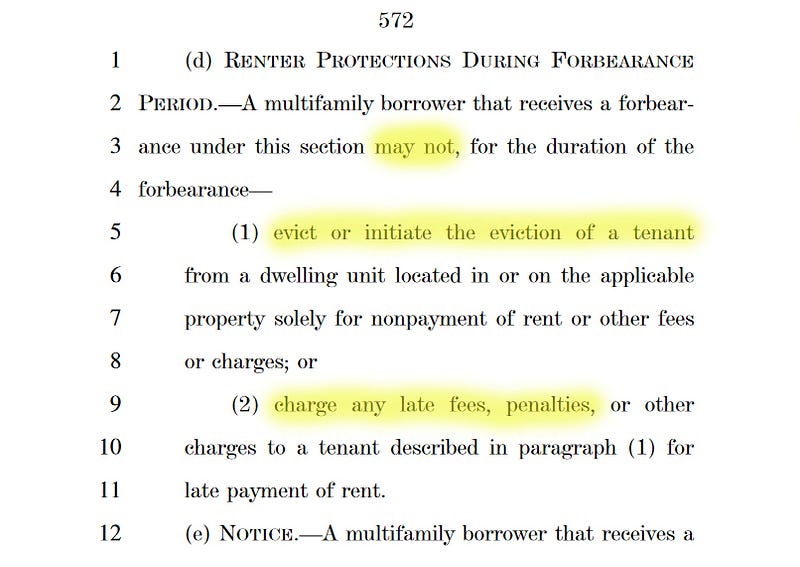
This order came into effect on April 1, 2020, and will last 120 days. After that, the Government would have to decide on a possible extension or choose to pass a new act.
The problem is that, as mentioned in Hasan Mihnaj’s show, not all the rental units are covered. This moratorium applies only to federally backed securities and government-subsidized buildings, representing only 28% dwellings in the United States. If you happen to live in a housing unit that doesn’t fall within those two criteria, only the state or a municipal government may be able to help with your rent payments.
How Do I Know if the Government backs my Building?
The National Low Income Housing Coalition allows you to check if your building is a part of the government-subsidized housing, or if it’s a federally backed mortgage. Hasan and his team decided to make our lives easier and created a website directing you not only to the addresses database but to other useful resources: DontGetKickedOut.com.
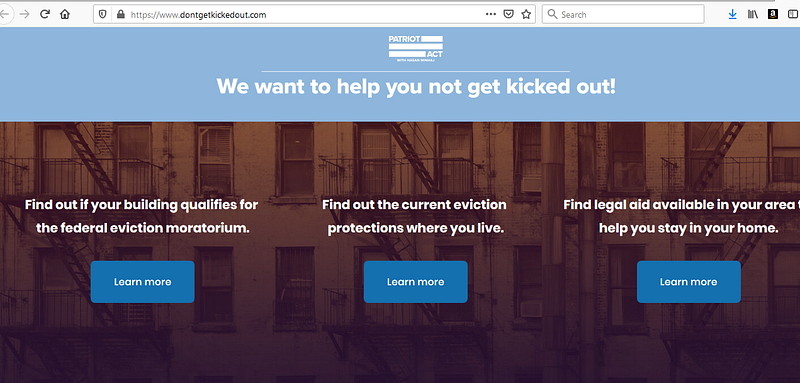
The website is also offering a resource to review the eviction protections you currently have — see the Eviction Lab — as well as a website highlighting the Legal Aid Organizations available to you.
The Implied Warranty of Habitability
Hasan also mentions one of the primary concepts which can help you win in housing court: the Implied Warranty of Habitability. What is it?
Investopedia describes it as: “an implied warranty of habitability is an unstated guarantee that a rental property meets basic living and safety standards before occupation and will continue to meet them for the duration of the occupancy. It only applies to lease or rentals for the residential properties, not commercial properties, as tenants of commercial properties do not live in them. Even if the lease does not actually state this warranty in writing, it is implied in the lease.”
In other words, this warranty provides tenants with basic human needs while residing in a rental unit. Those needs include, but not limited to: heating, hot water, drinkable water, working toilet, sanitary requirements being met, smoke detectors being up to date, working monoxide detector, security codes to be shared with you, protection from criminal harm and others. Note that the Implied Warranty of Habitability works in every state but Arkansas.
You can read more about this legal concept here: NYCBar.org, Nolo.com, HG.org, and Legalmatch.com.
The world may need some time to get back to normal, but we will get there.
Hardships don’t last forever.
What Options Do I Have?
Apart from referring to the CARES Act, you have other options to consider if you cannot pay rent and in danger of becoming homeless. Below, we mentioned a few other alternatives.
Legal Aid
Legal Aid Organizations were mentioned earlier. You may also want to check out the Americanbar.org and Legal Services Corporation. Alternatively, you can simply Google “legal aid office near me.”
Consider the Affordable Rental Housing
The USA.gov website prepared a list of options for those struggling with rent prices and wished to find affordable housing. Review their article dedicated to the rental relief, housing voucher program, and other resources.
Rental Assistance Programs
Debt.org listed several programs provided by non-profit organizations that can help you with rent:
- Emergency assistance and homeless prevention from Salvation Army.
- A grant from the rental assistance program — ModestNeeds.org.
- Financial assistance from St Vincent de Paul. You may also wish to look for rent assistance programs from your local religious organizations.
- Essential needs program offered by United Way.
- Rental Assistance from Housing and Urban Development (HUD).
- Housing Assistance by the USDA Rural Development Program.
Utilizing Plan “B”: Find a Homeless Shelter
If things go south, you might want to consider looking for shelter. No one should ever be ashamed about searching for help, especially in such unique and horrifying circumstances, like a worldwide pandemic. Here are a few resources to help you find a shelter:
We are currently going through exceptionally hard times as a community, and everyone around the world is experiencing the same difficulties. Don’t lose hope and don’t give up. The economy has seen many recessions over the years, but they are temporary.
The world may need some time to get back to normal, but we will get there. Hardships don’t last forever. Take advantage of all the available resources and seek assistance if you require any. Support your community, help out your friends and family if you can. We are all in this together.
It will get better soon.