
What TikTok Can Teach Us About Writing
“It’s just a bunch of dumb people dancing.”
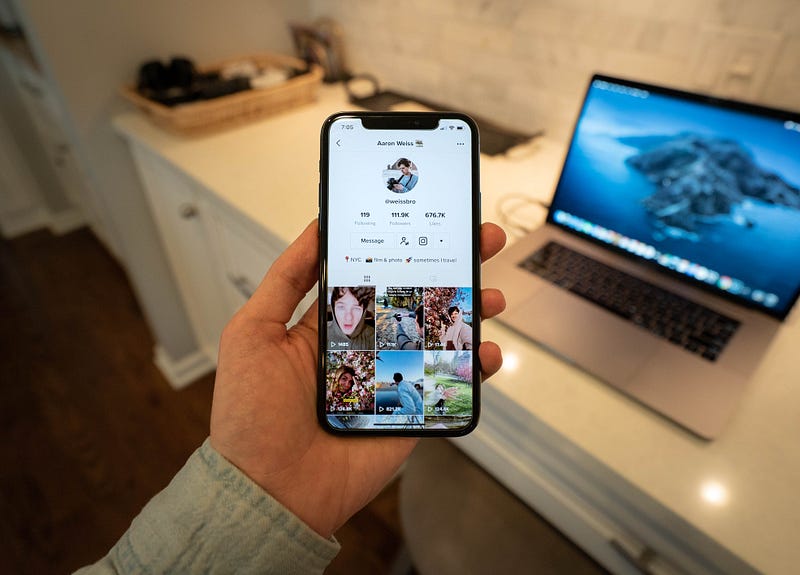
“This app is absolute nonsense,” I told myself as I begrudgingly set up an account. “It’s just a bunch of dumb people dancing.”
TikTok is blowing up. As the fastest growing social media platform, it’s hard to deny that they get something right. But for us creatives and intellectuals, it’s easy to write the app off as just a bunch of pandering, lowest-common-denominator bullshit.
I certainly took this approach. I scoffed at the idea of joining the app. I was better than that.
However, I’m trying to get signed to a modeling agency. As such, it's important that I grow my following on social media. Agencies like to see a following. I fought it for as long as I could, but it became inevitable: I was going to have to make a TikTok account.
So I signed up, recorded a silly little video of me in a leather jacket, overlayed a horrendously annoying song over it, and away we went.
Learning the game
So here I am, a writer awash in a sea of moronic videos. I figured it would be pretty easy to go viral considering my superior intellect. All I had to do was pay attention to the trends. There was a simple code. I just had to crack it and ascend to stardom.
I started scrolling through my feed, making note of every video that had a substantial number of likes.
There were some similarities. People definitely love to jump on trending songs. Physically attractiveness is rewarded. Humor absolutely slays. Pretty standard stuff.
What was surprising was the breadth of successful content. Some people performed skits, some employed self-deprecation, some even shared genuine expertise on complex issues like mental health or politics.
I lost whole days to the app before realizing I had to will my way back to balance. I’m ashamed to admit it, but it went deeper than research. TikTok is addictive as hell.
I’m equally ashamed to say I learned a lot; not just about TikTok, but about creative work in general. Some of that has even (gasp) made me a better writer.
So here I am, a humble consumer of 15-second clips made by strangers, telling you how an app that once made my eyes roll back into my skull has helped me grow as a writer. Here are the lessons I learned.
Cliche is the soil of originality
TikTok is a place where everyone puts their own spin on trends. While this might seem unoriginal (and it often is), there is something to be gleaned from the popular videos: many of the clips that go viral take preexisting trends and run in new directions.
For instance, one of the trends involves the user standing in front of the camera in sweats, looking generally disheveled. They then cover the camera with their hand, and when they remove it, they appear all done up and seductive. There are probably millions of videos following this format.
That being, a video that recently blew up subverted this trend. The user did the whole initial setup, covered the camera, and when they removed their hand, nothing had changed, and the voiceover said “I’m still fucking ugly”. Millions of views. This kind of subversion is everywhere on the app.
As writers, we often follow trends ourselves. An article goes viral, and we are faced with two thoughts: either “I should write about that too!” or “damn, I should have written about that before, now everyone is going to be writing about it”. Both miss the sweet spot.
We can still ride trends into success, but we need to take a hint from TikTok and play off the cliche. Don’t just rehash the same information and don't just give up on the topic. Take the topic, use it as a starting point, then throw something new in there. This will keep your writing relevant while keeping it fresh.
Speak to the audience’s understanding
I was shocked to find so many genuinely insightful videos on TikTok. From doctors discussing covid to astrophysicists explaining black holes, there were serious people providing genuine expertise in all sorts of fields. Not what I expected.
Most surprising about this is that these experts managed to communicate enormous ideas within 60 seconds. They’re doing genuinely great work by making these complex concepts so digestible to the public. How do they do it?
Then it dawned on me: they meet the audience where they are. The therapist offering mental health advice knows the person on the other side of the screen probably isn’t going to read a book on psychotherapy. They know they only have 60 seconds to get their point across, so they cut out all the unnecessary background information and get right to the practical points.
As writers, we have a tendency to think more is better. Sometimes that really is the case. If I’m writing a scientific paper about quantum physics, I better have strong arguments to support my claims. But if I’m writing to a general audience, all that background info does is put them to sleep.
The lesson we can learn here is that we have to consider our audience and their level of interest in our topic. If you’re an expert in psychology and you have something everyone needs to know, tell them! But know they probably don’t want the whole history of the field. Sometimes you can make a bigger impact by leaving out your reasoning and just telling people the important bits.
Be authentic to the point of tears
This is perhaps the most baffling trend I’ve noticed on the app: people upload videos just sobbing, talking about how shit their day is going or how they found out their partner has been cheating. And they get tons of views.
I’m not here to get into the psychology of why we love this kind of thing (see the point about sticking to what’s relevant). All I’m saying is, it works. We love seeing people be recklessly authentic.
So do that with your writing. Write the shit that hurts, the shit that no one wants to talk about. Tell that story you keep deep inside your head. Talk about what keeps the sleep from your eyes at two am. Bleed on that page.
This advice isn’t new. Tons of writers have given it before. But we people of words tend to get too pretentious with it. We look for some deep truth in the suffering rather than the suffering itself.
Don’t overthink it. The profundity, if there is any, isn’t some tag along to the honesty. It’s in the honesty itself. So be fucking honest.
Conclusion
So here I am, a literary man learning about creativity from an app full of teenagers doing stupid little dances. My ego’s taken a hit, but my writing has grown. And in the end, that’s what really matters.
Now if you’ll excuse me, I have to go film myself crying.


