avatarA mote of dust

Free AI web copilot to create summaries, insights and extended knowledge, download it at here

5065

Abstract

gutenberg.org/cache/epub/29433/pg29433-images.html">Nature</a>, Emerson asserted that the natural world offers “a sanctity which shames our religions.” Thoreau must have agreed vehemently. It seeded a friendship between the two prolific thinkers of the era, both <a href="https://plato.stanford.edu/entries/transcendentalism/">transcendentalists</a>.</p><p id="a938">Thoreau strongly believed in mindful living, and deliberate presence of mind. <b>He lived “to be always on the alert to find God in nature”</b> and to hear “the language which all things and events speak without metaphor”. This led him to many philosophical observations on how an individual perceives his world, esp. the natural world around him.</p><figure id="93fb"><img src="https://cdn-images-1.readmedium.com/v2/resize:fit:800/1*gE-TyNLGzeMwkgn85f9LEg.jpeg"><figcaption>“I have, as it were, my own sun and moon and stars, and a little world all to myself” — Thoreau | Image © Shreyasi</figcaption></figure><p id="1212">He writes about the “<b>much grander significance</b>” of the mechanisms of the natural world. We are short-sighted and mostly selfish beings, who go about our daily lives quite unaware of the complex, living, breathing earth around us.</p><p id="6a66">But after all, we are sentient beings in a sensory world!</p><p id="95c4">By being a mindful observer, we get to discover that the “world” as we define it, is merely a concoction of topics of self-interest, and circumstances that we, individually, take note of.</p><p id="bca2">My “world” is really like a limited sphere centered around me, the conscious perceiver. Each of us are alike in this sense. We live in our own <i>small</i> worlds.</p><p id="25be">You and I could <i>look</i> at the same scene, and <i>see</i> different. That’s the novelty of being individuals — we each have distinct, seldom overlapping points of view.</p><p id="5a86"><b>We access the external “world” only through the lens of our own subjectivity.</b></p><blockquote id="c11c"><p>A man sees only what concerns him.</p></blockquote><figure id="80ed"><img src="https://cdn-images-1.readmedium.com/v2/resize:fit:800/1*G3x0Ss2Pz90a9iCfgAbIzA.jpeg"><figcaption>Henry David Thoreau photographed by Benjamin D. Maxham, 1856. (National Portrait Gallery, Washington, DC; public domain via Wikimedia Commons)</figcaption></figure><p id="475b">This leads us to a profound revelation about <b>the true vastness of the pluralistic universe</b> <b>we are momentarily part of</b>.</p><p id="9a67">There must be countless instances of thoughts and opinions and actions, each as unique as its originator.</p><p id="fd94">Truth, as we each know it, is radically perspective-dependent. <<a href="https://plato.stanford.edu/entries/thoreau/">Source</a>></p><blockquote id="4634"><p>How novel and original must be each new man’s view of the universe!</p></blockquote><p id="2770">Through this “<b>infinite extent of our relations</b>”, we learn to recognize and accept bigger schemes and broader perspectives at play.</p><p id="230a">It’s not possible to know <i>everything</i>. And Thoreau teaches us to acknowledge the inevitable differences in the innumberable perspectives, for it can only humble us.</p><figure id="e261"><img src="https://cdn-images-1.readmedium.com/v2/resize:fit:800/1*RLtRSWdXuVVJQBiP7JiLMg.png"><figcaption>Thoreau | Illustration by Eric Nyquist</figcaption></figure><p id="d3df">In effect, our limited scope of knowledge and incomplete, subjective judgements often keep us from appreciating <b>the harmonious interdependence of all parts of the natural world</b>, including human relationships.</p><p id="c368">“Thoreau argues that we must approach the world as “nature looking into nature,” aware of the relation between the form of our own perception and what we are able to perceive (<i>Correspondence</i>, 7/21/41). <b>By acknowledging the limits of what we can know with certainty, we open ourselves up to a wider horizon of experience.</b>” <<a href="https://plato.stanford.edu/entries/thoreau/">Source</a>></p><blockquote id="5f23"><p>Whatever we have perceived to be in the slightest degree beautiful is of infinitely more value to us than what we have only as yet discovered to be useful and to serve our purpose.</p></blockquote><figure id="2a7d"><img src="https://cdn-images-1.readmedium.com/v2/resize:fit:800/1*yBvXKe4zgRI9dPSoX3_ZNQ.jpeg"><figcaption>An intricate world of wonder | © Shreyasi</figcaption></figure><p id="c2db">Oh, the trouble with subjectivity!</p><figure id="4cfd"><img src="https://cdn-images-1.readmedium.com/v2/resize:fit:800/1*Ux2UX6Ez-83qjZ04iJg_CA.jpeg"><figcaption>“I don’t know anything with certainty, but seeing the stars make me dream” — Van Gogh | <a href="https://mymodernmet.com/van-gogh-cartoons-alireza-karimi-moghaddam/">Art</a> by Alireza Karimi Moghaddam</figcaption></figure><blockquote id="8cfa"><p>It is the beauty within us that makes it possible for us to recognize the beauty around us. The question is not what you look at but what you see.</p></blockquote><p id="21

Options

5f">When you next chance upon a field of wildflowers — try imagining exactly what Van Gogh saw and felt during his walks through Saint-Rémy de Provence…</p><p id="aa0c">I’m sure you’d have no clue.</p><p id="7630">I hope you do relish the beauty in your own way anyways.</p><p id="bd07">A fierce Romantic and ardent admirer of nature, Thoreau went as far as saying “<b>The perception of beauty is a moral test</b>”, and frequently chastised himself and us for failing in this respect.</p><blockquote id="f6d1"><p>How much of beauty — of color, as well as form — on which our eyes daily rest goes unperceived by us.</p></blockquote><p id="0492">Think of what you notice when outside for a walk.</p><p id="7402">Do you observe the shy creeper slowly taking over the derelict sidewalk, flush with minuscule yet intricate blooms? Do you see the dusty roadside bougainvillea, yet to come alive with vivid hues in summer? Do you hear the brave robin whistling warnings when it spots the cat crossing your path? Or the dandelion seed riding the wind expertly, in search of a new home?</p><blockquote id="4bd7"><p>Man has not seen a thing he has not felt.</p></blockquote><p id="7d75">He expands on “beauty lies in the eyes of the beholder”, claiming that the presence of a mindful, alert perceiver is the precondition for beauty to even materialize.</p><figure id="6fb3"><img src="https://cdn-images-1.readmedium.com/v2/resize:fit:800/1*fYOnDLRsj1JC_oXzfL1CBw.jpeg"><figcaption>Serenity | © Shreyasi</figcaption></figure><p id="4f03">A careful, deliberate observer will always be highly rewarded by nature — <b>but there is only “as much beauty visible to us in the landscape as we are prepared to appreciate, — not a grain more</b>”.</p><p id="8c15">Different eyes gauge beauty in unique ways.</p><figure id="bbcd"><img src="https://cdn-images-1.readmedium.com/v2/resize:fit:800/1*zm4jlsM_J_sfVlFO3Ag1qw.jpeg"><figcaption>Watch the birds | © Shreyasi</figcaption></figure><p id="385e">As someone who declared that he can simply sit at the doorstep and watch trees and birds all day, it must have been painfully obvious to Thoreau that the tribe sharing his sentiments has become ruefully limited in a world rapidly getting usurped by commercialization and consumerism, reeling under the impacts of morbidly fake society and unjust governments.</p><p id="f70a">He chose to think about it deeply, and produced over 20 volumes of work brimming with intense contemplations about the complicated relationship between man and nature, and core tenets of individualism, like individual resistance against unjust civil governance.</p><p id="d1b5">Walden, his most celebrated work, is widely regarded as his bold act of declaring independence from the many superficial and ostensible constraints that we let society chain us with.</p><p id="027d">His philosophy of <a href="https://en.wikipedia.org/wiki/Civil_disobedience">civil disobedience</a> later influenced the political thoughts and actions of such notable figures as <a href="https://en.wikipedia.org/wiki/Leo_Tolstoy">Leo Tolstoy</a>, <a href="https://en.wikipedia.org/wiki/Mahatma_Gandhi">Mahatma Gandhi</a>, and <a href="https://en.wikipedia.org/wiki/Martin_Luther_King_Jr.">Martin Luther King Jr</a>.</p><blockquote id="d02d"><p>If a man does not keep pace with his companions, perhaps it is because he hears a different drummer. <b>Let him step to the music which he hears</b>, however measured or far away.</p></blockquote><p id="540d">An individualist to the point of being called an <a href="https://theanarchistlibrary.org/category/author/henry-david-thoreau">anarchist</a>, Thoreau believed in paving his own way, and was a devout critic of conformity in society.</p><blockquote id="9988"><p><b>Be yourself — not your idea of what you think somebody else’s idea of yourself should be.</b></p></blockquote><figure id="7f8a"><img src="https://cdn-images-1.readmedium.com/v2/resize:fit:800/1*GeF3MYO5p0zyHgSVidaugg.jpeg"><figcaption>“Our life is frittered away by detail. Simplify, simplify.” — Thoreau | © Shreyasi</figcaption></figure><p id="c43f">Thoreau’s wisdom resonates deeply even today, about two centuries later. He is immortalized through his unique, bold voice echoing in the minds of generations he has inspired.</p><p id="3dac">His philosophy has encouraged me to continue seeking wonder and meaning in nature, keep walking confidently in the direction of my dreams, and revel in the limitless amazement that comes from acknowledging diversity in perspectives.</p><p id="2022">My journey is momentary, fleeting… I must live well.</p><blockquote id="ce33"><p>You must live in the present, launch yourself on every wave, find your eternity in each moment.</p></blockquote><blockquote id="3101"><p>Fools stand on their island of opportunities and look toward another land.</p></blockquote><blockquote id="104c"><p><b>There is no other land; there is no other life but this.</b></p></blockquote><p id="cac7">All quotes in this essay, if not stated otherwise, are from Thoreau’s works.</p></article></body>

What Thoreau Said

Resonates damn perfectly today, 208 years later
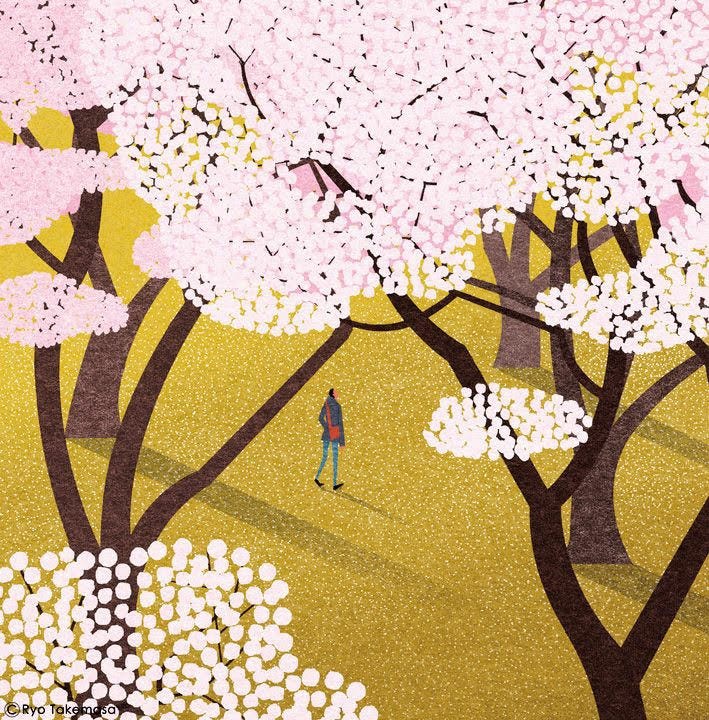
“All good things are wild and free” — Thoreau | Art credit: Ryo Takemasa

We need the tonic of wildness…

At the same time that we are earnest to explore and learn all things, we require that all things be mysterious and unexplorable, that land and sea be indefinitely wild, unsurveyed and unfathomed by us because unfathomable.

We can never have enough of nature.

Henry David Thoreau (1817–1862), American philosopher, poet, transcendentalist, and environmental scientist, has spoken to me in my 30s.

A hardcore naturalist, Thoreau was a lifelong advocate of mindfulness.

The way to self | © Shreyasi

An Extraordinary Excursion

The author of Walden; or, Life in the Woods spent 2 years, 2 months and 2 days living alone in a second-growth forest, in a cottage he built himself, literally few miles away from any neighbouring people, as an experiment to test his self-reliance. He called it “an experiment in simple living”.

The piece of land in Concord, Massachusetts USA belonged to his friend and contemporary transcendentalist, Ralph Waldo Emerson.

Thoreau’s intention was to momentarily step away from the civil society, with absolute isolation from the evolving trends of consumerism. He went to live in the lap of nature not to become a hermit, but to gather a more objective understanding of the human society. To figure out a better way to live.

Wherever a man goes, men will pursue and paw him with their dirty institutions, and, if they can, constrain him to belong to their desperate odd-fellow society.

He realized a good life is feasible only by escaping what he considered “over-civilization”. He went in search of the “raw” and “savage delight” of the wilderness, and spent good amounts of his time reading and writing.

I went to the woods because I wished to live deliberately, to front only the essential facts of life, and see if I could not learn what it had to teach, and not, when I came to die, discover that I had not lived.

(left) A replica of Thoreau’s tightly plastered, shingled cabin at Walden | (right) Site of the original cabin | Credits: Richard Smith

Any admirer and observer of nature is bound to fall in love with his lucid discourse of a surprisingly simple lifestyle attuned to the forest.

Walden, published in 1854, has been admired by a larger global audience than any other book written by an American author, and according to Stanford, is a literary masterpiece so steeped in speculative philosophy and close observation of the natural world that it defies categorization altogether!
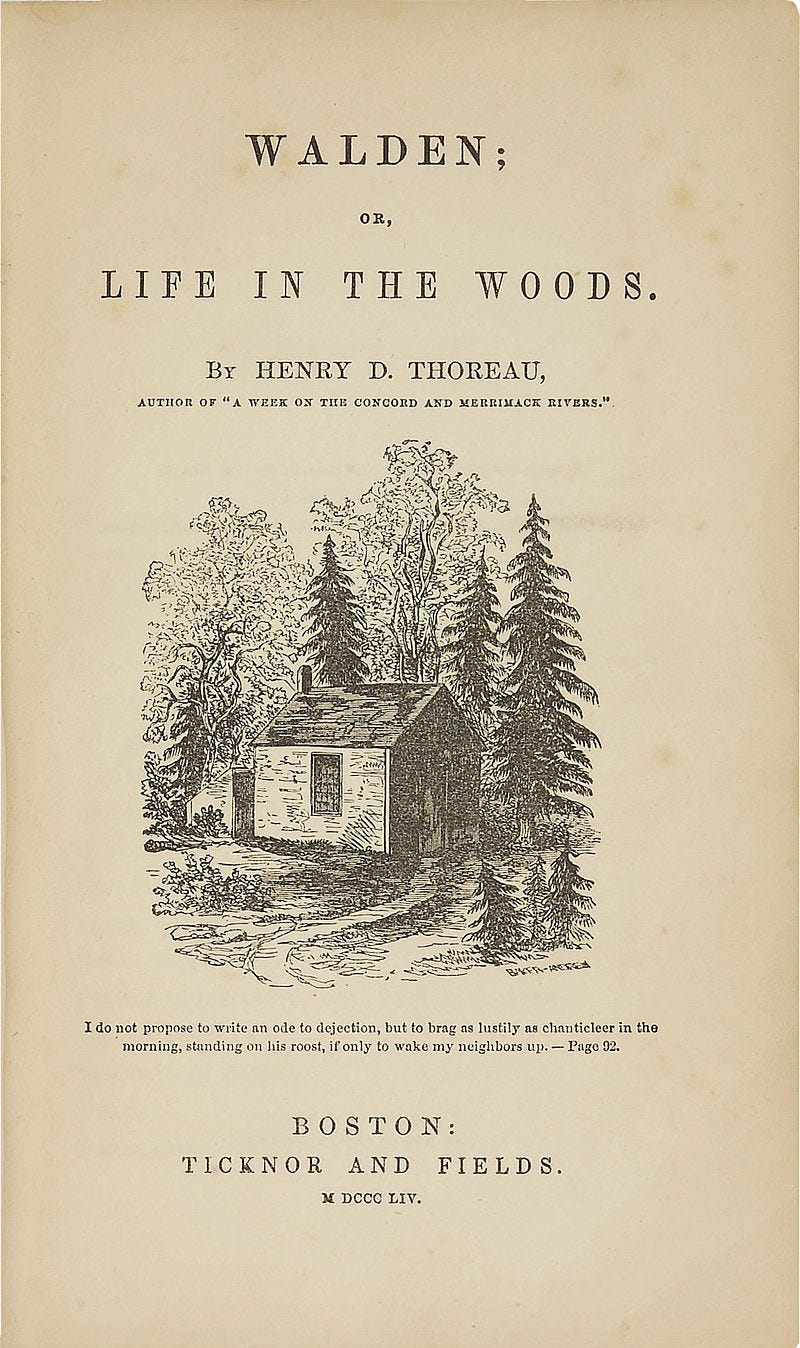
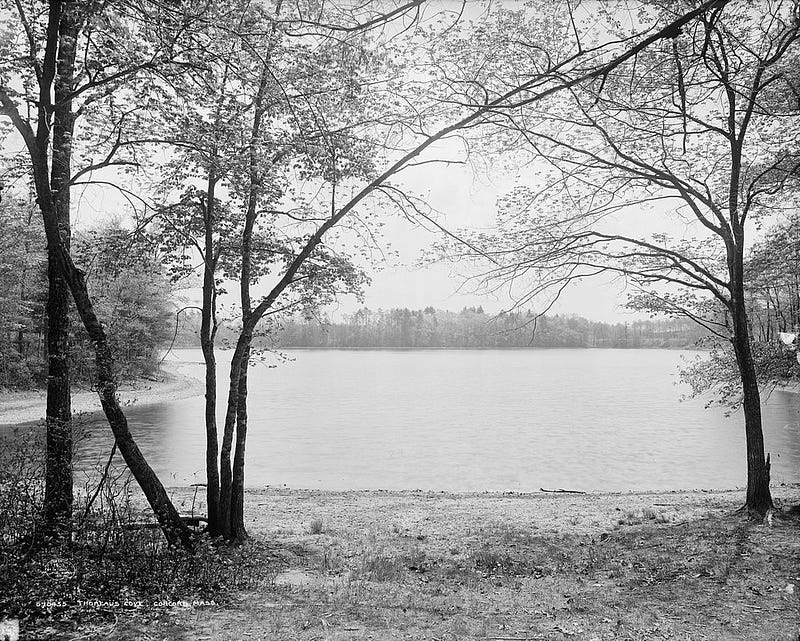
(left) Original title page of Walden featuring a picture drawn by Thoreau’s sister Sophia (Source) | (right) At the shores of Walden Pond: Thoreau’s cove, Concord, Massachusetts (Credit)

Thoughts on Nature and Perception: “The infinite extent of our relations”

In his 1836 essay Nature, Emerson asserted that the natural world offers “a sanctity which shames our religions.” Thoreau must have agreed vehemently. It seeded a friendship between the two prolific thinkers of the era, both transcendentalists.

Thoreau strongly believed in mindful living, and deliberate presence of mind. He lived “to be always on the alert to find God in nature” and to hear “the language which all things and events speak without metaphor”. This led him to many philosophical observations on how an individual perceives his world, esp. the natural world around him.

“I have, as it were, my own sun and moon and stars, and a little world all to myself” — Thoreau | Image © Shreyasi

He writes about the “much grander significance” of the mechanisms of the natural world. We are short-sighted and mostly selfish beings, who go about our daily lives quite unaware of the complex, living, breathing earth around us.

But after all, we are sentient beings in a sensory world!

By being a mindful observer, we get to discover that the “world” as we define it, is merely a concoction of topics of self-interest, and circumstances that we, individually, take note of.

My “world” is really like a limited sphere centered around me, the conscious perceiver. Each of us are alike in this sense. We live in our own small worlds.

You and I could look at the same scene, and see different. That’s the novelty of being individuals — we each have distinct, seldom overlapping points of view.

We access the external “world” only through the lens of our own subjectivity.

A man sees only what concerns him.
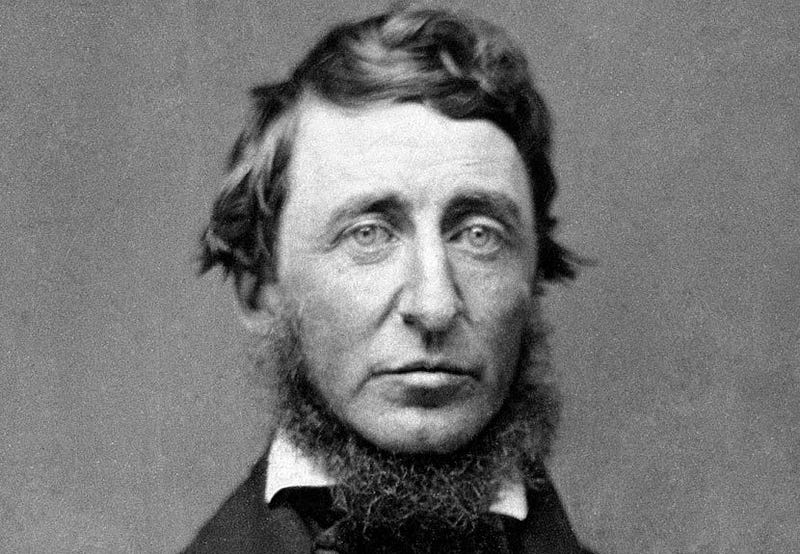
Henry David Thoreau photographed by Benjamin D. Maxham, 1856. (National Portrait Gallery, Washington, DC; public domain via Wikimedia Commons)

This leads us to a profound revelation about the true vastness of the pluralistic universe we are momentarily part of.

There must be countless instances of thoughts and opinions and actions, each as unique as its originator.

Truth, as we each know it, is radically perspective-dependent. <Source>

How novel and original must be each new man’s view of the universe!

Through this “infinite extent of our relations”, we learn to recognize and accept bigger schemes and broader perspectives at play.

It’s not possible to know everything. And Thoreau teaches us to acknowledge the inevitable differences in the innumberable perspectives, for it can only humble us.
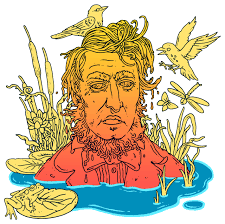
Thoreau | Illustration by Eric Nyquist

In effect, our limited scope of knowledge and incomplete, subjective judgements often keep us from appreciating the harmonious interdependence of all parts of the natural world, including human relationships.

“Thoreau argues that we must approach the world as “nature looking into nature,” aware of the relation between the form of our own perception and what we are able to perceive (Correspondence, 7/21/41). By acknowledging the limits of what we can know with certainty, we open ourselves up to a wider horizon of experience.” <Source>

Whatever we have perceived to be in the slightest degree beautiful is of infinitely more value to us than what we have only as yet discovered to be useful and to serve our purpose.
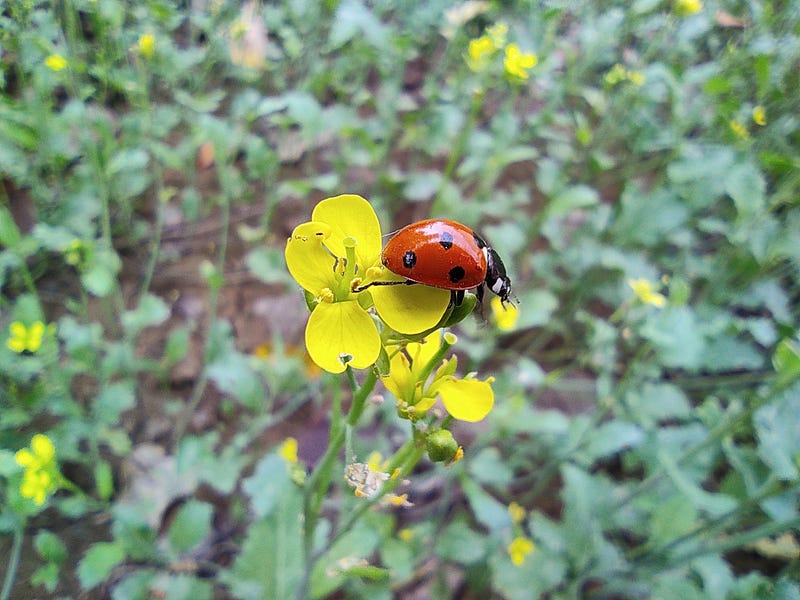
An intricate world of wonder | © Shreyasi

Oh, the trouble with subjectivity!

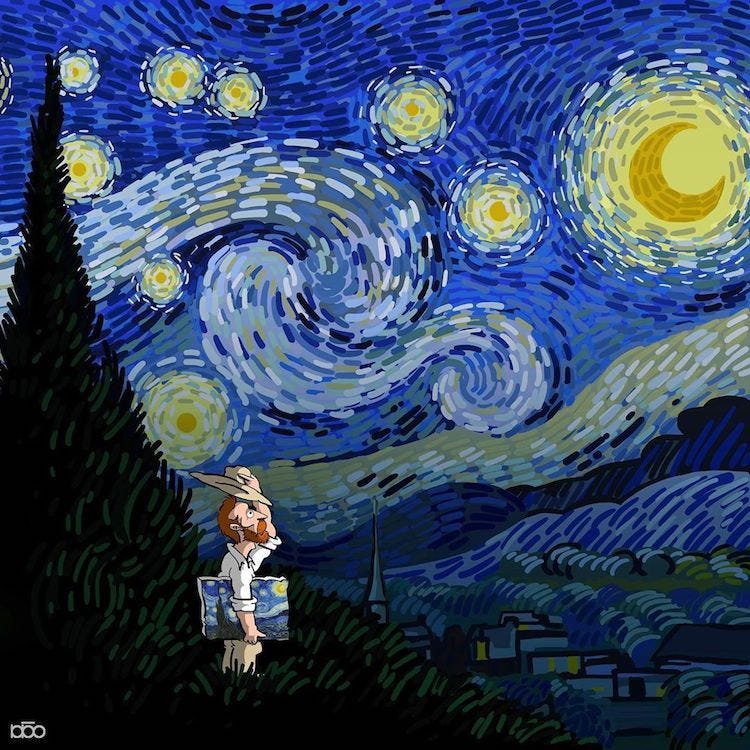
“I don’t know anything with certainty, but seeing the stars make me dream” — Van Gogh | Art by Alireza Karimi Moghaddam

It is the beauty within us that makes it possible for us to recognize the beauty around us. The question is not what you look at but what you see.

When you next chance upon a field of wildflowers — try imagining exactly what Van Gogh saw and felt during his walks through Saint-Rémy de Provence…

I’m sure you’d have no clue.

I hope you do relish the beauty in your own way anyways.

A fierce Romantic and ardent admirer of nature, Thoreau went as far as saying “The perception of beauty is a moral test”, and frequently chastised himself and us for failing in this respect.

How much of beauty — of color, as well as form — on which our eyes daily rest goes unperceived by us.

Think of what you notice when outside for a walk.

Do you observe the shy creeper slowly taking over the derelict sidewalk, flush with minuscule yet intricate blooms? Do you see the dusty roadside bougainvillea, yet to come alive with vivid hues in summer? Do you hear the brave robin whistling warnings when it spots the cat crossing your path? Or the dandelion seed riding the wind expertly, in search of a new home?

Man has not seen a thing he has not felt.

He expands on “beauty lies in the eyes of the beholder”, claiming that the presence of a mindful, alert perceiver is the precondition for beauty to even materialize.
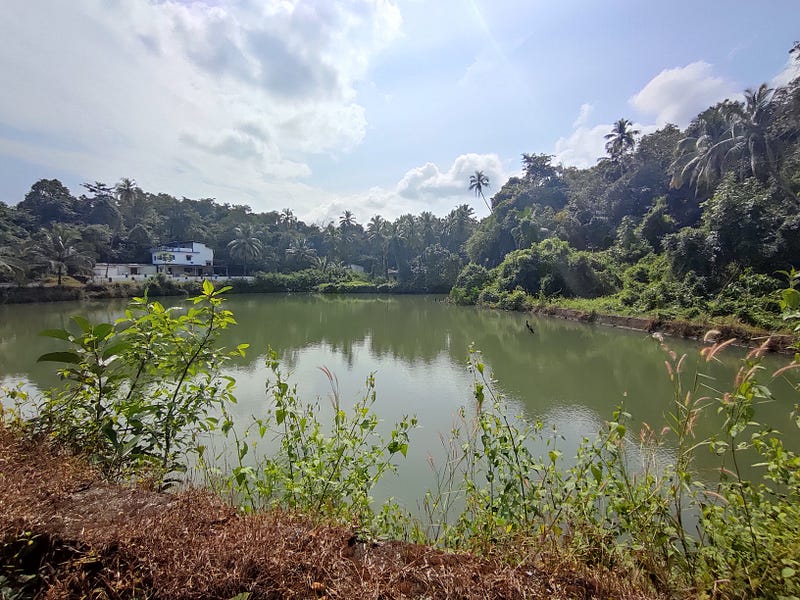
Serenity | © Shreyasi

A careful, deliberate observer will always be highly rewarded by nature — but there is only “as much beauty visible to us in the landscape as we are prepared to appreciate, — not a grain more”.

Different eyes gauge beauty in unique ways.
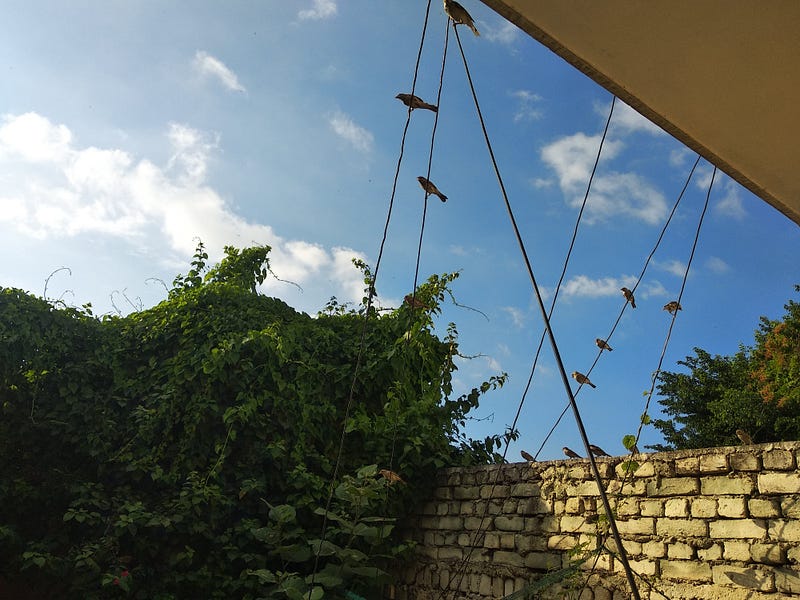
Watch the birds | © Shreyasi

As someone who declared that he can simply sit at the doorstep and watch trees and birds all day, it must have been painfully obvious to Thoreau that the tribe sharing his sentiments has become ruefully limited in a world rapidly getting usurped by commercialization and consumerism, reeling under the impacts of morbidly fake society and unjust governments.

He chose to think about it deeply, and produced over 20 volumes of work brimming with intense contemplations about the complicated relationship between man and nature, and core tenets of individualism, like individual resistance against unjust civil governance.

Walden, his most celebrated work, is widely regarded as his bold act of declaring independence from the many superficial and ostensible constraints that we let society chain us with.

His philosophy of civil disobedience later influenced the political thoughts and actions of such notable figures as Leo Tolstoy, Mahatma Gandhi, and Martin Luther King Jr.

If a man does not keep pace with his companions, perhaps it is because he hears a different drummer. Let him step to the music which he hears, however measured or far away.

An individualist to the point of being called an anarchist, Thoreau believed in paving his own way, and was a devout critic of conformity in society.

Be yourself — not your idea of what you think somebody else’s idea of yourself should be.
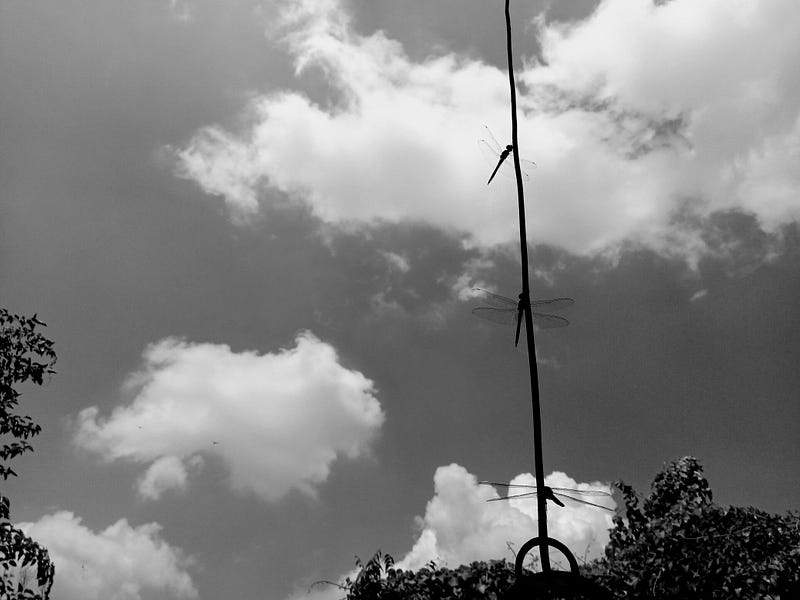
“Our life is frittered away by detail. Simplify, simplify.” — Thoreau | © Shreyasi

Thoreau’s wisdom resonates deeply even today, about two centuries later. He is immortalized through his unique, bold voice echoing in the minds of generations he has inspired.

His philosophy has encouraged me to continue seeking wonder and meaning in nature, keep walking confidently in the direction of my dreams, and revel in the limitless amazement that comes from acknowledging diversity in perspectives.

My journey is momentary, fleeting… I must live well.

You must live in the present, launch yourself on every wave, find your eternity in each moment.

Fools stand on their island of opportunities and look toward another land.

There is no other land; there is no other life but this.

All quotes in this essay, if not stated otherwise, are from Thoreau’s works.

Philosophy
Thoreau
Nature
Self
Mindfulness
Recommended from ReadMedium