
What the World Didn’t Tell You About Michelangelo’s David
But I will
What’s your take on science and art?
One of the panelists asked the interviewees.
We were vetting the next cohort of researchers for our research consortium, ReMed.
At the time, it was purely student-led. Interviews were among the tools we felt would whittle down the ones interested in medical research from those who weren’t. It was also a way to identify the interesting from there merely qualified.
Most people, like the panelist I was working with, believe art to be different from science. Art is beautiful, science is the opposite. Not ugly, but just the opposite. But I disagree.
In Popper’s treatise, The Logic of Scientific Discovery, the biggest takeaway is the importance of creativity. The development of a new theory is not possible if creativity is absent.
Think about it this way. If a theory is significant, there will be several deductive conclusions from it. But how will science progress besides stretching a single theory?
There must be something new and different from what we presently know.
Take gravity, for example. Newton described gravity as an attractive force between two masses. The strength is inversely proportional to the distance between the two masses. The closer they are, the stronger the force, and vice versa.
Einstein thought otherwise. He said gravity is the curvature of spacetime. Masses distort the fabric of spacetime, causing objects to fall.
Tell me, who would have come up with such a crazy idea when all evidence points toward the accuracy of Newton’s laws?
The creative mind.
That’s who.
New progress does not happen without creation, even in mathematics. Despite their absolute nature once mathematical theorems are discovered, creativity is needed.
David Hilbert, one of the greatest mathematicians of the 19th and 20th centuries, remarked how difficult it was to survive in mathematics without creativity.
Creativity is needed to solve problems, even math problems. It’s unpredictable and irrational. Creativity is artistic.
Art, therefore is inseparable from science and math.
Now I can bring the Renaissance artist, Michelangelo and relate it to the theories of evolution — an element the world barely considers.
What this theory does is no different from Michelangelo’s comment
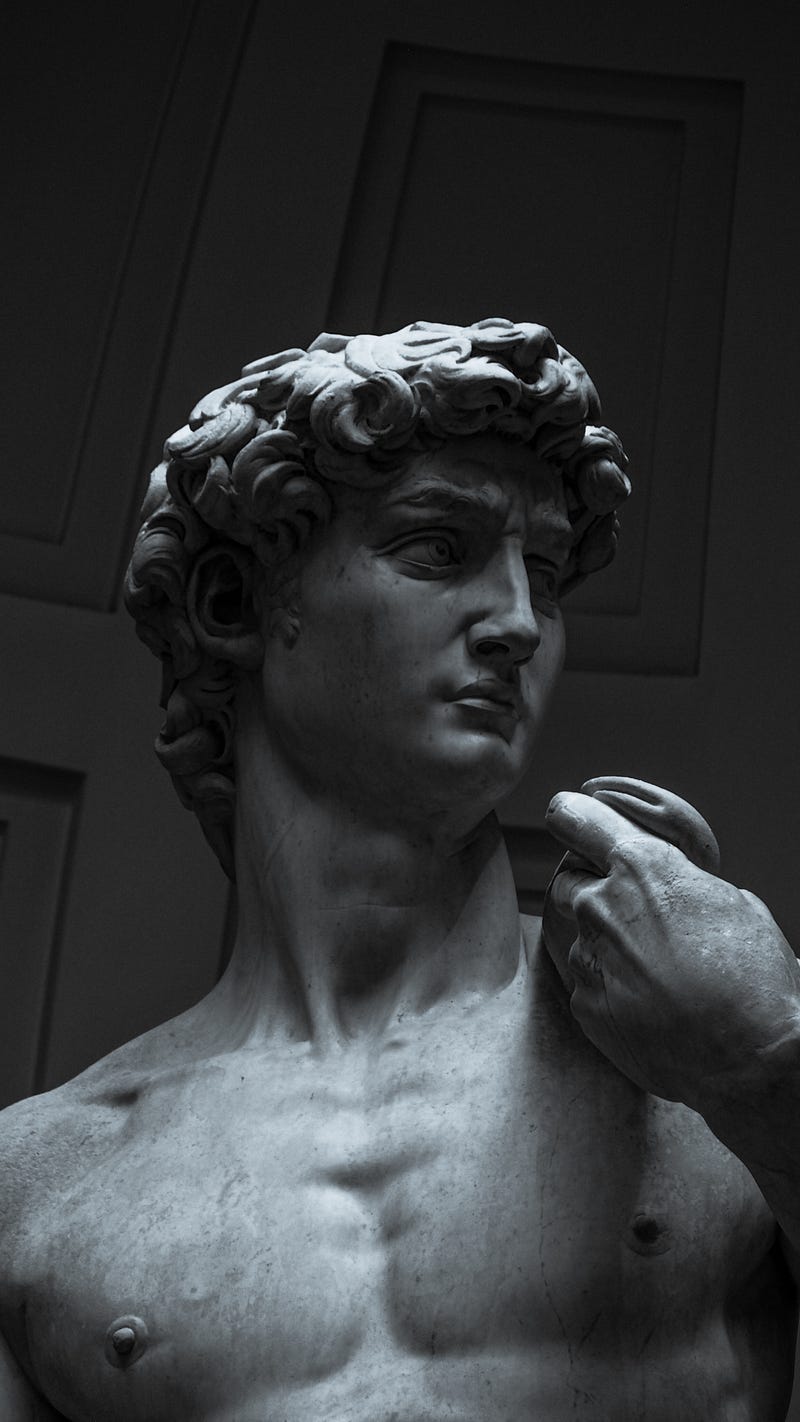
Arguably one of Michelangelo’s greatest artworks is the David.
What Michelangelo says about the process of sculpting David is:
I chipped away all that wasn’t David.
Simple enough.
While most people visualize the chipping process as art at work, I only see the evolutionary process.
Natural Selection is the dominant theory of evolution.
Nature, however, does not select. It only annihilates.
The most active component of nature is elimination. I have never been comfortable with selection as a name. Operationally, it shows how nature annihilates. In this case, it shows how Michelangelo chips away the stone block to find David.
Once David is found, we remark just how creative Nature is.
Some of the largest anthills and termite mounds are marvelous feats of architecture. Who takes all the credit? Natural Selection.
Michelangelo and Natural Selection, thus, share similarities. Their role is to chip off until they discover something beautiful like David.
That’s not how I see it. I flip the script, 180 degrees.
Unlike Michelangelo, what my theory does
I see creativity coming from the organism, not from nature.
Remember, nature only annihilates. Not create. Creativity is primarily a product of the organism.
Mathematics highlights this easily overlooked bit. When students are sent home with assignments, they are given a set of problems for them to solve.
Let me repeat that: problems to solve.
When they report back to class, they must have solutions.
Problems are soluble through creativity. One can solve it how the teacher taught it, or how the parent, guardian, classmate, or sibling taught you. At times you can invent your solution.
One time, while I was habitually typing away, my girlfriend told me how she had discovered a new way of doing multiplication. She gave me the example of numbers ranging from 11 to 19. We tested the idea, it was robust. But a concept was amiss.
What she highlighted were key concepts in theory making — the solution, and the domain where it is applicable. She had her solution and knew it applied only in the range between 11 and 19.
When I pushed her to consider the possibility of breaking the 19 barrier, she then saw what to change in her initial idea. It could then apply to other double-digit figures, not just 11 to 19.
She was faced with a problem and solved it herself.
Mathematics shows how solutions don’t come from nature. They come from organisms. In this case, nature is the organism’s universe. The organism’s universe is anything and everything outside it.
If nature annihilates, then that’s a problem. Organisms don’t want to be annihilated. Thus, organisms exist in universes filled with problems.
All life becomes problem-solving. So all solutions come from organisms. Not Natural Selection.
If Natural Selection were to solve problems, we would be assuming that organisms are passive.
It’s one of the arguments hurled at the Darwin’s idea. Clearly, organisms are not passive. They are active. They seek solutions to their problems.
These only come through creativity.
Creativity is irrational. It is, therefore, random. We cannot tell when it will strike. It only does.
Thus, the first way my theory distinguishes itself from the rest is through stressing the active part of organisms.
It is easily aggregable that organisms are active. Natural Selection, however, gets credit for the creative process of organisms. Adeptly called selection pressure.
But even with selective pressure surrounding us, creativity still stems from organisms. Necessity is the mother of invention. Organisms are the inventors.
The other different perspective from Michelangelo’s comment
The other way my theory differs from other theories is that it doesn’t give Michelangelo all the credit. It focuses on David.
Most theories — I chipped away at all that wasn’t David.
My theory — David found a solution to avoid Michelangelo’s chisel.
David solved the solution of the moving chisel. Not Michelangelo stopping to avoid chipping out more of David.
If we’re to consider Michelangelo’s idea and frame it as most theories do, the central question would be:
Why doesn’t Michelangelo continue chipping?
Michelangelo’s chisel is akin to nature, the annihilative force. But after Michelangelo has found out the figure that is David, the other question becomes:
Why doesn’t nature continue eliminating and annihilating?
In other words, why does Michelangelo stop chipping?
It’s not because Nature stops to admire the beauty as Michelangelo does.
Nature always carries its chisel with it. Always trying to chip more of David. It never stops. So the idea that creativity comes from Natural Selection is misattributed.
However, if we consider beauty as an element emergent from an organism, we can see how it can solve the problem of the hammering chisel.
Beauty is a powerful tool in evolution. It is a creative concept emergent from the organism. The organism solved the problem using its attribute — beauty.
Then Michelangelo stopped.
David avoided annihilation however it could. In this case, it was by possessing a beauty that Michelangelo admired.
What does my theory state?
It says that organisms tend to avoid annihilation. They will do this through whichever means they can including using beauty.
David avoided annihilation, not that Michelangelo stopped chipping.
Think about other organisms and how they avoid death. Fleeing is a common solution. But how do you flee?
- You can crawl very fast, like a black mamba.
- You can swim very fast, like like a salmon.
- You can fly very fast, like the peregrine falcon.
- You can run, like Bolt or Omanyala.
These are creative ways of fleeing. They were developed by the organism to avoid annihilation. Not Natural Selection.
As I close…
Art and science are not inseparable.
Science is impossible without art. Art can survive without science. Both are ways of solving problems.
Most theories prefer attributing creativity to Natural Selection. But nature only annihilates.
Granted, organisms are also part of nature, but operationally, nature is the force outside the organism trying to break it apart. This is the nature that I speak about.
To solve this problem, the organism must be creative.
Michelangelo has nothing on David.
David stupefies Michelangelo with its beauty.
Thus, he avoided the annihilative power of Michelangelo’s chisel.
Organisms create. Nature annihilates.
However, nature still hunts David. It might have stopped Michelangelo’s chisel, but erosion exists. It slowly chips off tiny pieces of David.
Eventually, we’ll all die.
Until then, we’ll create solutions to keep Nature’s big guns at bay.
PS: You can avoid the annihilative properties of the internet, which takes your precious time, by subscribing to my newsletter. It guarantees sending you a 4-piece curation every week, to edge you towards extreme value creation.


