
What the Tao Te Ching Teaches Us About Leadership
We work with being, but non-being is what we use
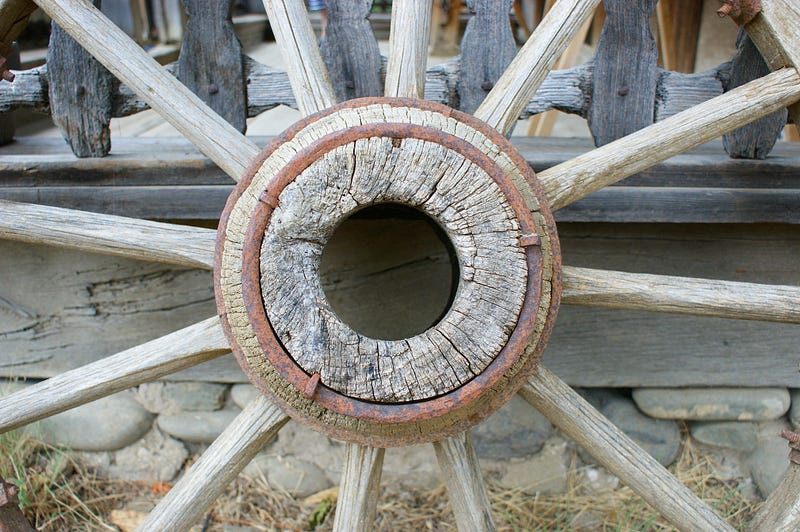
When I read Stephen Mitchell’s beautiful translation of Lao Tzu’s Tao Te Ching, poem №11 singles itself out to me as I view it from an orchestra conductor’s perspective and causes me to think about leadership in a new way.
Is leadership about what we create ourselves — the tangible things that we accomplish and build — the energy and guidance that we outwardly project to other people and situations?
Or is it found in the space that we open up for others — enabling connections and ideas to conspire together to create something special in a unique, (albeit perhaps a guided and curated), space?
№11 of the Tao Te Ching reads:
We join spokes together in a wheel, but it is the centre hole that makes the wagon move.
We shape clay into a pot, but it is the emptiness inside that holds whatever we want.
We hammer wood for a house, but it is the inner space that makes it livable.
We work with being, but non-being is what we use.
What does it teach us about leadership?
I guess I’ve always thought of what I do as a leader as primarily active — my energy and ideas directed towards others. A conductor can easily think this way as it is their interpretation of the music that the orchestra must follow.
But if we ponder Lao Tzu’s words, we can apply them to any organization and style of leadership. They compel us to think about leadership from an entirely fresh perspective.
1. We join spokes together in a wheel…
Within our organizations we can be like spokes of a wheel that join together to create motion in one direction. The wheel only moves when every spoke moves together at the same time.
But it is the centre hole that makes the wagon move. Everyone is equidistant to the centre and makes a simple and direct motion around it. All are connected to each other through that space in the middle.
And what is the space in the middle?
It’s the vision and purpose of our team, our goals — even the passion for what we do together.
As leaders we might sometimes envision ourselves to be the space in the middle of the wheel. But if we fill the space with ourselves, we take away the connection that every spoke has to the centre —we distract from the focus on our shared goals.
2. We shape clay into a pot…
In our work we shape clay into a pot, building up our visions and ambitions, stroke by stroke — working to correct imperfections and managing complexities until we make it smooth.
But this next concept is powerful —
It is the emptiness inside that holds whatever we want.
Possibility is inside the pot — it’s here that growth resides. We create the shape of the walls through our leadership, but it is through watering, light and energy that something worthwhile grows of its own accord inside.
3. We hammer wood for a house…
Through our leadership we can build something extraordinary — we can hammer wood for a house to create an image that we present to the outside world, a frame made up of goals and a vision of success.
But a house is really the home within. Inside is the family who takes risks together, sparks ideas, builds alliances, tells stories and argues with abandon.
As leaders, how do we create an inner space where all can take risks, be imaginative and explore possibilities to reach their highest potential?
4. We work with being…
When I conduct music with an orchestra, I notice that when I force the orchestra to watch me continuously, I distract them from listening to each other and focussing directly on the music.
There are many moments that they need me. I have to share and lead a vision for the interpretation of the music so that we can be unified with one purpose and direction. I have to show them when to play, when to slow down, what kind of energy or mood to embody. Often my leadership is critical to their success. I aspire to support them and to enable their best.
But I recognize that equally often I can do more by pulling back and taking my hands out of the music. When I step back, the energy goes completely inside the orchestra, the musicians connect directly to each other and their awareness of their own power and communication takes over. This empowers and inspires them to invest more deeply in the music they are playing.
When a leader recognizes this potential, then they can truly lead— showing that they understand when to lead and when to let go. It becomes understood that we recognize everyone as a part of the wheel — all turning together for something beyond ourselves.
We work with being, but non-being is what we use.
It’s a message for leaders.
We work with people, but if we give them space, they will create great things. We guide and we also pull back. We create a place where growth happens without us. We listen. We work hard so that we can inspire others’ growth and ideas as well as our own. We work to create something spontaneous and beautiful every day — together.
As a conductor, I do my best conducting when I disappear into the music and let the music be the centre of the wheel.
I am the caretaker of the space.
In my world, this space is the music itself.
What is your music?