
What the Spiky Profile of Autism Looks Like
Also known as: “For someone so clever you can be pretty dumb!”
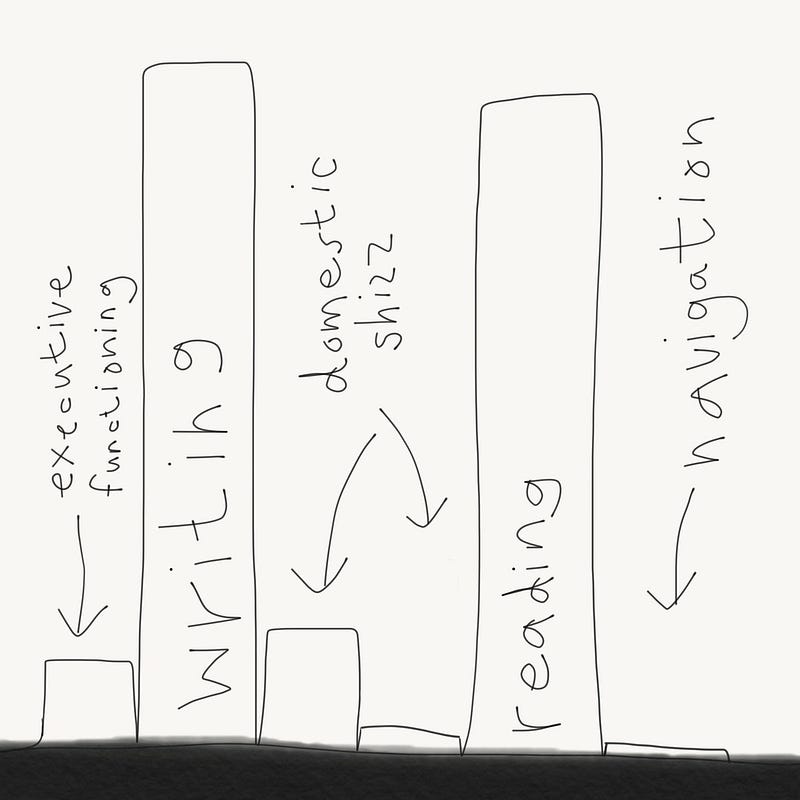
The spiky profile in autism is one of the biggest tells if you are playing Autism Detective. Which you shouldn’t because disability isn’t a game.
But to get a better sense of what I’m talking about, let’s have a look at how the spiky profile manifests in me, Chelbo F.
Exhibit A
I’m a published author but I cannot keep track of what day it is. Sometimes I know and sometimes I don’t. (Right now it’s Wednesday. Oops, no, Thursday. Ok, close.)
The problem is that the day names are arbitrary. And they all feel/sound/taste/smell the same. And they change every day. Just when I am getting the hang of what day it is, the day changes. It’s impossible to keep up!
Exhibit B
I teach Master’s students creative writing at university, and I’m good at it (apparently) but I cannot always find my way around my hometown. I also can’t read a map successfully. Or follow the sat nav instructions easily.
I have no sense of place. There is no internal mapping system. Nada. My experience of walking around is like being in a driving game, where the new location loads as you approach it.
( Does that make any sense? If you relate, can you describe it better?)
Exhibit C
I can write a pretty solid 1000 words an hour but I can’t cook without making a mess, physically and emotionally. Sometimes, by the time of plating up a meal, I am so stressed and uncomfortable that I want to cry.
My executive functioning defecit means I cannot instinctively plan the order in which I do things. Unless I take the time to write down the order in a recipe (which I will never do, obviously, because there’s no time unless I get a support worker) I cannot seem to find the right order. Instead, I sort of try to do everything at the same time, which doesn’t work. At all. Because it is physically impossible.
Also, I can’t monitor my body temperature, find the time to take a layer off, so I end up boiling hot and angry.
So yeah, basically the ‘hostess with the mostess’. If mostess means a substandard meal, partially cold, delivered with pure rage.
Less sensitive people in my life have summed it up like this: “for someone so clever you can be pretty stupid”. And to be fair to them, I understand where they are coming from. My spiky profile can be infuriating. How can someone be so clever and so dumb? My diagnosis shed a lot of light on my predicament.
Since I was diagnosed as autistic I understand that this spiky profile is a common experience for autistic people. If we are lucky, we excel in certain areas (for me: writing, books and remembering things about writing and books) but can lag behind the average ability in our peer group in many other areas.
Everyone has strengths and weaknesses, but in the autistic population, these can seem starker. Hence the spiky profile. Some of the graphs are right near the very top, and some are really scraping the bottom.
Does this sound like your experience? How do you manage your uneven abilities?
I’m fortunate to have things I excel at. Many times in my life, I have felt my writing has saved my life. It has been something to hang onto when I have felt myself lagging behind my peers. At least I can write, I have told myself, kangazillions of times.
But having noticeable strengths can be tricky, too. Seeing my proficiency in one specific area people assume I am capable in many more areas. It is embarrassing to admit how much help I really need.
Historically, instead of asking for help, I have spent extra time struggling to overcome the latest challenging thing by myself (with the help of ‘my parents’, aka the Internet). My goal this year is to change this habit and practice asking for help or admitting when I don’t understand what is required of me.
In the past, not asking for help has led to what I now recognize as autistic burnout. A state in which social anxiety and exhaustion from ‘pushing through’ becomes so high that I can no longer function. My body takes me down and I am forced to rest.
Autistic burnout is understudied in academia, though well-defined in the autistic community as the consequence of living in an unaccommodating ‘neurotypical’ world. It can be defined as finding “expectations to outweigh abilities” over a sustained period, something which research shows can lead to suicidal ideation as well as suicide attempts.
Asking for help isn’t just important, it can be life-saving.
I’m still looking for ways to deal with my spiky profile. My partner helps a lot, and my employers have been very supportive regarding reasonable adjustments, but I still feel I have a long way to go to make progress with managing this.
The aim of these posts is to discuss what works and so as I learn more workarounds, I promise to share them. Please join me in this quest to help autistic people live happier and more fulfilled lives. Share your progress and solutions in the comments, and we can improve together. 😻
You can connect with the Autism community on Twitter. If you have a question, use #ActuallyAutistic or #AskingAutistics (or both). You can also visit The Autism Self Advocacy Network and the Autistic Not Weird Facebook page and website.
Chelsey Flood is the author of Infinite Sky and Nightwanderers, and a lecturer in creative writing at Falmouth University. She writes about freedom, addiction, nature and love at Beautiful Hangover, and is also working on a non-fiction book about getting sober, and a new YA novel.
Originally published at https://chelseyflood.substack.com.