
What the International Space Station Can Teach You about Achieving Your Goals
And how Russian trains can make all the difference
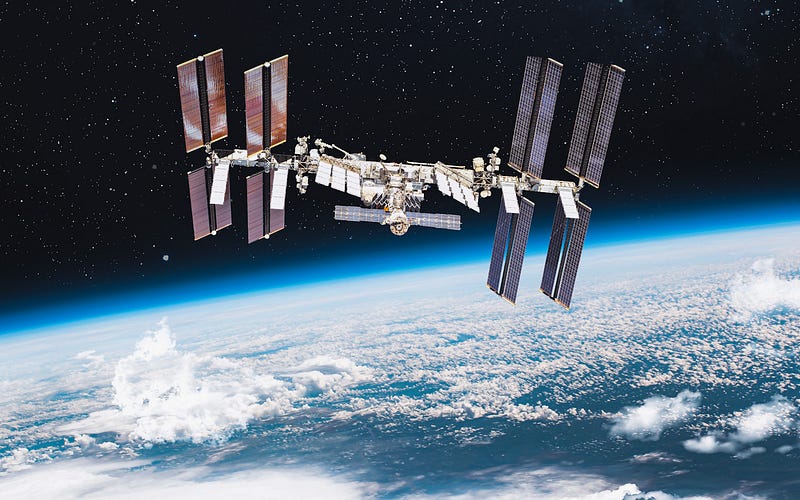
The International Space Station (ISS) is a marvel of modern science, technological achievements and international collaboration. A floating metropolis rocketing around our planet at 17,500 mph (5 miles per second!) that was built and launched over a 10-year period by 15 different countries. It’s the largest man-made object in space and is still one of the greatest resources for scientific study and human exploration (it’s also the most expensive object ever built with a $150 billion price tag).
Talk about the Everest of goals.
The list of technical challenges to bring this into being are almost endless, and chief among them, it weights almost 1 million pounds. The ISS is too large to launch into space if it were completely built on Earth. So an army of engineers decided to build the different sections as individual modules and launch those into orbit separately. So they took a large task, broke that into smaller sections and planned accordingly (spoiler alert).
To launch anything into space you have to overcome what’s called the drag equation. The simple version is the space craft has to fly fast enough through the atmosphere to escape Earth’s gravity and achieve orbital velocity (hang in there). So when each contributing country engineered their modules they had to take this into account and design accordingly. But there was one final technical hurdle the Russians had to account for that was unique to them; the height of the train tunnels along the railway that was used for transportation to the launch facility.
They not only had to account for the technical components, weight restrictions and the ability to dock with previously launched modules but tunnels built decades earlier would also be a determining factor. Something like this can easily be overlooked as we saw in 1999 when NASA lost one of it’s Mars orbiters due to certain instructions not being converted from English to metric as it was arriving in orbit. A clear lack of communication but also a failure to plan the goal of placing that space craft in orbit with enough focus on the details.
Spectacular but how does this help you lose weight before your 10 year high school reunion? Much like the Russian engineers, you need to establish the overall goal and then work backwards on how best to achieve this with as much detail as possible.
Think of it like this: if you say ‘I’m going to lose 15 pounds in 3 months by eating better and going to the gym’, are you accounting for everything? What does ‘eating better’ mean? What about when you travel and there’s no gym or you’re schedule picks up and you have much less free time? And energy.
Or there’s a global pandemic.
Here’s a better plan: you’re going to lose that weight by planning your meals 5 days a week, cut out sodas and workout at least 30 minutes at a high intensity those same 5 days. Add to that contingency plans for busy schedules (or quarantines) and an accountability partner to keep you honest in your progress and those pounds don’t stand a chance. This is how you solve your own drag equation but let’s get specific.
In the immortal words of MC Hammer, “Break it down now.”
Use SMART goals:
- Specific- clearly defined (ex. I want to lose 20 pounds)
- Measurable- you need a way to track your progress
- Attainable- be realistic, don’t set yourself up for failure
- Relevant- this should fit with your life goals
- Time- set a specific date when you want to achieve this (ex. by July 10th)
- Write it down. As long as it exists only in your mind it doesn’t exist in reality. Speaking things into existence is helpful but writing it down creates a binding contract with yourself. It gives you something tangible to refer back to when the going gets tough. You’re also 42% more likely to succeed.
- Believe and you can achieve. It may sound like something you’d see on a cat poster but the truth is simple, if you don’t think you can do something you probably won’t. Our thoughts create our reality, so choose the best ones.
- Don’t go it alone. Make sure you seek help from people that are experienced because that further improves your odds. Also don’t discount an accountability buddy, have someone close that you can trust to kick you in the unmentionables when you fall behind.
- On that same note, don’t quit if/when you fall behind. Expect to make mistakes and have times of weakness because no matter what your goals are, change is hard. Focus instead on the triumphs and wins. Again writing them down to reflect on later can be huge.
“Our goals can only be reached through a vehicle of a plan, in which we must fervently believe, and upon which we must vigorously act. There is no other route to success.” — Pablo Picasso
With all of this keep in mind that change takes time and effort. Usually more than you realize at the start. President Reagan directed NASA to build the ISS in 1984 but the first module wasn’t launched until 1998, the first occupants didn’t take up residence until 2000 and it wasn’t completed until 2011. More than likely you won’t need to negotiate over national budgets, changing leadership and other political pitfalls but the point is the bigger the goal the bigger the effort to achieve it. The outline is simple, it’s the execution that determines the results.
Set your goal. Write it down. Take action.
And watch out for those Russian train tunnels.


