
What the Heck is ‘Moderate or Vigorous’ Physical Activity?
We’re all supposed to get some, so let’s define the terms and understand the thresholds

Advice on the benefits of physical activity invariably invokes the need to achieve a minimum amount of “moderate or vigorous physical activity” on a daily or weekly basis. The formal thresholds — achieved by only 24% of U.S. adults, by the way — offer outsized rewards: better physical and mental health and emotional well-being, improved sleep, more daytime energy, stress reduction, and a chance to live longer.
But what exactly are these thresholds? And what the heck do “moderate” and “vigorous” even mean? Let’s unpack it all. Then at the end of the article, you’ll find a list of suggestions and motivations—ways to get it done.
To achieve the bulk of the benefits offered by physical activity, the latest science says adults should get at least…
- 150 minutes weekly of moderate physical activity. That’s 2–1/2 hours a week, or about 22 minutes a day, but the effort can come in larger amounts on some days, less on others, and sessions as little as a few minutes count toward the total.
- Or 75 minutes weekly of vigorous activity. Or you can do some combination of moderate and vigorous activity.
- Plus two muscle-strengthening sessions weekly. This can involve weights, resistance bands or simple at-home exercises like squats, push-ups, planks, or even strenuous yoga.
Note that the guidelines focus on activity, not exercise. That’s important. Exercise is an unnatural concept we’ve invented to make up for the lack of physical effort required in modern life. But you can get your healthy dose of effort via any sort of movement that elevates your breathing rate and gets your blood pumping sufficiently — from old-fashioned chores and hard work to pure fun.
Examples of moderate physical activity:
- Walking briskly (more below on what this means)
- Biking slowly (10–12 mph on flat pavement)
- Light yoga
- Pickleball doubles
- Housework (washing windows, vacuuming, mopping)
- Mowing the lawn
Examples of vigorous physical activity:
- Jogging
- Hiking (like, you know, up hills)
- Biking fast (14–16 mph, or up hills)
- Playing fast-paced sports like basketball, soccer or singles tennis
- Dancing the tango or other fast forms
- Shoveling snow or spading the garden
- Chopping wood
Standing, sauntering, cooking or playing guitar are all good for you, too, but are generally considered to be light activities.
How to gauge your activity level
Don’t let this next paragraph bog you down. It’s technical but worth noting:
Scientists define activity level based on metabolic equivalents, or METs. One MET is the energy you’re using right now — presumably sitting on your but reading about exercise instead of exercising—about 1 calorie for every 2.2 pounds of your body weight. Moderate activity involves 3 to 6 METs. Above 6 METs is considered vigorous. The scheme, while helpful in scientific study, is inherently imperfect in the real world, since someone in great shape can, for example, walk as fast as a sedentary person while expending much less energy.
A more practical way of measuring activity is by how it feels. This can be done with the Borg Scale of exertion, developed by Gunnar Borg at Stockholm University, in which heart rate is estimated by multiplying your perceived exertion rate by 10. Forget I even mentioned heart rate. Too complex. Just look at the chart:
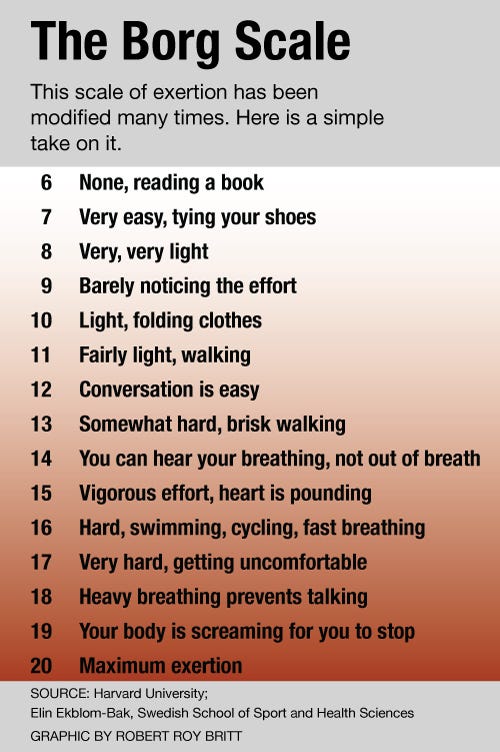
Moderate activity is somewhere between “conversation is easy” and “you can hear your breathing but you’re not out of breath” on the Borg Scale. Vigorous activity is everything above that.
Brisk walking is often cited by experts as an ideal moderate physical activity. Your mileage may vary, but scientists generally say around 3 mph represents a brisk walk for a typical adult. That means you’d cover about 1 mile on a 22-minute walk. A mile is roughly four trips around a 400-meter track surrounding a football field.
Another way to measure walking pace: For the average healthy individual between age 41 and 60, brisk walking involves about 100 steps per minute, with 130 steps per minute verging on vigorous territory, according to a 2019 study. A follow-up 2021 study by the same researchers found that 100 steps per minute will get most people ages 61 to 85 into the moderate zone, too.
Of course, few people are average. So…
“Individuals who are sedentary could aim to walk at a cadence of approximately 100 steps per minute, and then gradually challenge themselves to walk faster up to or above 130 steps per minute to achieve a vigorous intensity,” said Elroy Aguiar, PhD, an exercise scientist at the University of Alabama who worked on the above two studies. “Anyone struggling to achieve the 100 mark should aim to just get out there and amble around, and build up their pace,” he told me, adding: “Any physical activity is better than none.”
If a health condition or disability makes certain types of physical activity impractical or impossible, the U.S. government’s Physical Activity Guidelines suggest seeking advice from a physician or fitness expert for alternatives, such as aquatic therapy, rowing or wheelchair sports (more info here and here).
Bottom line: Don’t worry too much about all these definitions and thresholds. Just move more (and talk less) and challenge yourself to do it with greater vigor tomorrow than you did yesterday. You can find more practical tips and motivation in any of my previous articles:
- The No-Excuses Guide to Physical Activity
- Weightlifting vs. Aerobic Exercise: Which is Best?
- Really Short Weightlifting Workouts Work
- Get a Grip: A Firm Way to Slow Aging
- Surprising Benefits of Brief, Intense Exercise
- How to Start Running Effectively and Avoid Injury
- 3 Doctor-Designed Workouts Anyone Can Do
- Sit a Lot? Move This Much Every 30 Minutes, Study Says
- Two At-Home Workouts to Stay Fit
- The Best Time of Day to Exercise
- It’s OK to Despise Exercise
- The Myth of 10,000 Steps
Your support makes my health and wellness writing possible. You can sign up for emails when I publish on Medium, or join Medium to directly support me and gain full access to all Medium stories, get my health news briefs on Mastodon, or check out my book: Make Sleep Your Superpower: A Guide to Greater Health, Happiness & Productivity (paperback or Kindle version). — Rob


