
“What the FAQ?” Your Landfill Questions Answered
Without a doubt, landfills play a critical role in modern-day society, but they also perpetuate our wasteful habits as consumers.
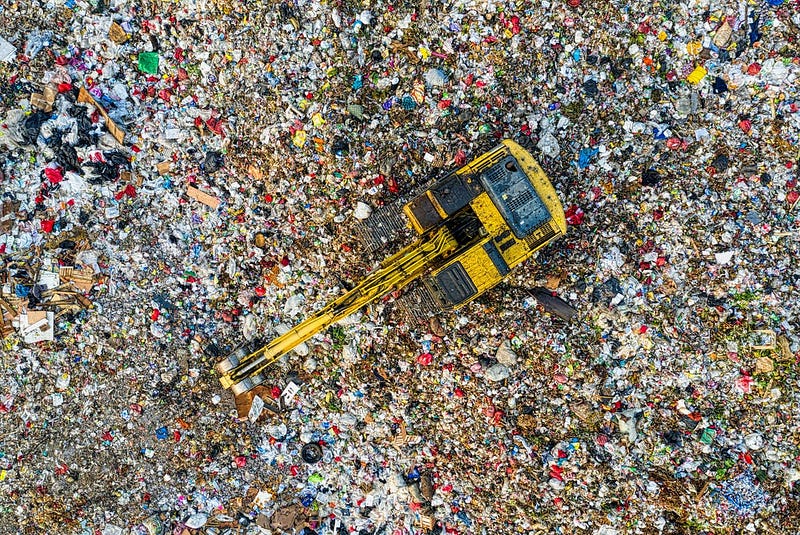
As a landfill operations analyst, I have an appreciation for landfills, but I also understand that landfills cannot coexist in a truly sustainable world.
Do you ever wonder what happens to your trash after you throw it away? Although we all produce waste, not everyone is familiar with landfills. Which is why I created this FAQ to answer some of the most common questions I encounter. Read on to learn more about the good, the bad, and the smelly.
What is a landfill?
First off, a landfill is NOT a dump. These two terms are used interchangeably, but they mean different things.
Both terms are used to describe excavated land used to store waste. The only difference is that landfills are government-regulated, and therefore are subject to more environmental protections.
These protections include:
- Limiting the amount of exposed waste
- Covering the waste with dirt regularly to manage pests and smells
- Collecting and removing landfill gas from the landfill (especially methane, a potent greenhouse gas)
- Collecting and removing leachate from the landfill (aka, water in the landfill that becomes toxic “trash goo”)
- Using a thick impermeable liner to ensure no trash goo escapes into the groundwater or surrounding earth
A landfill is useful for keeping our waste separate from the surrounding environment. But unfortunately, landfills are a privilege not available to everyone around the world.
In many developing countries, large open dumps are used more frequently than landfills. This may result in environmental and human health concerns for local residents. Especially when they sift through the garbage in search of valuable or recyclable materials.
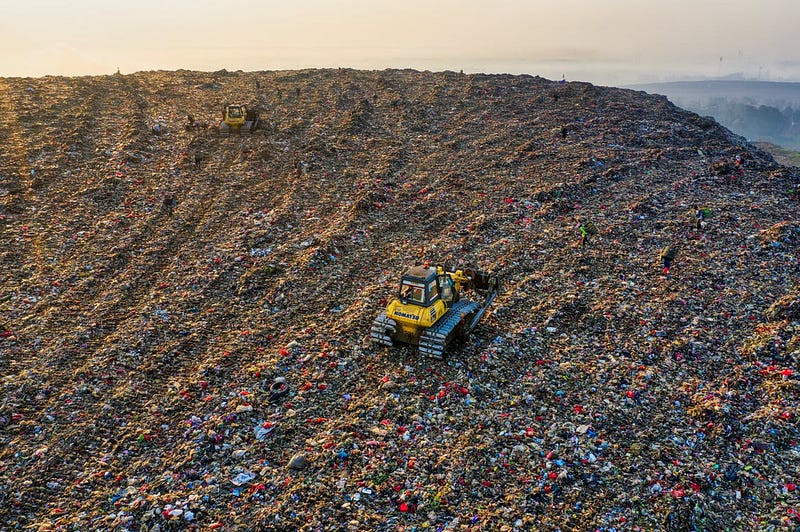
The image above is an example of a large open dump in Indonesia with an endless stretch of garbage. At a landfill, this would be considered unacceptable. Only a small patch of exposed waste is operated at a time.
Many densely populated countries, especially in Europe, don’t have as much physical space for landfills and therefore are more likely to use incinerators. Sometimes the trash is burned for energy, but either way, this results in unnecessary carbon emissions.
What happens to my trash after it goes to a landfill?
In a world where billionaires race to go to space and vaccines are developed in record time, you may be shocked at the simplicity of waste management.
Whenever I explain landfills to the average person, I can see the disbelief and confusion in their eyes. Most of them say:
“Our trash gets put into a hole in the ground…and that’s it?”
It’s demoralizing to hear that your trash gets put into the ground without serving a higher purpose, but that’s just the reality. (Side note: Our waste can produce gas for energy, but it’s not as “renewable" as some might suggest. I’ll write a separate piece on this topic soon).
“But…then what?”
Perhaps someday landfills will be excavated for valuable materials, but the process would be both cumbersome and expensive, especially if the materials are not valuable enough to fund the project.
It would make more sense if we could source these materials now before they are compacted under thousands of tons of garbage.
Until then, these landfills will patiently sit with our garbage slowly decomposing inside of them.
Which brings me to the next question…
What is landfill gas?
Although landfills are filled with trash, they don’t decompose as fast as you might think.
Landfills are designed to store trash, not break it down.
Each landfill has a limited amount of airspace that it can reach. In other words, the operators must squeeze as much waste as possible into their allotted space.
The more trash they can fit, the longer the landfill operation can exist.
Due to compaction and dirt cover, the waste has very little exposure to the elements, such as oxygen and sunlight, and therefore biodegrades slowly.
When bacteria breaks down waste in the absence of oxygen, this is called anaerobic digestion, resulting in landfill gas that is primarily made of methane, but also carbon and a few other trace gasses.
The landfill gasses are collected via a gas collection system which are then flared (burned) or processed into natural gas.
Do landfills contribute to climate change?
Yes they do, mostly from the gas they produce. The following is a direct quote from the EPA:
“Municipal solid waste (MSW) landfills are the third-largest source of human-related methane emissions in the United States, accounting for approximately 5.1 percent of these emissions in 2019.”
Methane is a potent greenhouse gas. Although it doesn’t last as long in the atmosphere as carbon (a decade versus centuries), it is still 25 times more effective at trapping heat.
By generating more trash, we inadvertently create more greenhouse gases.
And whether they are burned in a flare, combusted for energy, or escape through improper dirt cover, we will suffer the consequences of these emissions for years to come.
What happens to landfills after they close?
Once landfills reach their airspace limit, they must be closed down and capped. The cap of the landfill is similar to the liner used at the bottom of the landfill.
But a landfill closure doesn’t mean the job is over. Its contents will continue decomposing which produces both gas and leachate for years to come.
For that reason, all landfills are required to be monitored for 30 years after closing.
However, it’s not clear what happens after 30 years. Although most of the landfill’s gas and leachate will be removed by then, it’s unclear who is responsible for any remaining byproducts or subsequent leaks.
(It’s important to note the rule was made just over 30 years ago, so it’s possible this arbitrary number could be amended over time.)
In the meantime, vegetation will be grown over the liner. This means the closed landfill can be used as a park, hiking area, or solar farm. You wouldn’t even know it was a landfill by looking at it. It would just look like a big grassy hill.
All the while…the trash underneath continues decomposing.
Will we ever run out of space for landfills?
Technically speaking, we will eventually run out of space at some point in the distant future.
But just because there is land available doesn’t mean a landfill can be built there, especially if it would interfere with the local environment, nearby communities, or city codes.
Starting a new landfill is both time and capital-intensive. It can take up to a decade and millions of dollars before the landfill begins operating. It’s more preferable to extend the life of an existing landfill through effective compaction, or by requesting a vertical or horizontal expansion.
And yes, space can also be an issue. Especially for densely populated areas with limited space (i.e., parts of the eastern and northeastern United States). When space is limited, the trash must either be incinerated or sent via rail to another distant landfill.
But let’s just be honest…no one wants to live next to a landfill.
Communities with higher incomes and more political influence will have a better chance at protesting and halting new landfill projects. Which means they may get pushed onto lower-income communities instead.
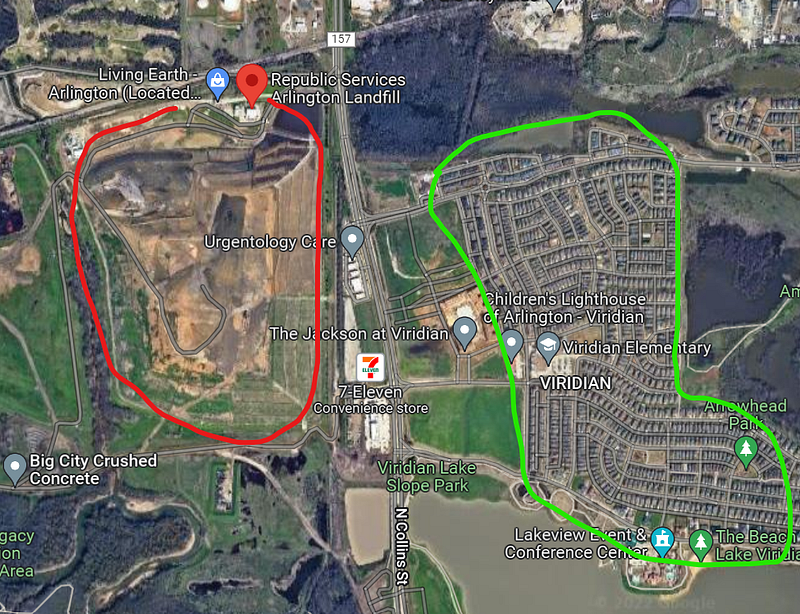
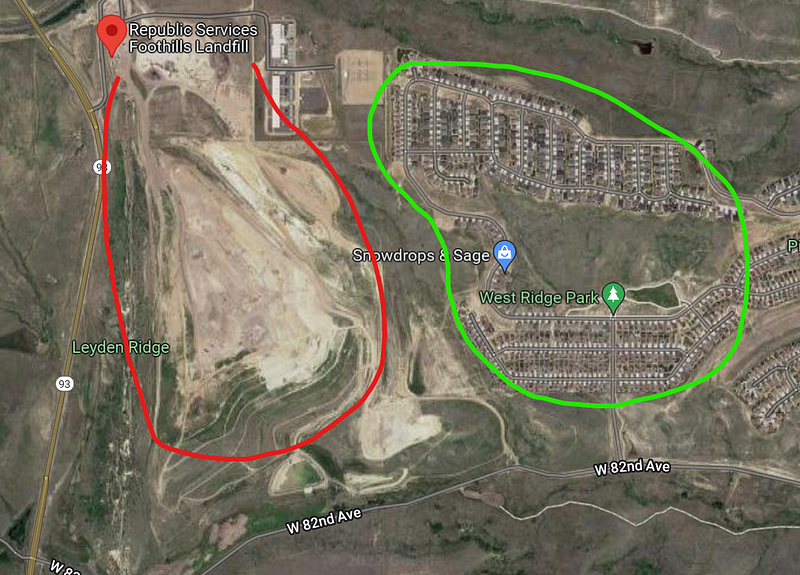
But as suburbia continues expanding, they inch closer towards existing landfill sites. Landfills used to sit far away from residential communities, but now builders are designing brand new housing complexes right next door!
The following images show two examples. The red outline is the existing landfill, and the green outline is the new upscale housing complex built next to it.
Are landfills sustainable?
In my opinion, the short answer is no.
Landfills are necessary to keep our modern societies sanitary. If all landfills were suddenly closed, we would feel the impact right away. Garbage would line our streets, pests would take over, and diseases would spread. The environment would quickly get contaminated, including our drinking water sources.
But just because landfills provide us with modern-day luxuries doesn’t mean we should keep them around forever.
Landfills encourage us to continue our wasteful behaviors. It’s easy for us to make a careless purchase when disposal is so easy. In fact, many of the things we buy are designed to be disposable.
And it will be the young people and future generations who will have to contend with our waste. I refuse to accept landfills as the best solution possible. In fact, it’s almost insulting to the ingenuity of our species.
When compared to environmental pollution or incineration, I believe landfills are the best modern solution we have at this moment, but we can’t become complacent. Landfills are not a suitable long-term solution. What we really need to do is produce less waste to begin with.
In the meantime, I guess we’ll just continue adding more crap to humanity’s underground time capsules.
What did you think about the FAQ? Do you have any other landfill questions you want to be answered? Let me know in the comments!
If you find these articles helpful, claps and comments are always appreciated. You can also support my work in the following ways:
- Buy me a coffee at ko-fi.com/crystalclear
- Sign up for a subscription to Medium using my referral link
- Subscribe to my mailing list for more trash talking!