What the Experts Say About Leadership Versus Management
A whirlwind tour about an age-old workplace conundrum

Sometimes the term ‘leader’ and ‘manager’ are used interchangeably. However, they’re completely different.
“The manager does things right; the leader does the right thing.” — Warren Bennis
Consider it like this — ‘Protected’ elements in an organization can survive with efficient management but ‘exposed’ parts require effective leadership.
So let’s explore this a little further.
What is management?
In 1974, Peter Drucker said that “Managers give direction in their organizations, provide leadership, and decide how to use organizational resources to accomplish goals”.
“Management is the attainment of organizational goals in an effective and efficient manner through planning, organizing, leading, and controlling functions.” (Daft, 2000)
According to Steers et al (1985), management is “the process of planning, organizing, directing, and controlling the activities of employees in combination with other organizational resources to achieve stated organizational goals”.
So that’s management defined by three experts.
What is leadership?
In 1981 Hicks & Gullet stated that “Leadership is the ability (through whatever means) to influence the behavior of others in a particular direction”.
“Leadership is generally defined simply as influence, the art or process of influencing people so that they will strive willingly toward the achievement of group goals” (Koontz & O’Donnell, 1976)
According to Steers et al (1985) leadership can be viewed from the following three perspectives:
- An attribute of position (CEO)
- A characteristic (natural-born leader)
- A category of behavior (influence)
Katz & Kahn suggested the following three leadership patterns:
- Organization — introducing structural change or formulating policy
- Interpolation — piecing together various parts of the organization or making the existing structure more complete
- Administration — using the organization’s structure to keep it in motion and running smoothly
Categorized into three domains:
- Individual — leaders influence behavior by motivating, inspiring, and coaching
- Group — leaders build teams, create cohesion and resolve conflicts
- Organizational — leaders foster culture, generate change and ensure the attainment of goals
As such, if leadership is seen as a layer above management the functions performed by a leader are more specialized, more tangible compared to those of a manager.
According to Davis (1967) leadership is part of management, but not all of it:
- A manager is required to plan and organize
- A leader is expected to get others to follow
- Leadership is the ability to get others to seek defined objectives enthusiastically
Davis considers that management activities such as planning, organizing, and decision-making are “dormant cocoons” until the leader triggers the power of motivation in people & guides them toward goals.
That’s leadership covered, but how do we differentiate with management?

Leadership power versus managerial power
Power is the potential ability to influence others. A traditional manager has positional power:
- Legitimate power — Based on the individual’s position or right to exercise power, give orders or make demands.
- Reward power — The ability to grant or distribute rewards such as money, recognition, promotion, referrals, or indeed other favors.
- Coercive power — The remit to discipline someone if they do not comply or resist instruction/influence.
By contrast, a leader has personal power:
- Expert power — From special knowledge, skill, or expertise in a certain field. A person’s expert power increases when they suggest a successful course of action, but diminishes when their suggestions fail.
- Referent power — Driven by the desire to be connected to, associated with, or identified as a charismatic person.
Leadership styles
Broadly speaking there are three traditional categories of leadership styles, which are as follows:
- Democratic
- Autocratic
- Laissez-faire
Leadership style — Autocratic
Autocratic styles involve close supervision of subordinates with the leader issuing precise and detailed instructions for a task.
This is a dictatorial style where the leader gives orders and instructions to employees, without engagement or discussion. They also reward good performance and sanction poor performance.
The advantages of this style are:
- Work tends to be finished on time
- Fast decision making
- Employees get direct and immediate assistance to achieve goals
The disadvantages are:
- Employee initiative is suppressed
- Employees cannot develop their full potential
- Employees’ knowledge, skills, and experience are not fully utilized
Leadership style — Democratic
This involves a lot of communication and consultation between the leader and the group i.e. group members actively participate in the decision-making process with the leader.
The advantages of this style are:
- Improves motivation by involving the team in planning and decisions
- Improves morale as a result
- Enhances subordinate satisfaction by broadening their responsibilities and making work more interesting
- Increases the utilization of employee's expert knowledge and skill to solve problems and develop ideas
The disadvantages of this style are:
- Decision making is slower due to the time required for consultation
- Subordinates may not be capable of working without close supervision
- Employee participation in minor operational matters, while excluded from all major strategic decisions, can lead to friction and resentment
Leadership style — Laissez-faire
This style centers on empowering followers, giving them the responsibility to make decisions and decide on the best course of action. A Laissez-faire leader is available for guidance, direction, and support when required.
This style of leadership is suited to situations where followers have a high level of knowledge and clearly understand their role and responsibility.
The advantages of this style are:
- Enhances creativity and innovation
- Freedom to make decisions
- Encourages and improves networking
The disadvantages are:
- Low boundaries, so there can be a lack of role awareness
- Low accountability
- Employees can become passive
The above are three broad styles, more styles are covered in the article below:
Final Thoughts
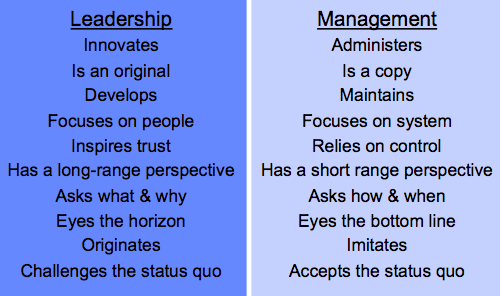
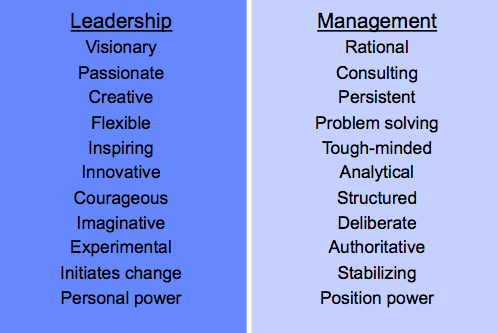
Clearly ‘leadership’ and ‘management’ are different, certainly in terms of traits and behaviors. To summarise, below are two tables to easily contrast and compare both:
1. Leadership versus management behaviors
2. Leadership versus management traits
To conclude, allow me to reiterate Bennis’s quote, who captured it so well:
“The manager does things right; the leader does the right thing.”