avatarMaxi Gorynski

Free AI web copilot to create summaries, insights and extended knowledge, download it at here

3388

Abstract

efer to any poorly understood form of matter, like <a href="https://science.nasa.gov/astrophysics/focus-areas/what-is-dark-energy">dark matter</a>[1]or <a href="https://futurism.com/mirror-matter">mirror matter</a>.</li><li>Exotic matter which abides by the principles of mainstream physics, but manifests in forms that are very rarely encountered, like <a href="https://science.sciencemag.org/content/367/6475/eaay0668.full">quantum spin liquid</a>, <a href="http://www.sci-news.com/physics/new-kind-photonic-matter-05737.html">photonic matter</a>, or the Bose-Einstein condensate successfully produced on the ISS.</li></ol><p id="a0a1">The key aspect of this exercise is that it could have been done nowhere else — at least, nowhere else on Earth. The production of exotic matter in low-earth orbit is significant, as substances like the BEC find their cloud structures collapsed almost instantaneously when they form within gravitational fields, like the Earth’s. That’s why, despite the fact that the condensate has been fashioned on Earth, it has never been studied quite like this before. The unique disposition of the ISS — chiefly, its microgravity — was key in making this breakthrough possible, by making the BEC observable at reasonable length.</p><figure id="4469"><img src="https://cdn-images-1.readmedium.com/v2/resize:fit:800/0*x-MmXs-IYQ7CFBqk.jpg"><figcaption>The International Space Station. Image from WalesToday</figcaption></figure><p id="49cd">So why try to create this substance in a fifth state of matter? The intent has a lot to do with the quantum properties of the condensate. At such extraordinarily low temperatures, a significant number of the BEC’s bosons come to occupy what is known as the ‘lowest quantum state’. In this instance, quantum phenomena which would otherwise be visible only microscopically (and, given planetary conditions of gravity, for a fraction of a second) become visible macroscopically, with a camera.</p><p id="f84b">The kind produced for the first time in the Cold Atom Lab could prove to be science’s “gateway drug” to dark matter and dark energy. To put it another way, it could prove to be a gateway to an understanding of the universe itself. As Kamal Oudrihri, the Cold Atom Lab’s Mission Manager, observed:</p><p id="4105">“Roughly 68% of the universe is dark energy, and about 27% dark matter. All we know [about the universe currently] is less than 5%.”</p><p id="acf0">Being able to freely recreate exotic matter substances like the Bose-Einstein condensate represents a preliminary step into that 95% share of the universal unknown. Some researchers have suggested that understanding the relationship between this condensate and ultralight scalar dark matter could <a href="https://www.sciencedirect.com/science/article/abs/pii/S2212686416300589">lead to greater understanding of the formation of the universe</a>. The ‘non-minimal’ coupling of BEC to spacetime curvature has led others to suggest that the condensate “<a href="https://arxiv.org/pdf/1310.3753.pdf">could provide a new mechanism to address cold dark matter paradigm issues at galactic scales</a>.”</p><h2 id="aa89">A More Exotic Future</h2><p id="310d">Exotic matter, in all its many forms, will not stop at the secrets of the universe, either. Other kinds of exotic matter (specifically, the kind we mentioned above that possess negative mass characteris

Options

tics), will lead to their own spate of astonishing instances of sci-fi-fantasy-made-reality. You’ve heard of wormholes, haven’t you? Exotic matter could prove decisive in turning them from a speculative structure, as hard to observe as control, into a tool of exploration in spacetime.</p> <figure id="2c61"> <div> <div> <img class="ratio" src="http://placehold.it/16x9"> <iframe class="" src="https://cdn.embedly.com/widgets/media.html?src=https%3A%2F%2Fwww.youtube.com%2Fembed%2F-epbMh56diQ%3Ffeature%3Doembed&amp;display_name=YouTube&amp;url=https%3A%2F%2Fwww.youtube.com%2Fwatch%3Fv%3D-epbMh56diQ&amp;image=https%3A%2F%2Fi.ytimg.com%2Fvi%2F-epbMh56diQ%2Fhqdefault.jpg&amp;key=a19fcc184b9711e1b4764040d3dc5c07&amp;type=text%2Fhtml&amp;schema=youtube" allowfullscreen="" frameborder="0" height="480" width="854"> </div> </div> </figure></iframe></div></div></figure><p id="b3d4">Elsewhere, scientists have <a href="https://www.realclearscience.com/articles/2019/09/24/strange_alien_planets_may_be_made_of_exotic_matter.html">identified a number of exoplanets</a> which they believe to be constructed from another form of exotic matter. These hyper-dense planets are believed to be made of so-called ‘<a href="https://science.sciencemag.org/content/360/6390/697">strange matter quarks</a>’, making them incredibly hardy structures capable of sustaining themselves against intense gravity. They’d have to, given they orbit around pulsars. Pulsars, <a href="https://www.nytimes.com/1983/02/09/us/pulsar-termed-most-accurate-clock-in-sky.html">the timekeepers of the universe</a>, are incredibly dense and rapidly spinning <a href="https://en.wikipedia.org/wiki/Neutron_star">neutron stars</a>, and they exert surface gravity that is 350,000 times stronger than the Earth’s.</p><p id="3d95">More terrestrially-versatile uses of exotic matter revolve primarily around superconductors and superfluids. <a href="https://en.wikipedia.org/wiki/Superconductivity">Superconductors</a>, as their name suggests, allow electricity to pass through them with absolutely zero resistance, while <a href="https://en.wikipedia.org/wiki/Superfluidity">superfluidity</a> implies a liquid that is able to flow without any loss whatsoever of kinetic energy. The topological phase transitions which occur in incredibly thin films of exotic matter could enable broad advances in superconductive and superfluid applications, in computing, engineering and beyond.</p><p id="3c6c">Participants in those recent exercises aboard the ISS were keen to stress that their successful creation of BEC in the Cold Atom Lab represents the start of a journey, a technical achievement, and the verification of forecast, as opposed to an unprecedented stand-alone discovery. Nevertheless, it is a form of history newly made, and points to fascinating directions for humanity’s experience in reproducing, handling and studying mysterious and rarely encountered forms of matter.</p><p id="1512">The future is exotic.</p><p id="ccdf">[1] Extending this principle to, say, sociology, does that mean that the “silent majority” is a form of exotic or dark matter in that field? That which we cannot prove exists, but is merely our way of occupying and forming an at least makeshift understanding of negative space?</p></article></body>

What the Creation of Exotic Matter on the ISS Means for the Future of Science

Space Exotica, and more Adventures on the International Space Station

A 5-Minuter from Wonk Bridge
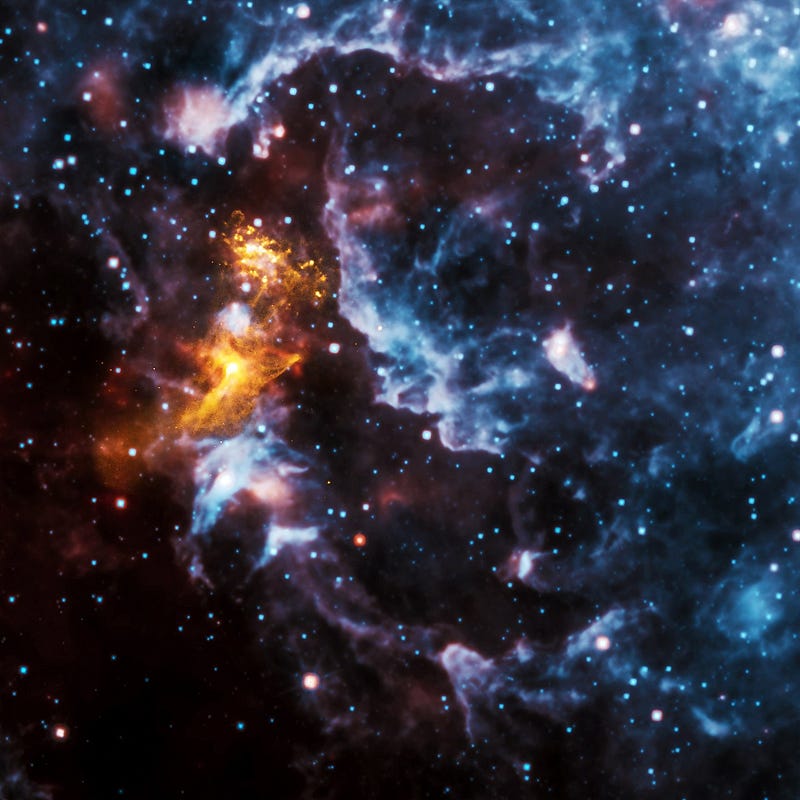
Radiation observed from the pulsar PSR B1509−58. Pulsars such as this one and J1614–2230 have been adjudged by scientific commentators as a ‘clue’ to the nature of exotic matter.

One aspect of the great scientists which most fascinates the public is that their brilliance of foresight sometimes appears to give them a near-prophetic sense of predictive vision. Think of Alfred Wegener, proposing the notion of continental drift decades before the discovery proper of tectonics and seafloor spreading. Think of William Hyde Wollaston and Joseph von Fraunhofer making independent surveys of the elemental make-up of the sun, two years shy of a century before spaceflight. Think of Albert Einstein’s theory of gravitational waves — predicted in 1916 as part of his theory of general relativity, proven by observation only in 2016.

The past week has seen another venerable theory, first realised through experimental method in 1995, finally be vindicated at length. Exotic matter, first theorised collaboratively by Einstein and Satyendra Nath Bose in the early 1920s as a fifth state of matter (to go alongside solids, liquids, gas and plasma), was created in the Cold Atom Laboratory aboard the ISS. In this environment, atoms are slowed with laser light (a process known as ‘laser cooling’) and their temperature reduced to absolute zero. The change of state which results is known as a Bose-Einstein condensate.
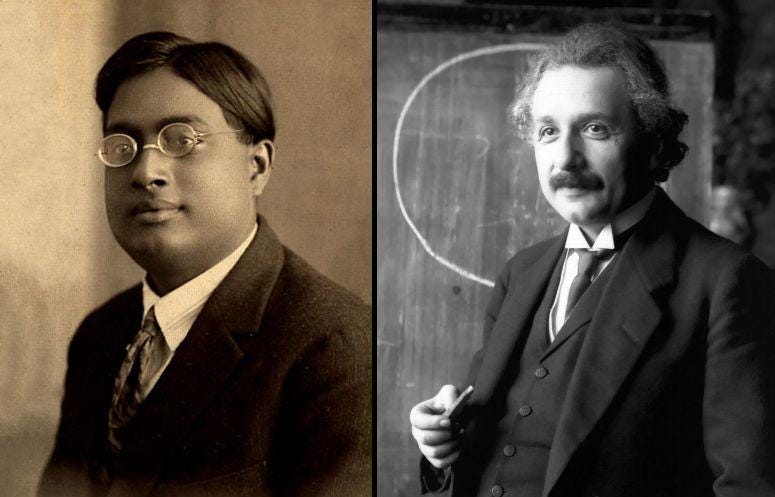
Satyendra Nath Bose & Albert Einstein

This supercooled gas is what Bose and Einstein were talking about — an exotic matter that no longer demonstrates behaviours common to atoms, but rather exists in a single quantum state. This is what accounts for these atoms’ ‘exoticness’; they are no longer distinguishable as individual particles. Rather, they’ve lost their individuality, and have begun to act more like a wave.

But what does it all mean? And what does it mean for science?

A Matter of Another Matter

Exotic matter is difficult to pin a discrete definition on, as there are a number of proposed types. The main ones are as follows:

  1. Exotic matter which “violates energy conditions…[and appears] as the source of the negative curvature and the accelerating expansion of our universe and of anti-gravity.” You might have heard exotic matter, in similar circumstances, be used as a catch-all to refer to any poorly understood form of matter, like dark matter[1]or mirror matter.
  2. Exotic matter which abides by the principles of mainstream physics, but manifests in forms that are very rarely encountered, like quantum spin liquid, photonic matter, or the Bose-Einstein condensate successfully produced on the ISS.

The key aspect of this exercise is that it could have been done nowhere else — at least, nowhere else on Earth. The production of exotic matter in low-earth orbit is significant, as substances like the BEC find their cloud structures collapsed almost instantaneously when they form within gravitational fields, like the Earth’s. That’s why, despite the fact that the condensate has been fashioned on Earth, it has never been studied quite like this before. The unique disposition of the ISS — chiefly, its microgravity — was key in making this breakthrough possible, by making the BEC observable at reasonable length.

The International Space Station. Image from WalesToday

So why try to create this substance in a fifth state of matter? The intent has a lot to do with the quantum properties of the condensate. At such extraordinarily low temperatures, a significant number of the BEC’s bosons come to occupy what is known as the ‘lowest quantum state’. In this instance, quantum phenomena which would otherwise be visible only microscopically (and, given planetary conditions of gravity, for a fraction of a second) become visible macroscopically, with a camera.

The kind produced for the first time in the Cold Atom Lab could prove to be science’s “gateway drug” to dark matter and dark energy. To put it another way, it could prove to be a gateway to an understanding of the universe itself. As Kamal Oudrihri, the Cold Atom Lab’s Mission Manager, observed:

“Roughly 68% of the universe is dark energy, and about 27% dark matter. All we know [about the universe currently] is less than 5%.”

Being able to freely recreate exotic matter substances like the Bose-Einstein condensate represents a preliminary step into that 95% share of the universal unknown. Some researchers have suggested that understanding the relationship between this condensate and ultralight scalar dark matter could lead to greater understanding of the formation of the universe. The ‘non-minimal’ coupling of BEC to spacetime curvature has led others to suggest that the condensate “could provide a new mechanism to address cold dark matter paradigm issues at galactic scales.”

A More Exotic Future

Exotic matter, in all its many forms, will not stop at the secrets of the universe, either. Other kinds of exotic matter (specifically, the kind we mentioned above that possess negative mass characteristics), will lead to their own spate of astonishing instances of sci-fi-fantasy-made-reality. You’ve heard of wormholes, haven’t you? Exotic matter could prove decisive in turning them from a speculative structure, as hard to observe as control, into a tool of exploration in spacetime.

Elsewhere, scientists have identified a number of exoplanets which they believe to be constructed from another form of exotic matter. These hyper-dense planets are believed to be made of so-called ‘strange matter quarks’, making them incredibly hardy structures capable of sustaining themselves against intense gravity. They’d have to, given they orbit around pulsars. Pulsars, the timekeepers of the universe, are incredibly dense and rapidly spinning neutron stars, and they exert surface gravity that is 350,000 times stronger than the Earth’s.

More terrestrially-versatile uses of exotic matter revolve primarily around superconductors and superfluids. Superconductors, as their name suggests, allow electricity to pass through them with absolutely zero resistance, while superfluidity implies a liquid that is able to flow without any loss whatsoever of kinetic energy. The topological phase transitions which occur in incredibly thin films of exotic matter could enable broad advances in superconductive and superfluid applications, in computing, engineering and beyond.

Participants in those recent exercises aboard the ISS were keen to stress that their successful creation of BEC in the Cold Atom Lab represents the start of a journey, a technical achievement, and the verification of forecast, as opposed to an unprecedented stand-alone discovery. Nevertheless, it is a form of history newly made, and points to fascinating directions for humanity’s experience in reproducing, handling and studying mysterious and rarely encountered forms of matter.

The future is exotic.

[1] Extending this principle to, say, sociology, does that mean that the “silent majority” is a form of exotic or dark matter in that field? That which we cannot prove exists, but is merely our way of occupying and forming an at least makeshift understanding of negative space?

Science
Physics
Space
Space Exploration
Recommended from ReadMedium