What the Brain, Athlete, Basket Case, Princess, and Criminal Taught Us
A look at The Breakfast Club, what its characters teach us, and whether it is relevant today
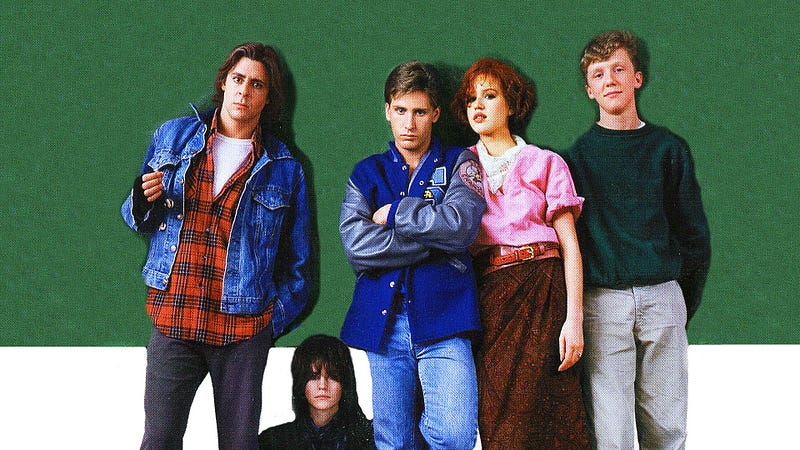
The nostalgia with which we look back on our youth blinds us to its shortcomings and leaves us longing for those halcyon days passed. We romanticise on how our teenage years were the golden age of film, music or whatever your jam happens to be.
But when that film that spoke to you in your youth is adopted and beloved by the next generation and the generation after that, the data is in: the movie you hold as the greatest of all time — it’s officially brilliant!
The Breakfast Club (TBC) is one of those films. After introducing it to whatever generation comes after the Zoomers, they will cleave to it, cherish it, quote from it, reference it, share it and copy it. It’s Iconic!
But why?
Because — unlike its preachy, modern counterparts — it entertains first.
The Breakfast Club’s setup is simple — a group of kids on school detention on a Saturday morning. And this is all that’s needed because the heart of the film lies with its archetypes: popular girl, basket case, jock, nerd, and bad boy. Or as our narrator Brian tells us: the brain, an athlete, basket case, princess, and criminal
The film’s archetypes embody real teenage problems, and this is where the criticism of stock characters loses its bite. It’s the representation of the problems each character has that the audience really relate to — irrespective of the characters themselves. Although, we do love the characters. Their troubles and flaws are really our own laid bare for us to examine and explore from the safety of the screen.
And it’s through the problems each member of this hodgepodge group of misfits have that allows them to develop into real characters — instead of political mouthpieces and approximations at teenagers sanitised for the screen.
In a piece for The New York Times, Molly Ringwald, who plays the character Clare, recounts the time she was told by someone, who might not appear as the film’s target demographic, how the TBC had “saved” his life.
“I have been told more times than I could count, by both friends and strangers, including people in the L.G.B.T. community, that the films [I starred in]‘saved’ them.
“Leaving a party not long ago, I was stopped by Emil Wilbekin, a gay, African-American friend of a friend, who wanted to tell me just that. I smiled and thanked him, but what I wanted to say was ‘Why?’ There is barely a person of color to be found in the films, and no characters are openly gay... ‘The Breakfast Club,’ he explained, saved his life by showing him, a kid growing up in Cincinnati in the eighties, ‘that there were other people like me who were struggling with their identities, feeling out of place in the social constructs of high school, and dealing with the challenges of family ideals and pressures.’ These kids were also ‘finding themselves and being “other” in a very traditional, white, heteronormative environment.’ The lack of diversity didn’t bother him, he added, ‘because the characters and storylines were so beautifully human, perfectly imperfect and flawed.’”
It was John Hughes’s sensibility to that confused period in our lives that allowed him to show us universal truths — in all their teenage, angsty colour — that make TBC instantly adopted by those holding on to the painful memories of youth, and those living it.
We learn in The Breakfast Club the shortcomings of stereotyping and below the charade of every fake-cool kid, a messed up, teenage misfit resides. As Andrew says of the group, “We’re all pretty bizarre. Some of us are just better at hiding it, that’s all.” Its characters are allowed to fall foul of political correctness — as teenagers do! And by allowing the characters this freedom, we learn the lessons that political correctness — for all its faults — wants to teach us.
This is seen early on in the film when Bender’s lewd questioning of Clare’s sexual history is met with ire from Andrew, Bender’s foil, and disdain from the rest of the group. The scene ends with Andrew avoiding a punch by Bender and wrestling him to the ground.
The lessons are there if you want them, and such is the storytelling, you tacitly accept. But unlike its modern counterparts, save HBO’s Euphoria, the lessons branch organically from the story instead of, what nowadays we have come to expect, the story acting as a delivery system, or adjunct, for a thinly-veiled lesson on normative ethics.
There are great lessons to be learnt from art, but good art assists and guides you on your discovery; it doesn’t sit you on a small chair and chastise you.
This is the first of two essays discussing TBC. The accompanying essay dives deeper into events in the film. In particular, I discuss the scene in which Bender hides under Clare’s desk. This scene was viewed as bawdy at the time, but more recently, Molly Ringwald and others deem it sexually transgressive, preferring it be removed from the film altogether.
Part 2: