
What Taking Ownership Looks Like in Leadership
Leadership and ownership are not military constructs, they are business
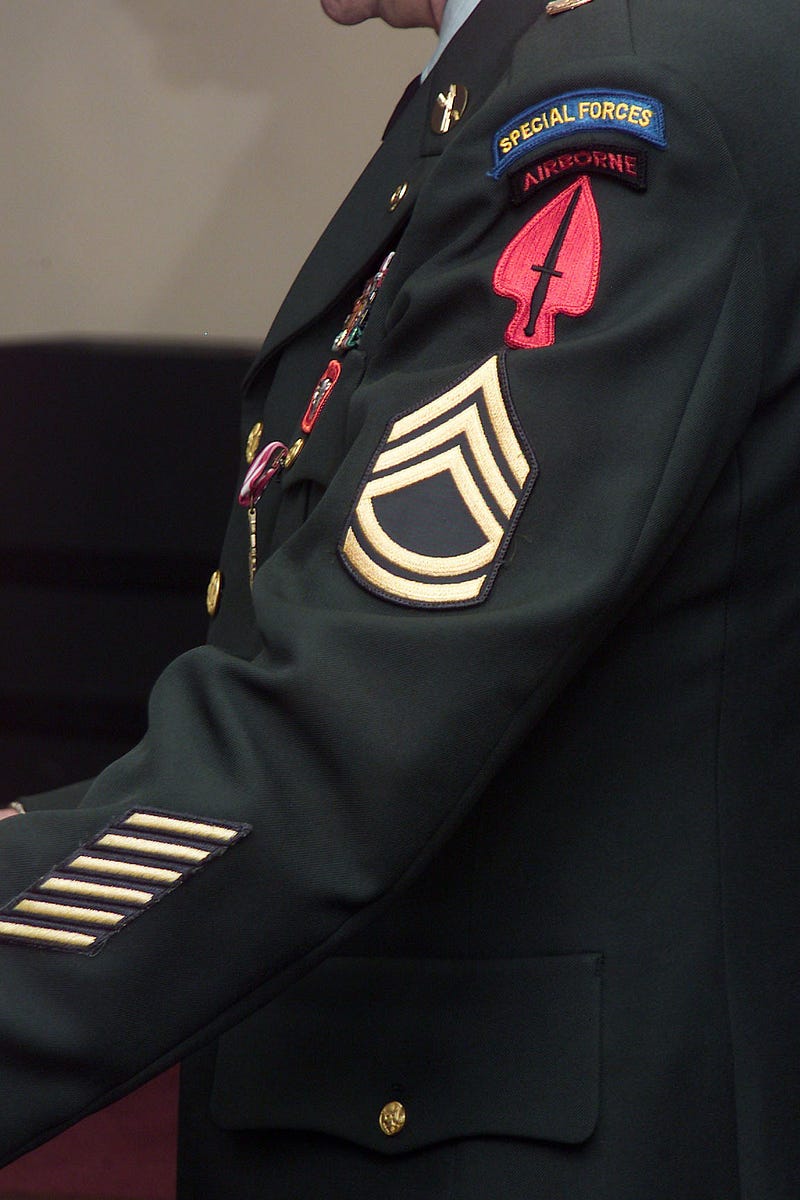
Where Leadership Begins
I’ll start out by saying ownership is the key principle in leadership. Without it, we will miss areas of concern. As you will read later in this.
When we take ownership, every corner is examined, every part of the operation is understood in detail, and every person on board (our team) is our family and we are the parent. Additionally, in a Special Operation team, everyone follows rank unless the rank has delegated control. That way, when operators show up there’s no question on who to follow.
In the above picture we read, “Special Forces” on the blue tab on his shoulder — granted, the picture is a picture of “Delta Arms of Service”, but I’m just referencing the 1 tab, the blue one, not the arrowhead unit patch. That 1 tab says, “I run shit”. It is the FBI showing up to a city police crime scene “alright city detective, you are here to either learn or watch”.
When that tab walks up to regular military, the company commander (captain) steps aside and says, “all yours”.
The reason I relate leadership, management, and ownership to special operations is because many of them have become business consultants like Dan Lok — and they use the same approach they learned in special operations. And for good reason. All leadership principles translate as universal rules.
What’s not Involved in Leadership?
Micromanaging is not part of ownership. It’s a part of paranoia and unaccomplished control or backward control.
- Or, the person who needs to be micromanaged probably should get more training if they can’t run with the team.
- If they are new and in training they only handle things that are not pertinent to saving lives. They begin learning administration, distribution, inventory, and presentations. And more. But, are given some time to learn operations.
- Or, if a company hired someone with a mental impairment. The employee might want that shadow. Side note: I’m a firm believer that any company can find an actual company place for individuals who can push out 4 hours a day of good work. One thing I like about it, is I get to see who the best managers/trainers are. Going back to Special Forces (some of you saw this coming), they train soldiers of other countries who’ve had no formal training and who do not speak English how to protect their country — and SF does a great job! That’s a business standard.
When we select a team, we are selecting people that we want to work beside. We select based on character mostly (because if someone is in our building they know the basics already). Again, in a Special Forces team, a random team member is chosen for an unknown task, because it’s expected if they are there, they can do it. No prepping time. Just the officer walks in the room, points, and directs.
Understanding the Principle
In Management
When we look at what ownership looks like in management, we see:
- excellent delegation
- someone who is engaged with the rest of the team and their welfare
- has a mountain of value from past teams work
- has successfully completed daunting tasks in rigorous environments (which make normal environments quite nice — psychology)
- understands what the end result should look like
- understands the strength of the project is the strength of the weakest team member
- always learning new stuff to better the project
- every detail is covered and has a contingency plan
More of what a leader is expected to know:
This list is the standard for military operation orders
1. SITUATION
- a. Area of Interest. b. Area of Operations (1) Terrain. (2) Weather. c. Enemy Forces (1) Composition, Disposition, and Strength. (2) Recent Activities. (3) Locations and Capabilities. (4) Enemy COAs (Courses of Action). d. Friendly Forces (1) Higher HQ Mission and Intent. (2) Mission of Adjacent Units. e. Attachments and Detachments.
2. MISSION. A concise statement that includes the Who, What, Where, When, and Why of the operation to be conducted.
3. EXECUTION
- a. Commander’s Intent. b. Concept of operations (1) Maneuver. (2) Fires.(3) Reconnaissance and Surveillance. (4) Intelligence. (5) Engineer. (6) Air Defense. (7) Information Operations. c. Scheme of Movement and Maneuver. d. Scheme of Fires. e. Casualty Evacuation. f. Tasks to Subordinate Units. g. Tasks to Combat Support (1) Intelligence. (2) Engineer. (3) Fire Support. (4) Air Defense. (5) Signal. (6) CBRNE (Chemical, Biological, Radiological, Nuclear, and Explosive weapons)(7) Provost Marshal. (8) MISO (Military Information Support Operations, formerly Psychological Operations or PSYOP)(9) Civil Military. h. Coordinating Instructions (1) Time or condition when the plan or order becomes effective. (2) CCIR (Commander’s Critical Information Requirements)(3) EEFI (Essential Elements of Friendly Information)(4) Risk Reduction Control Measures. (5) Rules of Engagement. (6) Environmental Considerations. (7) Force Protection.
4. SUSTAINMENT
- a. Logistics (1) Sustainment Overlay. (2) Maintenance. (3) Transportation. (4) Supply. (5) Field Services. b. Personnel Services Support. (1) Method of marking and handling EPWs (enemy prisoners of war). (2) Religious Services. c. Army Health System Support (1) Medical Command and Control. (2) Medical Treatment. (3) Medical Evacuation. (4) Preventive Medicine.
5. COMMAND AND CONTROL
- a. Command (1) Location of Commander. (2) Succession of Command. b. Control (1) Command Posts. (2) Reports. c. Signal. (1) SOI index in effect. (2) Methods of communication by priority. (3) Pyrotechnics and Signals. (4) Code Words. (5) Challenge and Password. (6) Number Combination. (7) Running Password. (8) Recognition Signals.
Ownership has a humility factor, they are too busy supervising, changing, and communicating to everyone to get boastful. If we have time to boast, we have stopped working. Remember leader, you are human. You have just taken the right steps at the right times to get to where you are. But, your business, project, or team is your baby — nature/nurture it when each are necessary.
Taking ownership means you take the pressure from the people making results happen (the people who get paid less). In the military we call this “shit rolls down hill”. Well, don’t let it roll down hill. Call the spouse, call the psychologist, hit the gym. Use the shit as a fertilizer and pass down nutrient leadership to the supervisors below you, stuff they can use for growth. When they grow, they create nutrition for their teams. Success rolls down hill. It’s generational. You can either hand down tools or feces. Choose wisely.
When a special operator commander gets chewed out, he gets his team together, “Alright all. Got the feedback. Since information is our enemy. Let’s go through what weapons and tactics to focus on.”
When we’re talking business, the principle goal of ownership is growth. What grows a company? What grows your company?
What is your goal with the project, business, team, etc.?
Teams
A team is made of People.
Why do people stay in a project or company?
For passionate work, life funding, and good leadership, right?
When they feel like they’re a part something and that something is what they are looking for. That is a valuable employee.
To Revisit
It’s hard to run a project, team, or business successfully when we do not take hard ownership over the details.
- bad parachute design
- collapse of a construction project that took too long, did not have enough innovation to fit in the required specifications of the lot, and lack of motivation of the team due to the management
- new products that do not take the product line up a notch for business and technology, bankrupting the company
- not obtaining the correct licenses
When a manager connects themselves to the company and to the project at the distinction level equivalent to that of Special Forces, the project, team, or company becomes easier managed.
It’s the difference between having to look at our notes for the task of the day when asked and shooting off not only the task of the day, but an additional innovation that you, the manager or director implemented, due to research and familiarization and who in the team had a doctor’s appointment today and who you delegated for that task.
It is the job of the CEO to not have to manage, but build and expand to the consumer demand.
And yes, US Army Special Forces principles can translate to building a company as well. Hence, a team of 16 members land in a country with maybe 3 cargo boxes of equipment, one or two people who can speak the language, and in 3–6 months that country has one well trained company of soldiers trained in leadership and assessment, enemy detection, inspection, marksmanship, stealth, reconnaissance, communication and technology, survival skills, and medical procedures.
The Special Forces Group Captain is the CEO. There are two things a higher ranking officer back in the states, says
- “WTF are you doing, captain?”
- “thanks for your report”
Is that not the premise of customer reviews? The boss of the CEO are the customers. The captain doesn’t get any more direction unless there is an idea that he wants to implement of which has never been done.
In Special Forces, if rapport is not built between the countries, the operation is a flop. There has been no Special Forces Captain, to date, that has not been able to complete the operation.
The Army SF is at 10/10. Can we beat them?
How is your company’s training?


