
What Sewing Jeans Taught Me About Perfectionism
Sometimes, good enough works

Denim rasped against my fingertips like sandpaper stapled to a woodblock. My feet flew across the cast-iron treadle. Right foot, left, the needle blurred into a silver line as I guided the fabric through the sewing machine. It punched through the layers, drawing a line of golden stitches up the inside seam. Not ten minutes before, I spread the freshly ironed pants out on a workbench and painstakingly drew a line exactly one-eighth of an inch from the seam. Next to the pockets, this was the most visible element on the pants. It had to be perfect.
“Focus on the line. Only on the line,” I whispered this mantra as the line faded from sight. My gaze latched onto the razor-sharp needle stabbing into the fabric half an inch from my fingers.
It was late April 2021, over a year into the COVID-19 pandemic. I was not yet fully vaccinated. Momma somehow talked me into making her a pair of jeans. To me, the very idea sounded like a guaranteed trip to the Emergency Room. The only bet was whether I’d sew through my finger or suffer a crooked seam-induced stroke first.
I’m a perfectionist. Most of my friends were betting on the stroke.
But Momma’s favorite jeans died in December. Patches held the knees of her second favorite pair together, and they were one squat away from a total booty blowout. You can’t buy another pair either. They quit making them. I tried to find a substitute, but today’s jeans manufacturers have all committed the same sin. They put lycra in their lightweight denim. I love my momma, so I bought 100% cotton denim and a pattern.
It seemed sane at the time. Then, I cut out the pieces and froze. For two months, the jeans languished on my worktable while I made up excuses for why I couldn’t.
Perfectionism is fear. When you strip away all the psychoanalysis wrapped in scientific jargon, being a perfectionist means constantly questioning whether I’m good enough while knowing deep down that I’m not. I believed the jeans would be unwearable not because I sewed the legs twisted or made the waist too small or for any other factual reason. They would be unwearable simply because I made them.
Indeed, my experience sewing masks last summer made this an indisputable fact.
Before the 2020 dumpster fire, I hated sewing. As in, I rewrote sweater patterns so I could knit the entire thing without any seams. Mema ensured I knew the basics. Nine-year-old me sewed a few lopsided pillows and a Barbie dress. Then I happily went back to my knitting needles. String made sense; fabric didn’t. For thirty years, I stood by that opinion. Then COVID struck, and my family named me their official mask sewer.
For the record, this was like appointing a fifteen-year-old with a shiny new learner’s permit as your designated driver for a 3 AM bar crawl. I last touched a sewing machine when I was sixteen and hopping on one foot after Granny’s Ancient Beast, aka the beloved New Home Rotary treadle sewing machine, magically jumped in front of my little toe. Seamstress, I wasn’t. However, I could see well enough to thread the needle. Plus, being a perfectionist meant I was unlikely to make something that fell apart. It might be butt ugly, but it would not have unplanned ventilation holes.
I was in over my head and knew it. When the only way out is through, you keep moving and pray you’re heading in the right direction. Desperate, I downloaded grade school sewing textbooks from the 1920s off archive.org and began teaching myself with books and YouTube videos while trying to follow a mask pattern. I sewed, ripped out stitches, and sewed some more.
The first finished mask was an accomplishment. It took a ridiculous five days to make, but it matched the pattern pieces. The seams were straight. The nose wire was in the right spot, and the ties were fully anchored to the fabric. It ticked all the boxes. Then, my daddy tried it on.
I am almost forty years old. I should be immune to certain types of criticism. I’m not.
According to him, everything was wrong with that mask. I didn’t do a single thing right. I altered the pattern based on his comments, made another mask, and the same thing happened. They say the definition of insanity is when you do the same thing while expecting different results. I must have lost my mind because I made a third mask.
All told, I made thirty-two masks deemed unwearable by one family member or another. A normal person would look at this and think the masks were fine. Certain people simply wanted something to fuss about, and I was a convenient target. That’s what my cousin said anyhow.
I couldn’t see that. I still can’t. To me, the masks were unwearable because I made them. I was the problem.
Those six weeks of mask sewing were psychological hell. Everything I touched was wrong. Then, my blood pressure spiked, prompting a televisit with my doctor. He gave me two options. I could either control the stress or increase my blood pressure medication. I picked the stress.
The next time someone nitpicked about a nose wire and demanded yet another change, I rage quit.
They had masks. No, they were not medical-grade N95 respirators with 3M stamped on the sides. They were three-layer masks with a filter pocket. They followed the available research and World Health Organization reusable mask best practices, as limited as that was. They were what we had. If they didn’t like them, they had two hands. I was done picking out mattresses for Goldilocks.
Instead of sewing another mask, I took the softest sheet scrap out of the rag bag and cut out a nightgown. Over those torturous weeks, I’d learned something. I didn’t hate sewing. I hated a specific electric sewing machine that ate more fabric than it sewed. Sewing itself was peaceful. No one bothered me while I was sitting at the treadle. Against all odds, the old sewing machine that Granny carted from port to port had become my refuge.
I simply wasn’t willing to sew for anyone else.
A month went by. I tie-dyed my nightgown and made a pair of pyjama pants. Then Momma asked for a skirt. My sister was getting married — a rushed outdoor affair while case counts were down. I bowed to necessity, grabbed a tape measure and a roll of paper, and went to work.
Sewing a 3D mask is ten times harder than a skirt. Skirts are a few pieces of fabric sewn in a straight line with a curve around the hips and a zipper. It’s almost impossible to screw up, but I did.
When Momma tried it on, she twirled around the kitchen. She said it made her feel pretty. My fashionista sister later said it looked beautiful and expensive. Objectively, it ticked all the boxes. However, as I gave the hem a final once over, I noticed a bobble beside her right knee.
When I reached for the seam ripper, Momma told me I was crazy. The hem was perfectly even. The problem only existed in my head. Then, she hid the skirt so I couldn’t pick out the hem before the wedding.
A month later, I snuck the skirt out of her closet. The wedding was long past, but that wavy hem haunted me. For weeks, I obsessed over this flaw, which grew more noticeable with each passing day. Then, I ironed the skirt, spread it over my worktable, and couldn’t find it.
She was right.
Once again, my perfectionism created a self-fulfilling prophecy. I believed the skirt was as inadequate as the masks. When I checked for flaws, I was one hundred percent convinced they existed before I picked a tape measure. My fear overwhelmed reality.
This is not a new experience. Perfectionism and I are old frenemies. I was the child who counted the screws on the erector set and aligned my blocks with a ruler. If a teacher left a note in the margin of a test, I’d think I needed to do better, even if I received a perfect score. As an adult, I manage it better unless I’m trying something new. Then, my inner critic drips poison in my ears, and I gradually become willing to believe the worst.
Starting a new sewing project that required skills I did not yet possess guaranteed weeks, if not months, spent fighting a war with myself. I knew this and still plunged myself into the delightfully frustrating world of sewing custom-fit jeans.
Once again, I found myself reading sewing books and practicing sewing full flat-felled seams. Just an aside, if you ever try something this, use the strongest booty seams you can manage, even if you have to practice them first. In my experience, booty blowouts always happen at Publix on Aisle 6 while bending over for a bag of flour. Strong seams minimize the risk of wondering how many holes you have in your underwear. For the sake of my remaining sanity, please do not ask me how I know this.
A week before Mother’s Day found me hunched over the sewing machine. The treadle rocked under my feet. The needle flew — a thousand stabs with a miniature scalpel — and a golden line emerged straight and true. Then my focus slipped. My mind wandered back to the family stories about Granny’s Ancient Beast. This sewing machine has churned out clothes, drapes, leather hunting gear, a wedding dress, and most recently repaired the loops on our tent for seventy years. It’s also sewn through two fingers and broke at least four more. We respect the Beast, or it sends us to the Emergency Room.
As I neared the crotch, my imagination conjured images of blood-soaked fingers and a faceless doctor equipped with needle-nose pliers. My hands jerked. The needle jogged over before I wrenched my mind back to the task at hand.
Another six inches flew past, then I stopped and raised the foot. My stomach twisted in knots as I rotated the mistake back towards me. Sure enough, my perfect line of yellow stitches snaked towards the seamline and then back again — a one-eighth inch deviation on the inner thigh.
No, this was not my overactive perfectionist imagination at work. I have photographic evidence.
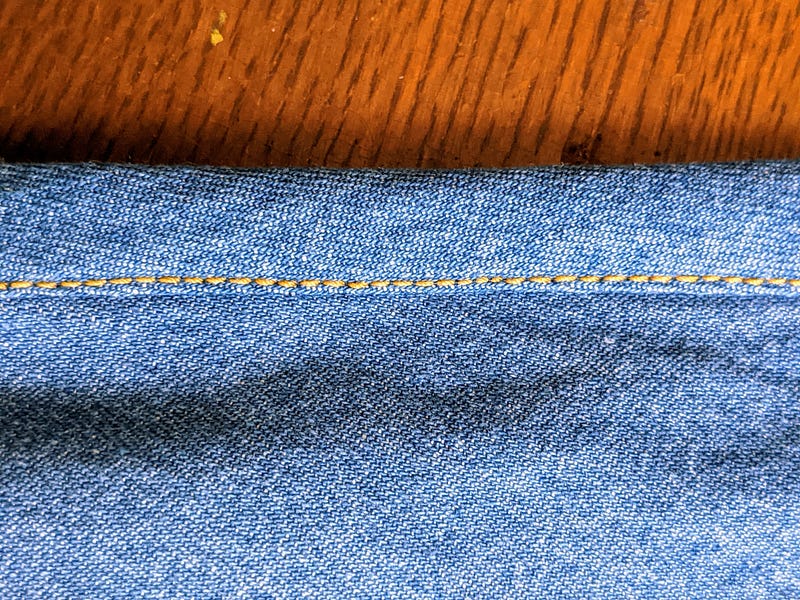
I saw the mistake. I measured it. Then, I did one of the hardest things a slightly neurotic perfectionist can do. I let it go and kept sewing.
Now, perfectionism does not have an off switch. For me, managing it is a learned behavior involving measurable goals and deadlines. It means learning how to say “good enough” and knowing when to say it. Some days, this is easier than others.
My stitches swerved off the line a week before my self-imposed deadline. This time constraint made accepting reality easier.
Yes, the topstitching looks a little snakelike on the left inner thigh. If anyone other than me notices it, they’re liable to end up with a concussion because their nose must be somewhere inappropriate. I called it “good enough” and finished the jeans in time for Mother’s Day.
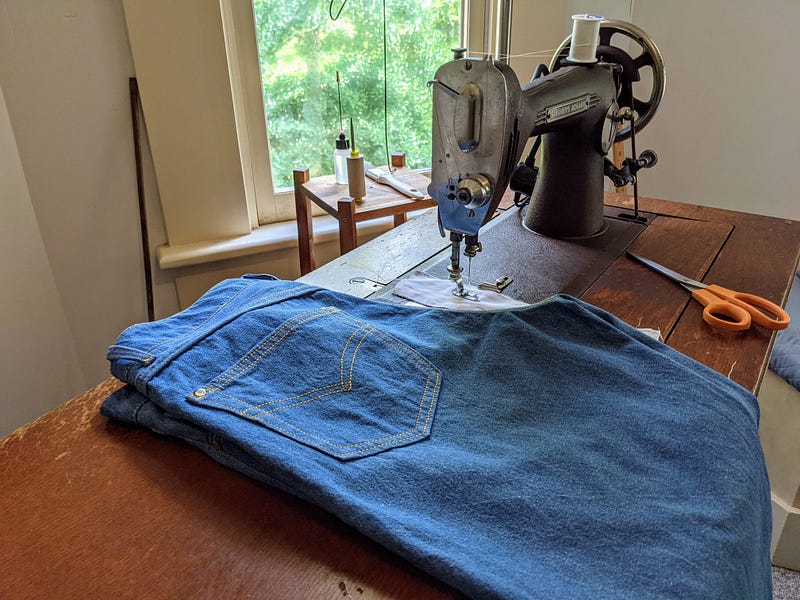
The jeans aren’t perfect, but they ticked all of Momma’s wearable jean boxes. They also fit better than the ones from the store. She wears them often.
My fingers still itch for a seam ripper every time I see them. That seam is evidence that, despite laying out the stitch line with a ruler and staring at the needle until my eyes crossed, perfection was unachievable.
Maybe someday, I’ll be okay with that.


