
What Science Tells Us About How To Have The Right Amount Of Confidence
And why you may not want too much belief in yourself

How confident are you that you could solve this equation?
(x^2+1) = 13
In theory, your confidence level should correlate with your ability.
People who know how to solve it should feel pretty good, and people who don’t should feel doubt.
Simple, right?
But that’s not how our weird brains actually work.
Overconfidence is Everywhere
Here are some stats I learned working in behavioural science:
- More than 50% of people think they’re above average drivers.
- More than 80% of entrepreneurs think they have a high chance of success (even though building a business is brutally tough).
- 93% of students think they have above average inter-personal skills.
The list of bravado goes on and on.
Confidence Doesn’t Come When It Should
Our unjustified self-assurance is well-documented in psychology (sometimes called the “overconfidence effect”).
But confidence is nuanced.
It’s not that we’re always overconfident.
It’s that confidence comes when it shouldn’t. Here’s a graph showing how it rises and falls with our actual abilities.
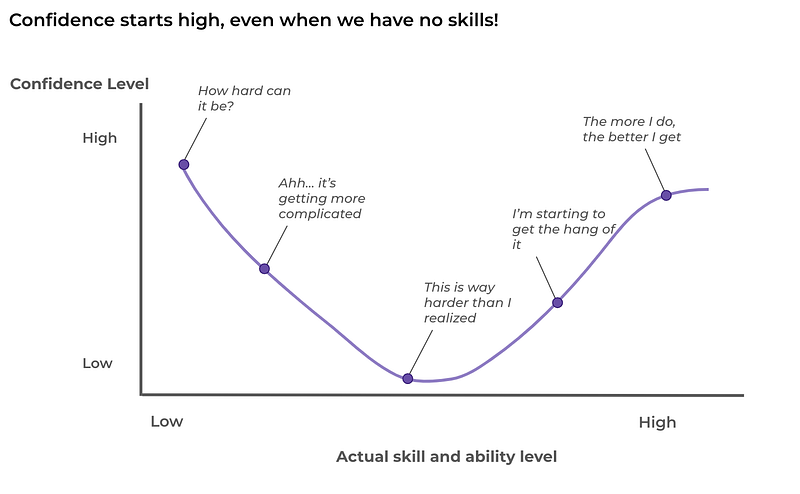
When we have zero skills, we’re bizarrely very confident. But our confidence rightly goes down as we realize how difficult developing a new skill really is.
Only later, when we gain more expertise, does it start to rise again.
I told you, our brains are weird.
How Does Confidence Get Built?
Even though conviction doesn’t come naturally when it should, demonstrating it is important.
When an employer doesn’t know how skilled we are, they unconsciously take our self-belief as a proxy (despite its flaws).
So how does confidence come to be? And are there ways to train confidence in ourselves?
Indeed, there are.
A recent scientific study[1] tested how confidence is built and what factors control it.
The Two Factors that Determine Confidence
In the experiments, students played simple games — select which side of the computer has more dots? Are there more X’s or O’s on the screen? Are there more blue dots or red?
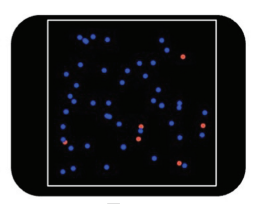
They started with some practice.
During practice, the students got feedback. The thing is, the feedback was rigged. The students were lied to, and were told they were doing really well, average, or badly compared to other people who played the game.
That rigged feedback was designed to influence their confidence levels.
The scientists also changed was how hard the game was. Sometimes it was super easy (see the image above). Other times, there would be almost an equal number of blue and red dots, so it would be really hard.
After each decision, the students had to indicate how confident they were in their decision.
Positive Feedback and Easy Games Lead to High Confidence
The authors found that they could successfully manipulate the students’ confidence.
Regardless of how well students played the game, when they were given fake positive feedback, the students later felt more confident when they played the actual game.
That means that giving someone insincere feedback that they’re doing really well, even when they’re not, boosts their ego later when they’re doing the task again.
In a similar vein, when they were playing easy versions of the game, they also felt more confident.
That makes sense. We all feel pretty positive that we can answer 2+2, but less confident we can solve a quadratic equation.
But here’s the most interesting thing:
Confidence was impacted more by feedback and by difficulty level than by the students’ actual task performance.
What This Means for You: Judging Your Own Confidence
This means, once again, when we’re terrible at a skill, we may still feel highly confident in our abilities.
This isn’t great for our image or self-development.
You don’t want to be the worst basketball player among your friends, bragging about how you’re the best. Your friends will think your full of it, and worse, you won’t push yourself to grow.
What’s influencing our confidence is:
- What other people tell us about our performance
- How easy or hard the tasks are
While we can control how easy or hard tasks are, we can’t control the feedback we receive.
Find Objective Feedback
Feedback is critical. Without it, we really don’t know how skilled we are at something.
Unfortunately, most skills don’t have “score boards.”
Athletes can count their goals and assists. Mathematicians can count the number of equations they solve.
But what makes a good marketer, a good writer, or a good designer?
Usually we have to wait for data from customers or users to tell us how skilled we are, and prior to that, feedback is slim.
People will undoubtedly give you their thoughts. Remember this study when you hear it: Be very careful who you listen to.
If you let them have too much say, they can lead you to be more self-assured than you should be. Or vice versa.
Trust the real data and track numbers.
Those won’t lie to you.
(Unless you’re in an experiment!)
Hi! I’m Celia👋 I appreciate you reading this post! If you’d like to read more about writing, psychology, and productivity, give me a follow.
[1] Van Marcke, H., Denmat, P. L., Verguts, T., & Desender, K. (2022). Manipulating prior beliefs causally induces under-and overconfidence. Psychological Science, 09567976241231572.


