
What Science Can Teach Us About Writing?
One of the subjects that are most written about is on writing itself, a lot of articles with personal tips from veterans on how to have success here on Medium, there're others who write about writing tips from successful writers, me included, I wrote an article about how Stephen King changed my life, after reading a lot of these articles (I do mean a lot), one thing kept recurring at me, as a fan of science and believe that at this moment I may call myself a scientist as well, what science has to say about writing? Well, there’s one thing or another…

Problems with erudite vernacular
In 2005, Daniel M. Oppenheimer, a psychologist and professor at Princeton, published a study “Consequences of the erudite vernacular regardless of need: Problems using long words without need”. It is an empirical study on the respect to the problem of searching complex and unusual words for intelligent opinions. In the study that can be found here, he conducted five different experiments to show why people are not supposed to look for bigger and fancy words, I’ll detail one of them that I found the most exciting one.
“Vigorous writing is concise. A sentence should contain no unnecessary words, a paragraph no unnecessary sentences, for the same reason that a drawing should have no unnecessary lines and a machine no unnecessary parts. This requires not that the writer make all his sentences short, or that he avoid all detail and treat his subjects only in outline, but that he make every word tell”
William Strunk Jr in “The Elements of Style”
The experiment
The Descartes experiment, that is not the name of it, it is just how I called it, thirty-nine Stanford University undergraduates participated the experiment, they were divided in two groups and each group received a translation of the first paragraph of Rene Descartes Meditation IV, one of them received the Heffernan’s (1990) 98-word translation and the other received Tweyman’s (1993) 82-word version, the Heffernan’s version was judged by two independent raters to be considerably more complex than Tweyman’s.
Half of each group were told that the paragraph that they were reading was from Descartes, the other half was told that it was from an anonymous author, after read it, they were told to evaluate on a scale of 1 to 7, the intelligence of the author and how difficult was to understand the message on the paragraph. Those are the results.
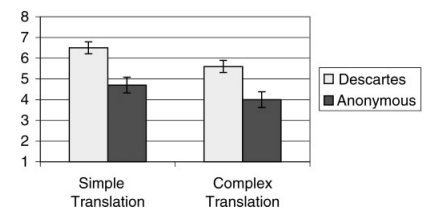
That image shows both groups and it is possible to see that the group who read the complex translation, with more and longer words, judged the author less intelligent than the group who’ve read the simpler version. That is only one of the five experiments that is present on his article, Oppenheimer won the igNobel (not the Nobel) prize for his work, showing that clarity, simplicity and parsimony are ideals that authors should strive for.
The Elements of Style
I believe that everyone that are here on Medium writing, knows about this book, “The Elements of Style”, from 1920, is one if not the most important book of writing that was ever written, by Strunk and White. Strunk was english professor at Cornell University, the book is about style guides and elementary principles of composition on writing in english.
It is funny, because the authors make recommendations like “Make every word tell”, some of its principles are “Omit needless words” and “Don’t be redundant or repetitive”, exact the same as the result of Oppenheimer’s experiments, i.e. science converges when the issue is writing. I believe that one of the good things of not writing on our native language, is that we avoid specially “dressing up” our texts with fancy and long words without the necessity.
Although it has some of scientific evidence, it is not easy to find scientific articles on writing itself, scientific community is concerned to the scientific writing only, I spend hours on scientific database such as PubMed, Scielo and Google Scholar and the results were the same, how to write scientific articles. It is a pity, because writing has so many things to investigate, who knows, someday.
If you want to receive more content about science, like riddles and questions that humanity could answer yet, just click here and subscribe


