
Roadmaps for Design Systems
Communicate What You’ll Do Next That Teams Can Depend On
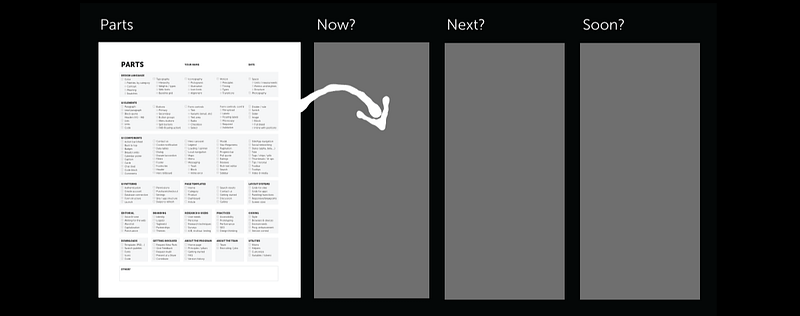
Whenever I chat with a new design system team, I ask:
So, what are you working on?
Some teams muster only an incoherent rambling of scattered tasks. Others confidently articulate discrete areas of focus, and when they plan to deliver each one. I view the latter — a team’s collective understanding that they are evolving a product with a roadmap — as a signal that that the system is operating well.
A Roadmap Reveals a System’s Direction
A design system’s roadmap need not be exhaustive. Most I’ve seen depict nothing more than what’s going on now, next and sometime in the near future across their increments of work, whether a two-week sprint or month-by-month delivery.
A roadmap enables a design system team to convey:
- commitment to delivering value, justifying their well-defined funding
- transparent priorities, especially critical when serving products and platforms with divergent interests
- reliable cadence that customers depend on
Roadmaps Signal Releases That Set Product Team Expectations
Roadmaps highlight the most important elements of each release, charting the system’s direction without drowning in detail. Organizing that simple story into a a milestone based, columnar roadmap format works wonders.
If a system is just getting started, a roadmap may be limited to fundamentals like visual style (like color and typography), key UI components (like buttons & forms), and parts needed to assemble common displays (like getting started and a layout/grid system).
In fact, getting all those aspirational parts on stickies _and then_ arranging those stickies in a columnar roadmap format is a great exercise to center a team’s purpose early on.
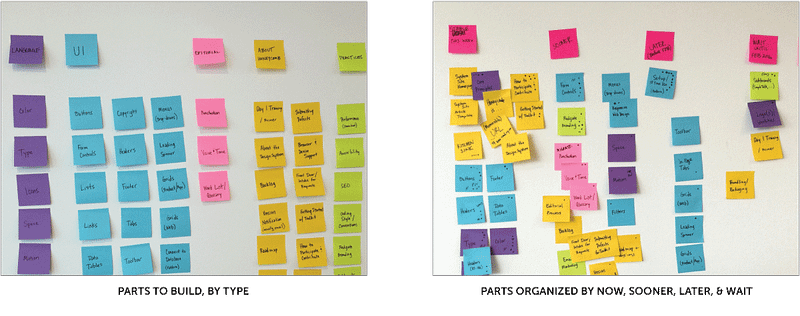
Once a design system is smoothly operating across releases, roadmaps tend to reveal, in priority order:
- New sections and broad topics first, like expansions into branding, editorial guidance, a new platform (like Android), or practice like SEO
- New, important parts, like a modal component, editorial word list, or system onboarding training for new hires
- Very important enhancements & extensions to existing parts, like adding tertiary button variation or more responsive layout variations
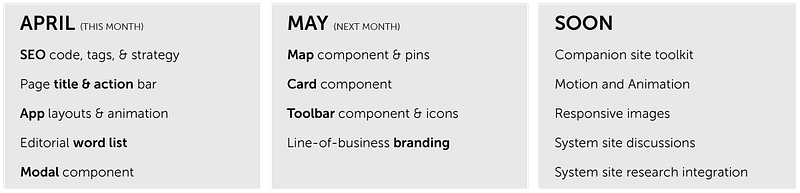
Leave out the detail. Less relevant parts and a long tail of fixes and burgeoning documentation drown a roadmap, robbing it of its simple and focused appeal.
Roadmaps Expose What a System Values
Roadmaps also expose what a system team — and by extension, an enterprise — values at any given time. Our system roadmap across years of a responsive redesign always seemed to position responsive images in the third, “coming soon” column. During every monthly (sprint) planning meeting, we’d try to nudge it into next.
But there was no organization traction, and thus no will on the system team to drive an initiative that they didn’t own. Responsive images stayed on the far right month after month after month, until one of us had the guts to finally remove it until products got their act together. The roadmap worked well: the system’s priorities aligned with the portfolio it served.
Does Your System Have a Roadmap?
Your team need not display a glossy roadmap visualization on your homepage or rendered dynamically from a Jira backlog (although, either would be awesome).
Just ensure your team can tell a consistent, confident story of “We are working on [this] now, [that] next, and the [other thing] sometime soon…”
If you get your story straight and you deliver releases predictably consistent with that story, teams will value and depend on you.


