
What riding an overcrowded train has to do with success
Or how to improve your chances of getting a seat
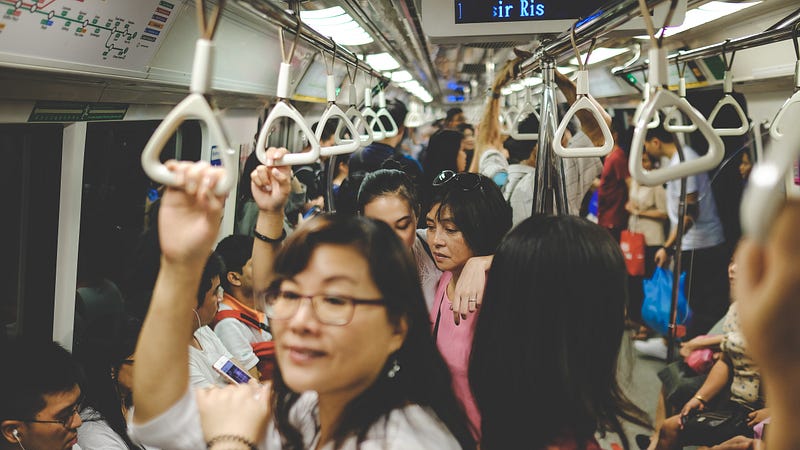
When I arrived at the station today, I thought, “What the hell’s going on?
The platform was clogged with crowds and the train I wanted to take was not there yet.
Moments later, an announcement was heard over loudspeakers: Due to a broken train, delays and irregular departure times occurred on all lines.
So that was the explanation.
Fortunately I still had time, until my appointment, to which I wanted to travel with this train. If it is possible, I always take a train earlier.
I looked around and realized that it would be difficult to get a seat, because all the people who were waiting with me for the train wanted to sit as well.
I ride this train very often and now I know where the doors are when the train has stopped. Many of the other passengers know that too, but by no means all of them.
In order to improve my chances of getting a seat, I waited at a spot where I knew there would be a door when the train stopped.
What I still didn’t know was when the train would come.
But all the other passengers didn’t know that either.
Using the available information
I thought about what my situation was like: No one knew when the train would arrive, some knew where the doors would be when the train arrived, and everyone wanted a seat.
I had an advantage over everyone who didn’t know where the doors would be, but there were still too many passengers who knew.
These knowledgeable people would compete with me for the place on the platform from which to board the train directly and without waiting.
But when I looked around, I noticed that most of the waiting people were still far away from the track. Apparently they wanted to wait until the train really showed up. That was my chance.
I immediately stood at the spot where a train door would later be and waited. I didn’t know whether the train would arrive in two minutes or in twenty, but I was willing to stay there until that point. The reward for my patience would be a seat.
So my chances were the best of all waiting people. Of course there are many places on the platform where more train doors would open, but I don’t know them all.
In fact, I only know two such places on the platform well enough to find them reliably. As I looked left and right, I saw more passengers who, like me, were already standing close to the tracks and waiting.
Surely they knew other promising places than me. If I had tried to compete with them, I would have had bad chances, because these regions of the platform are outside my area of competence.
But in my place I was the only one on time.
Long before the train finally arrived, it was possible to predict precisely who would.get a seat and who would not.
What does this have to do with success in general?
When I finally sat in the train, took my seat and looked at the passengers standing in the corridors, I had the realization that gave me the idea for this article.
I had a seat, because I
1. had certain key information (where do I have to be at the platform)
2. I had positioned myself in time
3. I have remained in my field of competence (in the area of the platform that I knew well)
These three can be applied to all cases in which one is in competition with one another. All three are important and interdependent.
Conclusion
Everyday situations can teach us a lot about the nature and rules of success and failure.
Whether we’re standing at a crowded station or in a supermarket deciding where to queue — if we ask the right questions about the situation, almost everything can reveal the basic principles of success and failure.
Next time you leave the house, walk the world with open eyes and look for situations that tell you something about the nature of man and the principles of success and failure.
do you want more of this?
Receive weekly email and don’t miss any of my articles.
suscribe here http://bit.ly/ReneJunge