
The 1000 Books Before 5 Years Challenge
What I learned and strategies that you can adopt to revolutionize your child’s life

Humble Beginnings Are Powerful
“Pressure is what turns a lump of coal into a diamond!”
- Anonymous
My journey of reading to my son did not begin with a plan of reaching 1000 books before he turned 5. It began with post-partum depression.
Battling thoughts of depression around three months after my son was born, I set out for a walk and decided to go into a nearby Barnes & Noble store. And for the first time in my adult life, I walked over to the Children’s section.
I picked up three books — ‘Good Night Moon,’ ‘The Big Red Tractor’ & ‘There Was An Old Lady Who Swallowed A Bell’ and walked back home.
Little did I know that I had unknowingly taken the first steps that would impact my life hugely and, more importantly, my son’s life.
We had a lot of family over to meet our son, and I remember it being a joke when I walked in with the books because he was just a 3-month-old then.
I began reading to him that day, and almost five years later, I do continue reading to him almost every day!
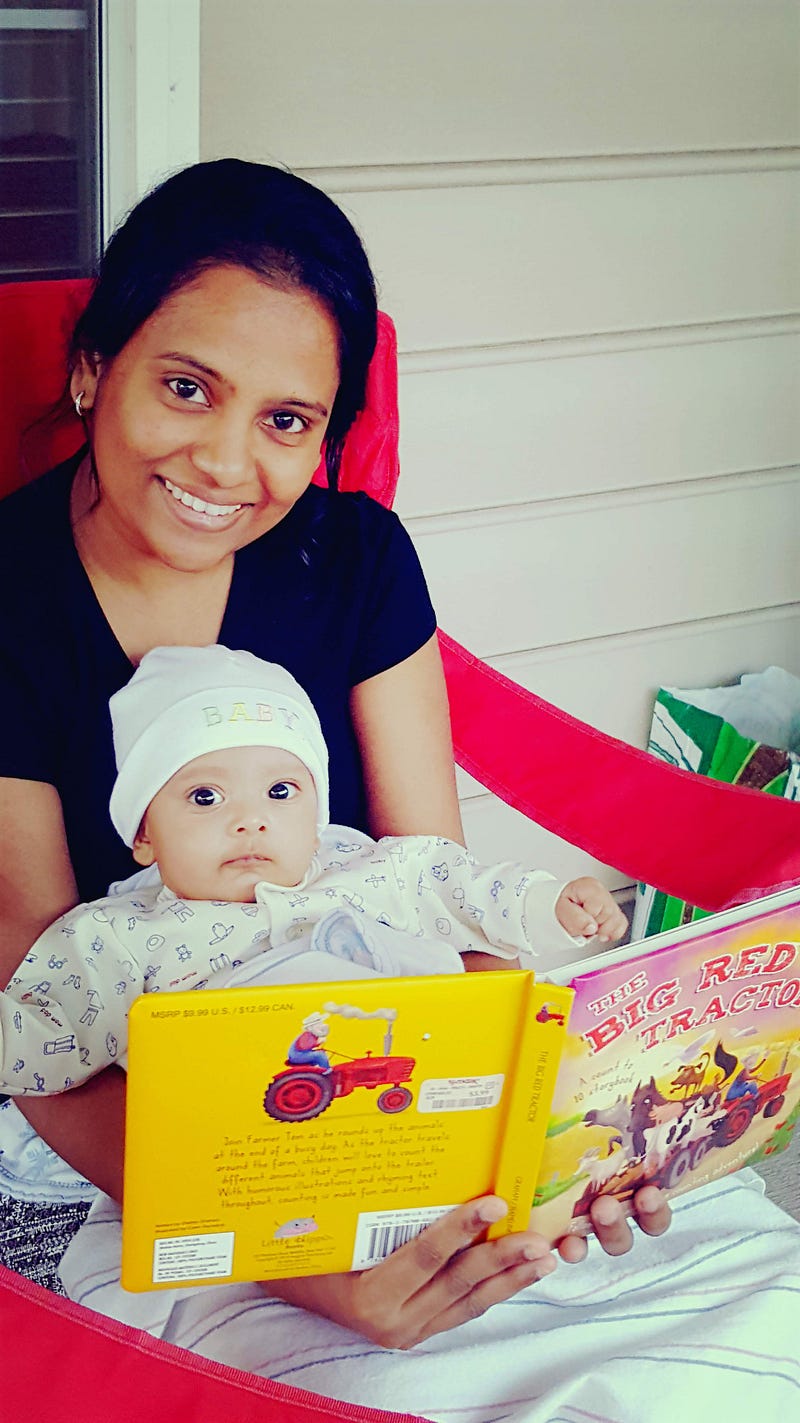
Eventually, after months of reading, I began to see how my son took to liking the time we read together. He was full of joy and also prompted me in his cute baby ways to read, read, read! By the way, that’s his dialogue even today when I get distracted— “Read, Mom, Read!”
I did not begin recording the books and setting targets until much later. A friend told me about our library’s 1000 Books Before Kindergarten program.
Initially, it seemed very daunting, and I was curious if I could follow through with it.
So, I set small targets for myself and decided that if I met a particular target, only then would I set my next target for a higher number of books. I set up a simple formula in an Excel Sheet and began recording the books.
Setting Small Goals to Achieve The Impossible
“Most “impossible” goals can be met simply by breaking them down into bite-size chunks, writing them down, believing them, and then going full speed ahead as if they were routine.”
— Don Lancaster
This was a crucial step in my success in completing the daunting task of reading a thousand books.
If you view the final number ‘1000’, it might seem impossible. But if you set smaller strategic goals leading up to the 1000 mark, it will seem achievable and easy to track and maintain.
I have demonstrated some of my goals of the number of books with their respective dates or milestones attached to each one of them as an example of the process I followed successfully.
“All who have accomplished great things have had a great aim, have fixed their gaze on a goal which was high, one which sometimes seemed impossible.”
— Orison Swett Marden
Here’s the first target I set for myself —
Book Count: 300

Ideas of books for this stage —
- Pop-up Peekaboo Books
- Hello World! Books
- The Very Hungry Caterpillar
- Freight Train
- Dear Zoo
Even then, I did not take this reading practice that seriously until after a couple of the periodic doctor’s visits with our son. His spoken word scores and general cognition were consistently above the required scores. That is when I began to search if there was some correlation between reading, speech development, and cognition.
Somewhere around this time, I stumbled upon this golden nugget of information about the importance of 0–3 Years in the development of the baby’s brain. My search led me to the awareness of Neurological studies and the evidence of the importance of Early Learning in brain development.
Critical Importance of Starting Early (Infancy)
The Neurology research about the brain development process dumbfounded me, and I have consistently spoken about it with most parents that I have met thereafter.
See this snippet from the book How to Build Your Baby’s Brain by Gail Gross —
“Your baby is born with approximately 100 billion neurons and over 50 trillion synapses. This may seem like a lot, but it’s only a fraction of the neural connections that she will develop — more than 1,000 trillion in the first year alone.
Out of your baby’s 24,000 genes, 12,000 of them establish these neural connections in the brain, which designate how the central nervous system will be created and function. However, those 12,000 genes aren’t nearly enough to activate all those neural connections.
Therefore, it is your baby’s heightened experiences, both emotional and physical, that specify and determine those connections. Because the brain is highly efficient, it actually dumps unused neurons while strengthening those used consistently. This process, called synaptic pruning, allows your child’s brain to develop correctly.
Stimulation enhances connections, and pruning discards what is not being used. Synaptic pruning extends over your lifetime, but it is most active during early childhood.
Synaptic pruning means that every experience counts.
Every touch, sight, smell, and interaction positively or negatively affects the wiring of your child’s brain — each experience, whether positive or negative, is a signal that strengthens, weakens, or reinforces synapses.
Think of it as two roads diverging in a yellow wood — except your child’s brain will always take the road most traveled.”
Heart of the matter — how does “Reading Aloud” relate to this?
As simple as the act of reading to your child might seem, it is a powerhouse of stimulation for your child’s brain that will affect his intelligence and learning abilities in the future.
Here’s another snippet from the same book that clarifies this point —
“Acts of love like cuddling, soothing your child with your voice, responding to her needs, and reading a book may sound simple, but they are the stimulation your baby’s developing brain needs and build upon more effectively.
The more you interact with and stimulate your baby, the more you increase his neurological cells. That increase in cells also leads to an increase in activity, and it’s easy to see how that promotes faster and more complicated patterns of thought.
You’re building the highways and infrastructure for high-traffic learning later.”
To demonstrate a baby’s response to reading, here’s a video of me reading to my 6-month-old.
His joy and engagement in the activity speak volumes of how valuable this time was.
Now, I was in full swing in the process of reading.
Here’s a snapshot of what my next goal looked like —
Book Count: 400
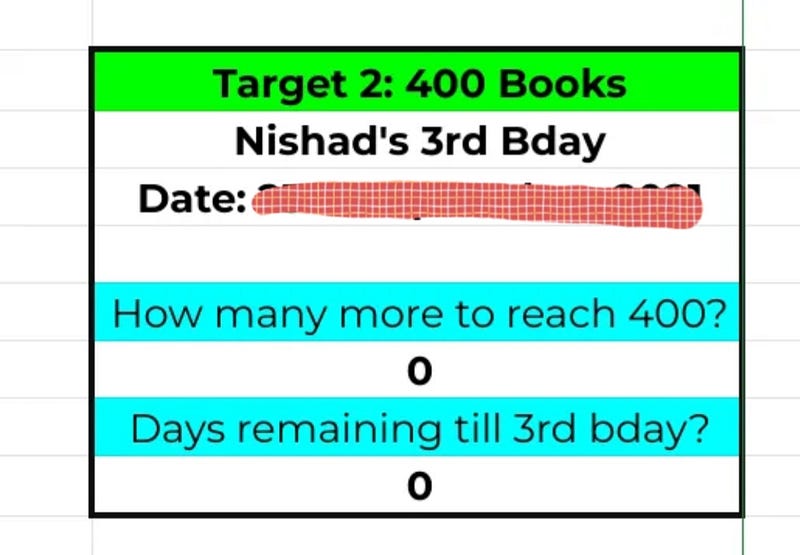
Ideas of books for this stage —
- Pete The Cat Books
- Little Blue Truck Books
- The Ultimate Book Set (pop-up book)
- Click Clack Moo
- Grumpy Monkey
- First Little Readers (Scholastic) {Each set includes 20–25 little books}
Was it easy to do all of this regularly and consistently?
No!
Then, what was the motivation for me to keep going on consistently?
Read on to find out…
Parenting: A Labor of Love!
As parents, we’re always seeking ways to help our children become the best versions of themselves and succeed in what they do.
Parenting is a very practical job; it is an arduous labor of love.
You must constantly watch, guide, and correct the day-to-day behaviors and actions. At the same time, you need to have a future vision for your child. This vision needs certain actions to be taken in the present and day-to-day.
Say, for example, you envision your child playing state or national-level tennis (or any other sport) in his teens. When do you think you need to start if he has to be successful? Some may say at least as early as four or five years of age.
The same goes for if you want your child to play a musical instrument well. Many successful artists start their learning with humble beginnings, at home when they are only toddlers - listening, watching, and assimilating information from their parents even before any formal lessons begin.
Parents may choose not to take a path like this and let the children decide for themselves what they want to do when they’re older. They may not want to be tennis players or musicians.
Sure!
They may choose to take a different path. But what if they love what they’re doing and decide to continue? They’ll certainly have the highest advantage because of all the hours of practice accumulated over the years, having started really young. Remember the 10,000-hour rule?
Malcolm Gladwell, in his book Outliers, talks about some phenomenal people who have achieved a level of greatness in their fields. His book mentions something common that he found among these greats. That was the number of hours they had practiced — you guessed it — 10,000 hours! Here are a couple of quotes from the book —
“In fact, by the age of twenty, the elite performers (violinists) had each totaled ten thousand hours of practice.”
“The emerging picture from such studies is that ten thousand hours of practice is required to achieve the level of mastery associated with being a world-class expert — in anything,” writes the neurologist Daniel Levitin.
“To become a chess grandmaster also seems to take about ten years. (Only the legendary Bobby Fisher got to that elite level in less than that amount of time: it took him nine years.) And what’s ten years? Well, it’s roughly how long it takes to put in ten thousand hours of hard practice. Ten thousand hours is the magic number of greatness.”
Now, unlike specific niches like sports or arts, reading to your children will develop skills that will give them unimaginable advantages no matter where they would like to go in life, really, ‘no matter where.’ It is the basis that can help them succeed in all other areas of their lives.
As a parent, if you want to do one thing that can maximize your impact on your child’s life to help them reach their potential, then this is what you need!
Reading to children is a parenting superpower that many parents tend to ignore despite being a timeless and proven way for the child to succeed in life.
Discovering The Superpower of Parenting!
Gail Gross, a human behavior expert, family and child development specialist with a Ph.D. in psychology and an EdD in education, and the author of How to Build your Baby’s Brain, is often asked how parents can awaken their child’s potential.
Here’s her powerful answer that is bound to inspire you —
“Parents have the power.
You are not merely a factor; you are the single greatest determinant of your child’s personality, intellect, and future.
Your power extends way beyond providing a boost in potential or a push to succeed; you, as a parent, are capable of shaping and are, to a great degree, responsible for the very structure of your child’s brain.
As a parent, you have the ultimate responsibility for the trajectory your child takes in life.
The good news is that you have everything you need to give your baby what she needs.”
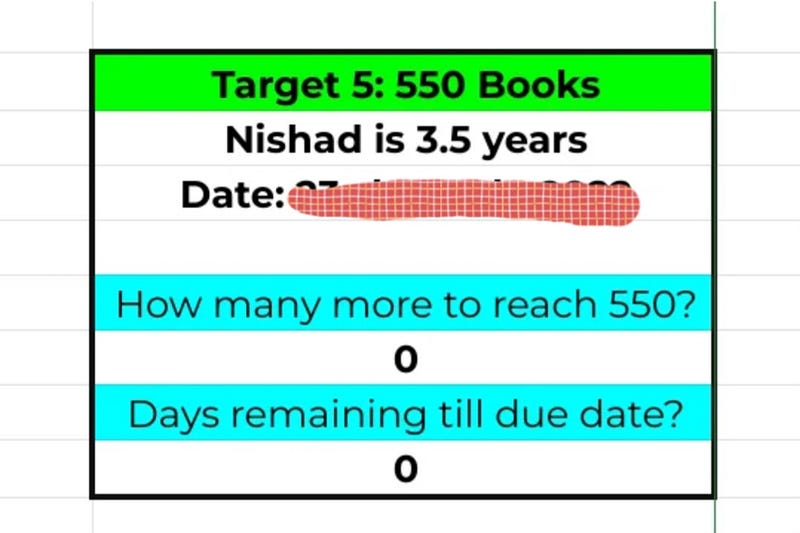
On this note, I want to share the next pit stop on my journey. I have used a very easy tool here, just an Excel sheet. Of course, there are better tools available, like Beanstack, etc., if you have the time and resources for them. This is just a very basic step to get started.
Here’s the reading snapshot taken six months later —
Book Count: 550
Ideas of books for this stage —
- Daniel Tiger 5-minute-stories
- Sesame Street 5-minute-stories
- Little Critter 5 -minute-stories
- Ninjago Series
- The Whale Tale
- Bunny Book Series (Richard Scarry)
I would like to add more evidence and talk more about the importance of reading aloud specifically.
A 1985 research report ‘Becoming a Nation of Readers’, funded by the U.S. Department of Education, concluded the following —
The single most important activity for building the knowledge required for eventual success in reading is reading aloud to children.
“A nation that does not read much does not know much. And a nation that does not know much is more likely to make poor choices in the home, the marketplace, the jury box, and the voting booth. And those decisions ultimately affect the entire nation...the literate and illiterate.”
― Jim Trelease
The book The Read-Aloud Handbook by Jim Trelease mentions a two-part formula for making children better readers —
1. “The more you read, the better you get at it; the better you get at it, the more you like it; and the more you like it, the more you do it.
2. The more you read, the more you know; and the more you know, the smarter you grow.”
This book also mentions why reading aloud is so effective:
“We read to children for all the same reasons we talk with children: to reassure, to entertain, to bond; to inform or explain, to arouse curiosity, to inspire. But in reading aloud, we also:
1. Condition the child’s brain to associate reading with pleasure 2. Create background knowledge 3. Build vocabulary 4. Provide a reading role model”
We will delve deeper with details into the importance of these four points.
1. Associating Reading With Pleasure
Jim Trelease also talks about two facts about reading aloud to help create lifetime readers -
Reading Fact No. 1: Human beings are pleasure-centered
The book draws our attention to the fact that we approach the things that give us pleasure and withdraw from the things that cause ‘unpleasure’ or pain. It also goes on to explain that pleasure is the glue that holds our attention to the things we like.
For example, as long as we’re enjoying a movie, we’re connected. When we stop enjoying it, we disconnect. And this applies to all the things that we do willingly. Thus, according to the book, every time we read to a child, we send a “pleasure” message (glue) to the child’s brain, which conditions the child to associate books and print with pleasure.
We may ask why the child needs to find pleasure in reading. Can he not read the textbooks and be done with it without having fun, etc.?
The answer would be that if they are just taught to read the textbooks and required reading, then they may get how to read and comprehend, but they will not want to read or will not have a longing and a desire to read, not only in their academic life but even as adults; the love for reading will fail to germinate and take root.
Reading Fact No. 2: Reading is an accrued skill
The Read-Aloud Handbook explains that —
“Reading is like riding a bicycle, driving a car, or sewing: in order to get better at it, you must do it. And the more you read, the better you get at it.
Students who read the most, read the best, achieve the most, and stay in school the longest.”
This can apply to adults as well. If we want to build the habit of becoming better readers, we need more practice. But what is so advantageous with little minds is that they are more malleable than adults.
“Men, are cast iron; but children are wax.”
— Horace Mann
And they can learn skills quickly when taught well.
Reading to your child is an Expression of Love
In Gary Chapman & Ross Campbell’s book, The Five Love Languages of Children, they talk about the primary love language, a way in which a child understands a parent’s love best.
They believe there is a primary way out of the five ways in which they recognize a parent’s love, but the child basically benefits from all five ways of receiving love.
The reason why this is important, according to them, is that the child needs to know that he or she is loved in order for them to grow into a giving, loving, responsible adult.
The reason that I am bringing this up here is that if you dive deeper into the five ways which I have mentioned below, you will see that reading aloud to your child hits the spot in almost 3-4 out of the five ways - which makes it a mind-blowingly easy choice in creating a deeper and loving parent-child bond.
This helps the child associate ‘Reading’ with being a pleasurable activity.
Here are the five love languages as mentioned in the book:
- Quality time
- Words of affirmation
- Physical touch
- Acts of service
- Receiving gifts
When you read with your child, you are evidently spending time with them, and that is very valuable to your child. He has your complete attention, which is all he craves in the tender years. So that’s the quality time.
Next, in the early years right up to preschool or so, a child is usually propped onto the lap of a parent or grandparent, which is not just a precious sight to behold, but it also hits the spot with another important and affirming love language: physical touch.
As for acts of service, we know that reading to a child may not always be pleasurable for a parent. It is a labor of love and an act of service to show our children that we care and love them enough to take the time and energy to give them joy.
Now, when your child is a reader and likes books, every book you give them as a gift is going to make them feel loved and cared for.
And so we can see that reading to children is a mighty powerful tool for two reasons - associating reading with pleasure and creating a deep bond of love between a parent and a child. This can help the child to effortlessly and easily transition into a good lifetime reader and learner.
I was now determined and set to help my son become a lifetime reader.
The complexities of the books we read now increased immensely from when we started.
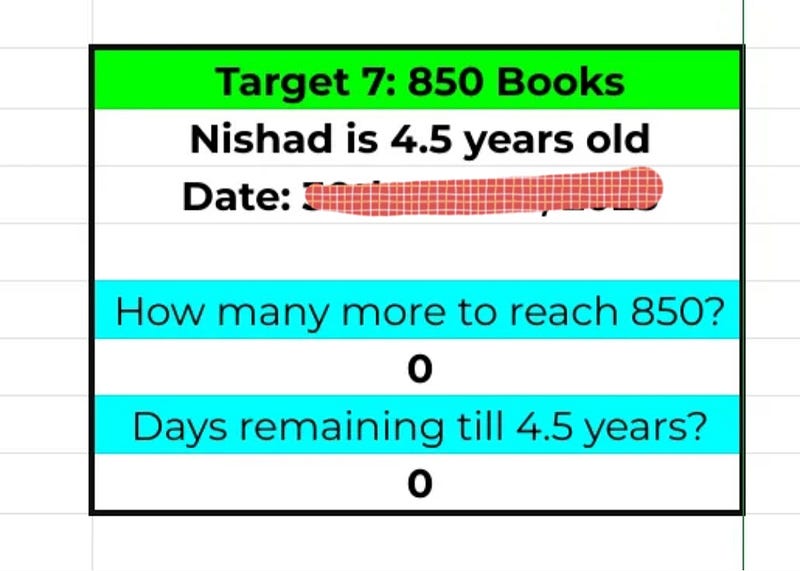
A lot of non-fiction was a part of the repertoire. And we were now only 150 books short of the target!
Here was my target one year later —
Book Count: 850
Ideas of books for this stage —
- The Boxcar Children Series
- Heidi
- Curious George Series
- Leveled Reader Books (Fiction & Non-fiction)
- The Magic School Bus
- Black Holes
2. The Importance of Background Knowledge
Here’s another snippet from The Read-Aloud Handbook that exemplifies the importance of background knowledge —
“Background knowledge is one reason why children who read the most (or those who travel the most) bring the largest amount of information to the table and thus understand more of what the teacher or the textbook is teaching.
Thus, children whose families bring them to museums and zoos, who visit historic sites, who travel abroad or camp in remote areas accumulate huge chunks of background knowledge without even studying. The less you know about a subject, the more difficult the reading becomes.”
Another important point the book mentions is that the frequency with which a child has met a word will affect how quickly he can decode and understand it.
In my experience, the combination of the two points above plays a huge role in a child’s learning. They are easily able to pile on and grasp information if they already know something about the subject. It becomes easier to relate and map the new information.
For instance, when you talk to my son about outer space, Star Wars, or some other topic of his interest, you do not have to explain much; just throw a fact or mention some point, and he meets you right there.
The love for the subject, coupled with the background information and frequency with which he has read about those topics, makes assimilating new information a piece of cake.
If you think about this, it can be a huge advantage in later learning for academic or professional purposes. This model will extrapolate, and newer and more varying and complex subjects will keep adding to the repertoire of the child as he progresses and as you read more and varied subjects to him.
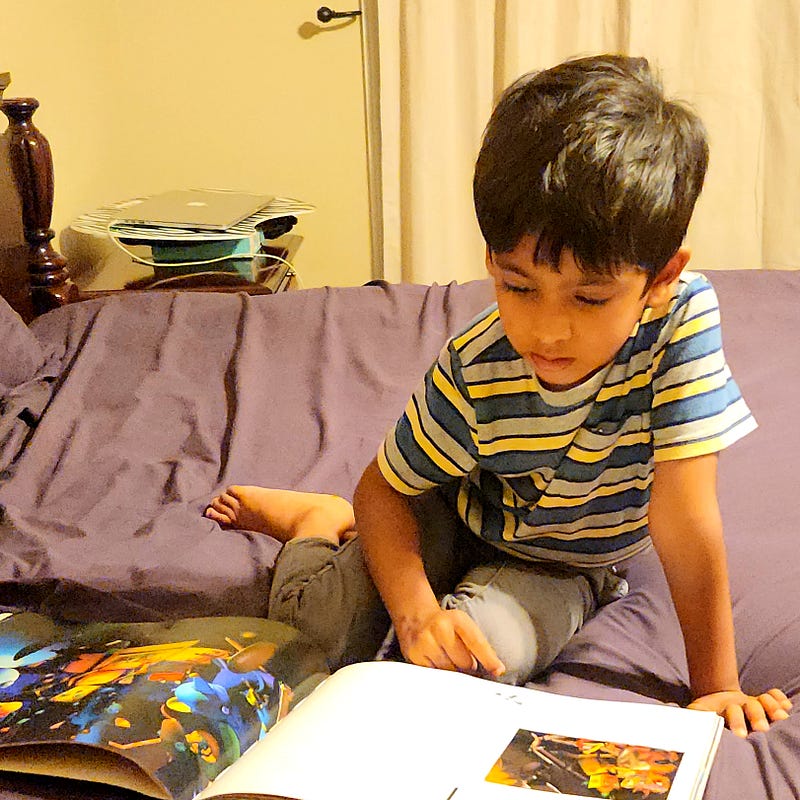
Here’s a video of Nishad reading two books — a Batman Adventures book and a book called After the Dinosaurs. He began reading when he was 3. At 4.5 years, he has achieved good speed and comprehension for his age.
The complex words and speed he could achieve were possible largely due to the daily reading and, more importantly, the love of reading that was inculcated in him.
3. Power of a Rich Vocabulary
This quote from The Read-Aloud Handbook makes a very important statement that should be noted by parents and teachers -
“There is one skill that matters above all others because it is the prime predictor of school success or failure: the child’s vocabulary upon entering school. Yes, the child goes to school to learn new words, but the words he or she already knows determine how much of what the teacher says will be understood.
And since most instruction for the first four years of school is oral, the child who already has the largest vocabulary will understand the most, while the child with the smallest vocabulary grasps the least.”
Thus, if the child has a good vocabulary coming in, his comprehension will be better and enhanced, but if the vocabulary is small, then the comprehension will be hampered.
Another important point to mention when it comes to vocabulary is how a child’s listening vocabulary affects his reading vocabulary.
Let’s first see the difference between the two -
The listening vocabulary is the words that we need to know to understand what we hear.
The reading vocabulary is the words we need to know to decipher what we are reading and to understand them.
Along similar lines, we also have speaking and writing vocabularies.
Reading aloud to a child strengthens and enlarges his listening vocabulary.
This makes way for better reading, writing, and speaking vocabularies.
Jim Trelease puts it beautifully by saying - “The listening vocabulary is the reservoir of words that feeds the speaking vocabulary, the reading vocabulary, and the writing vocabulary– all at the same time.”
He also gives this self-explanatory example -
Consider, for example, the word “enormous.” If a child has never heard the word “enormous,” he’s unlikely ever to say the word. And if he’s neither heard it nor said it, imagine the difficulty when it’s time to read it and write it.
Here’s an interesting quote from Tom Parker (an admissions director) replying to parents who asked about improving their child’s SAT scores -
“The best SAT-preparation course in the world is to read to your children in bed while they're little. Eventually, if that's a wonderful experience for them, they'll start to read themselves.”
— Tom Parker
Parker, who interviewed some of America’s finest applicants, claimed he’d never met a student with high SAT scores who wasn’t a passionate reader. And the SAT-prep course can’t package that passion, but parents can!
This thought reinforces the importance of parents reading to their children and making it a positive experience for them, which snowballs into the child’s future success.
4. Being a Reading Role Model
The Read-Aloud handbook talks at length about the importance of reading role models and how reading aloud can model reading for the child so that he or she can follow in the footsteps of the parent.
Here’s a snippet explaining it -
Each time you read aloud to a child or a class, you offer yourself as a role model. One of the primary abilities of children is imitation. They imitate much of what they see and hear, and it is this ability that allows a fifteen-month-old child to say his first words.
By age two, the average child expands his vocabulary to include nearly three hundred words, and it triples again in the next year. By age four, the child already understands two-thirds to three-quarters of the words he will use in future daily life.
Once he learns to talk, he’ll average as many as ten new words a day– not one of which is on a flashcard. Much of that pace is determined, however, by the amount and richness of the language he hears from you and others around him.
“Neither books nor people have Velcro sides– we don’t naturally attach to each other. In the beginning, there must be a bonding agent– a parent, relative, neighbor, teacher, or librarian–someone who attaches the child to a book.” — Jim Trelease
I personally know how important a reading role model is. I adored my seventh-grade English teacher for her reading skills, diction, vocabulary, and pronunciation. I always wanted to be read like her.
Likewise, I have observed my son from when he was only three — how he tries to imitate every single new word or phrase I use. I try my best to make use of a very rich vocabulary in my conversation.
But the vocabulary he can gather with me reading aloud to him cannot be compared to the one he picked up with conversations alone.
More Reasons to Read…
Here are some evident differences that you can see in your child when you read to them regularly.
- Advanced Vocabulary
- Love for Books and Learning
- Confidence and Good Articulation in Expressing Thoughts and Ideas
- Clarity of Thought
- Faster Learners (as they understand the format of the printed word and its mechanics from a very early age)
- Ease of Communicating with Anyone (including adults and older kids)
- Move to More Complex Books Sooner, leading to Enhanced Learning
- Readiness and Ease of Grasping and Learning New Concepts
- Early Start to Reading Themselves
- Paves the Way for Academic Success
Meeting the Million-Word Gap
Here’s a Research Article put forth by the Ohio State University that stresses the importance of reading to kids.
According to the research, young children whose parents read them five books a day enter kindergarten having heard about 1.4 million more words than kids who were never read to.
Jessica Logan, lead author of the study and assistant professor of educational studies at Ohio State University, said that this “million-word gap” could be one key in explaining differences in vocabulary and reading development.
Based on the calculations from this study, here’s how many words kids would have heard by the time they were five years old:
- Never read to — 4,662 words
- 1–2 times per week — 63,570 words
- 3–5 times per week — 169,520 words
- Daily — 296,660 words
- Five books a day — 1,483,300 words
“The word gap of more than 1 million words between children raised in a literacy-rich environment and those who were never read to is striking.”
— Jessica Logan
Reading Aloud Should Have No Age Limit
Although the above study mentions only the ages of 0–5, the value of reading to kids even after this age range is immense. If your kids are in this range, and you are not reading to them, then of course, I would implore you to begin now, and even if your child is much older, get into the game.
As per research, the suggested age range to which you should read to your children is almost their early teens since their listening levels are still higher than their reading levels.
“As Jim Trelease, the author of The Read-Aloud Handbook, points out, a child’s reading level doesn’t typically catch up to his listening level until about the eighth grade.
An adult reading aloud does far more than impart a story, therefore: he or she also shows by tone of voice, phrasing, and pronunciation how complicated sentences can be tackled, subdued, and enjoyed. And while all that is happening, the child is soaking up fresh ideas and unfamiliar words.”
— Meghan Cox Gurdon (The Enchanted Hour)
Finally, here’s the snapshot of having completed our target —
Book Count: 1000
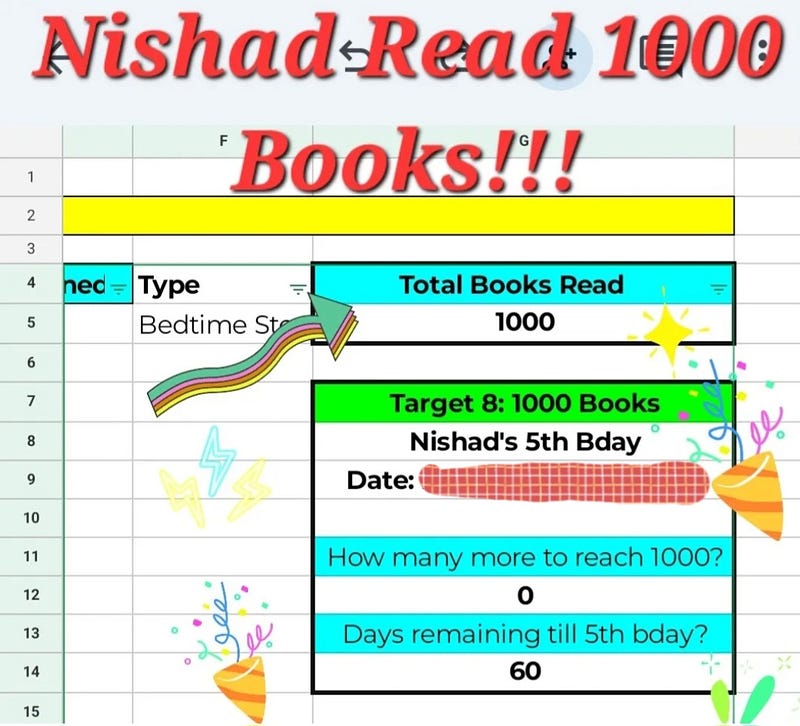
We completed a good two months before our target date.
And our reading journey continues…
I am even more excited about what we will achieve in the future!
Ideas of books for this stage —
- George Washington and the Cherry Tree
- The Polar Express
- The drinking gourd ( A story of the underground railroad)
- Ben Franklin and the Magic Squares (A Math Reader)
- Star Wars Series
- Nate the Great Series
- Wonder Woman Adventures
Conclusion
If you have reached the end of the article, then you have read through a lot of invaluable information about the importance of reading to your children and how you can have a lifelong impact on their lives for the better.
I hope you will consider this not just for yourselves but also to spread awareness to other new parents, friends, and neighbors whose children will benefit from this.
Maybe you might have neighbors or friends who are not as well-versed in English as you are. You could volunteer to read to their children, keeping in mind the impactful difference that it will make in their lives. Those children will be grateful to you for their entire lives.
I hope you spread the word and become an evangelist for Reading Aloud to children. And if each one does that, what a difference that will make!
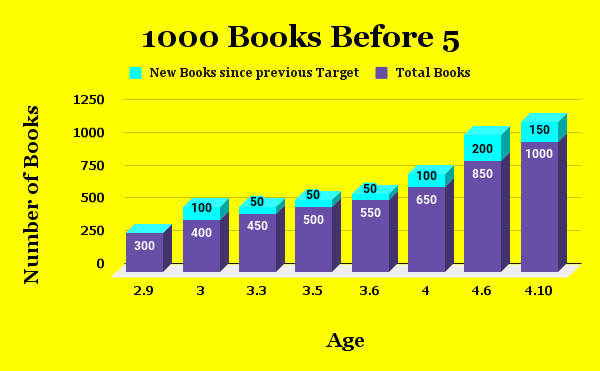
Here’s a snapshot of my incredible journey —
****************************************************************************
If you enjoyed this story, you might like this other story that talks about different other aspects of Reading Aloud to children.
About Me
Hello! I’m Prashansa! I have worn many different hats through the years — software professional, scrum master, executive management student, TEFL-certified English tutor, and an author of Children’s books..but my favorite and the most enriching of all my roles have been the five years that I have been a stay-at-home ‘Mommy.’ I love to write about my experiences and learnings from all the different fields I have had the privilege of going through. I hope you enjoy and get inspired by my writings!
****************************************************************************


