avatarShin Jie Yong, MSc (Res)

Free AI web copilot to create summaries, insights and extended knowledge, download it at here

5528

Abstract

"https://www.rcsb.org/structure/1u5l">general structure</a> of a prion protein to perform their analyses, but prion proteins <a href="https://www.ncbi.nlm.nih.gov/pmc/articles/PMC2634592/">are diverse</a>, some of which are harmful and some harmless.</p><ul><li>3. The inflammatory responses associated with Covid-19 involve pathological microRNAs (miRNAs), specifically NF-kB (p50/p65)-sensitive miRNA-146a-5p that is also involved in prion diseases.</li></ul><p id="97cd">This concern is legitimate as inflammation in general could aggravate almost any disease. But precisely because inflammation is universally linked to diseases, there’s no reason to suspect prion diseases in particular. It’s also far-fetched to link two diseases based on one common cellular process; for example, Covid-19 and AIDS (acquired immune deficiency syndrome) <a href="https://www.ncbi.nlm.nih.gov/pmc/articles/PMC3892619/">both</a> <a href="https://www.frontiersin.org/articles/10.3389/fimmu.2020.596631/full">inhibit</a> CD4 T-helper cells, but it doesn’t mean that Covid-19 causes or increases the risk of AIDS. And miRNA-146a-5p, in particular, is also linked to <a href="https://www.ncbi.nlm.nih.gov/pmc/articles/PMC8431499/">a long list</a> of viral and neurological diseases.</p><p id="8946">Moving on, nationwide surveillance reports <a href="https://pubmed.ncbi.nlm.nih.gov/35981813/">from Australia</a> (Figure 1) and <a href="https://www.ncbi.nlm.nih.gov/pmc/articles/PMC9305926/">the U.K.</a> (Table 1) have noted no significant increase in the incidence of prion diseases before and after the emergence of Covid-19.</p><figure id="4db6"><img src="https://cdn-images-1.readmedium.com/v2/resize:fit:800/1*1iAm89Bq4dkU1eTOBkvgTw.png"><figcaption>Sources: Stehmann et al. (2022) and Watson et al. (2022). <b>Table 1</b> (left; see red box): A total of 148 individuals were diagnosed with probable/definite CJD (the most common prion disease) during the pandemic, compared to 141 before the pandemic — no significant differences. <b>Figure 1 </b>(right; see red box): No obvious pattern in changes in prion disease incidence from 2019 to 2021. An overall upwards trend in prion disease incidence from 1997 to 2021 is likely due to the increasing ageing population.</figcaption></figure><p id="4878">But so far, <a href="https://www.ncbi.nlm.nih.gov/pmc/articles/PMC9294798/">at least</a> <a href="https://www.ncbi.nlm.nih.gov/pmc/articles/PMC9255144/">four</a> <a href="https://www.ncbi.nlm.nih.gov/pmc/articles/PMC8765092/">case</a> <a href="https://www.ncbi.nlm.nih.gov/pmc/articles/PMC7362815/">reports</a> from Italy, Iran, and the U.S. have been published describing the possibility of Covid-19 triggering or facilitating prion diseases, mainly based on the close temporal association; i.e., the short time interval from Covid-19 to prion disease onset.</p><p id="3c7b">Looking at all the four case reports, none provided convincing evidence suggestive of cause-and-effect. So, these cases of post-Covid-19 prion disease could be nothing but a coincidence, or they may not.</p><p id="84a1">Prion diseases are incredibly rare, affecting only one in a million people annually. So, it’s possible that Covid-19 may at least contribute to the development of prion diseases in certain cases, which may be a signal rare enough that surveillance studies can’t detect easily.</p><h1 id="45e9">Covid-19 vaccines and prion disease</h1><p id="c860">Once Covid-19 is linked to prion diseases, it’s only a matter of time before Covid-19 vaccines are linked to the same, usually by the anti-vaccine community. Several scientific papers (all not published in reputable journals), as well as questionable sites, have written on this topic.</p><p id="aa9d">In one of the papers, “<a href="https://scivisionpub.com/pdfs/covid19-rna-based-vaccines-and-the-risk-of-prion-disease-1503.pdf"><i>COVID-19 RNA Based Vaccines and the Risk of Prion Disease</i></a>,” the author looked at the genetic sequence of the Pfizer mRNA vaccine, writing that “the vaccine RNA has specific sequences that may induce TDP-43 and FUS to fold into their pathologic prion confirmations.”</p><p id="3307">Basically, this study claims that the mRNA code in the vaccine has certain sequences capable of causing prion protein aggregation. But this claim is merely based on looking at the mRNA sequence of the vaccine. No actual analyses were done. Specifically, such sequences were claimed to be the UG tandem repeats, but <a href="https://pubmed.ncbi.nlm.nih.gov/?term=%22ug+tandem+repeats%22+AND+prion&amp;sort=date&amp;size=200">nowhere in the literature</a> are such repeats shown to be related to prion diseases.</p><p id="29e0">Another notable claim by the author is that “the spike protein, created by the translation of the vaccine RNA, binds angiotensin-converting enzyme 2 (ACE2), a zinc-containing enzyme. This interaction has the potential to increase intracellular zinc. Zinc ions have been shown to cause the transformation of TDP-43 to its pathologic prion configuration.”</p><p id="eafd">But by this logic, it also means that anything that binds to ACE2 (including Covid-19) or anything that increases intracellular zinc (including eating zinc-containing foods) would also cause prion diseases.</p><p id="737d">In the end, the author’s interpretations were purely observational and speculative with no actual analyses or experimental findings, as several other experts <a href="https://www.usatoday.com/story/news/factcheck/2021/03/31/fact-check-covid-19-vaccine-n

Options

ot-associated-prion-disease/7053007002/">have</a> <a href="https://www.reuters.com/article/fact-check-no-evidence-that-pfizers-covi-idUSL1N2MZ382">pointed out</a>.</p><p id="f7a2">In another paper, “<a href="https://zenodo.org/record/6641999#.Y1i_5HZBy3B"><i>Towards the emergence of a new form of the neurodegenerative Creutzfeldt-Jakob disease: Twenty six cases of CJD declared a few days after a COVID-19 “vaccine” Jab</i></a>,” the authors examined 26 cases of prion diseases occurring across Europe in 2021.</p><p id="560b">The cases began to show symptoms after a mean of 11.4 days after Covid vaccination. And 20 of the cases died, with a mean of 4.76 months after vaccination (Figure 2). The remaining 6 cases also died a year after.</p><figure id="05dd"><img src="https://cdn-images-1.readmedium.com/v2/resize:fit:800/1*xr6NDspW6vW0xec04SD-4A.png"><figcaption>Source: Perez et al. (2022). Figure 2: 26 cases of Creutzfeldt Jakob Disease (CJD), the most common form of prion disease, occurred shortly after Covid-19 vaccination.</figcaption></figure><p id="902b">“All this confirms the radically different nature of this new form of CJD, whereas the classic form requires several decades,” the study authors wrote. “Usually this disease takes decades to manifest itself. Why and how can this same fatal disease declare itself so quickly following these injections? It is very likely that we are dealing here with a new form of Creutzfeldt-Jakob disease [the most common form of prion disease].”</p><p id="5b62">But claiming causation merely based on temporal association — i.e., the time interval between vaccination and CJD/prion disease symptom onset — is unconvincing. It’s similar to the case reports describing cases of post-Covid prion diseases, where causation cannot be inferred.</p><p id="aa07">However, at least the post-Covid prion disease case reports are formally published in credible journals. Data on post-vaccine prion diseases, in contrast, are based on electronic records, mostly from the Vaccine Adverse Event Reporting System (VAERS) that relies on voluntary, anecdotal reporting. In fact, some of the 26 cases described in the paper were not even formally diagnosed with prion diseases or CJD; they were only assumed so based on symptomatic resemblance.</p><p id="b441">Furthermore, the authors claim that cases of post-vaccine prion diseases are a new form of prion diseases due to the quick symptom onset. Usually, prion diseases have an incubation period —i.e., the time from infection or exposure to symptom onset — of years:</p><ul><li>For variant Creutzfeldt-Jakob disease (vCJD), the incubation period is <a href="http://For vCJD the incubation period is unknown but it is estimated to be 10 to 20+ years.">10–20+ years</a> from the time of exposure to contaminated meat or brain tissues to symptom onset.</li><li>For iatrogenic CJD that stems from exposure to contaminated medical devices or intervention, the incubation period is <a href="https://ceip.us/projects/cjd/background-information/#:~:text=For%20iatrogenic%20CJD%20it%20varies%20by%20route%20of%20exposure%20from%2015%20months%20to%20%3E%2030%20years.">1-30+ years</a>, depending on the route of exposure. But due to the current advanced medical practice, iatrogenic CJD almost never occurs.</li><li><a href="https://ceip.us/projects/cjd/background-information/">For sporadic CJD</a>, the <a href="https://www.nhs.uk/conditions/creutzfeldt-jakob-disease-cjd/">most common form</a> of CJD/prion disease, there’s no incubation period as the symptoms occur spontaneously. Sporadic CJD usually occurs among older adults over 60 years. And the disease progress rapidly, often leading to death within 6 months.</li></ul><p id="cd61">And nearly all of the 26 post-vaccine CJD cases occurred among people aged 60 and above. These cases also showed rapid disease progression. So, it’s rather reasonable to classify those post-vaccine CJD cases as sporadic CJD rather than a new form of CJD. And disease occurring post-vaccination doesn’t necessarily mean that the vaccine caused the disease. For instance, everyone who got vaccinated will face post-vaccine death eventually.</p><p id="a514">As follows, those 26 cases of post-vaccine CJD might just be sporadic CJD that occurred spontaneously due to old age, regardless of vaccination. Given that the majority of older adults are vaccinated, it’s expected that some of them will get CJD/prion disease, purely by chance.</p><p id="356c">Not to mention that the paper performed no statistical analyses to compare rates of prion diseases or CJD in the vaccinated vs. unvaccinated population to prove or at least support their claims. Although this analysis has not been done explicitly, we can infer some hints from the Australian and U.K. surveillance studies described above, where rates of CJD/prion diseases remain similar pre-pandemic and now. And pre-pandemic is a good sample size representative of the unvaccinated population.</p><p id="12f9">If you have made it this far, thank you. Subscribe to my Medium email list <a href="https://shinjieyong.medium.com/subscribe">here</a>. If you want to become a member to get unlimited access to Medium, you can use <a href="https://shinjieyong.medium.com/membership">my referral link</a>, and I will receive a small commission at no extra cost to you. You can also tip me below if you are feeling generous today, and I’ll appreciate it. Paying bills with science writing isn’t easy, so I’ll appreciate any help I can get.</p></article></body>

What Prion Diseases (99% Fatal) Have To Do With Covid-19 Or Its Vaccines.

Dissecting the hypotheses/theories linking Covid-19 and its vaccines to prion diseases.
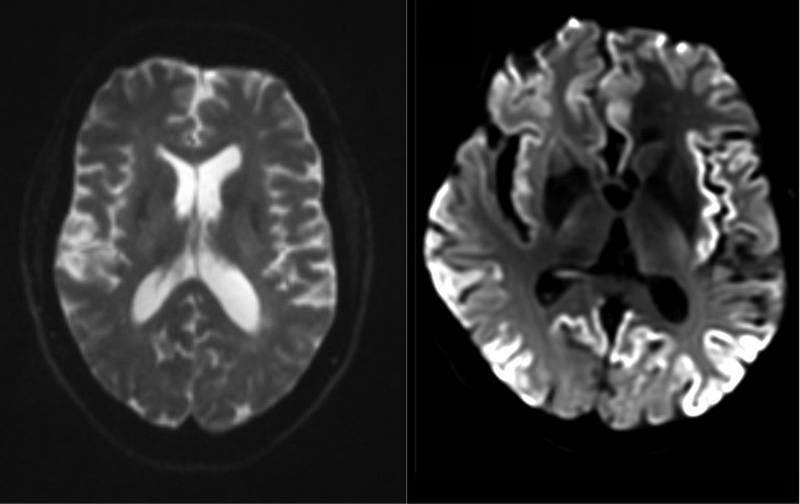
Sources: radiopedia.org (left) and Practical Neurology (right). Diffusion-weighted imaging of the normal brain (left) and sporadic Creutzfeldt-Jakob disease (CJD; most common form of prion disease) with striking cortical ribboning specific to prion diseases.

Since last year, I’ve received emails asking if Covid-19 or Covid-19 vaccines are related to prion diseases, also called transmissible spongiform encephalopathies (TSEs), a rare neurodegenerative brain disorder known as the most lethal disease known to mankind.

If you get prion disease, the chances of survival are almost 0%. About 85% of cases die within the first year of symptom onset. Prion disease is universally fatal because — unlike pathogens like bacteria and viruses —prions don’t get recognized by the immune system as a threat. So, prions inevitably degenerate neurons in the brain and kill the victim within a few years, causing progressive neurological symptoms along the way.

For this reason, prions are an enigmatic entity that separates itself from other pathogens or infectious diseases. Prions are just infectious proteins (yes, they are transmissible, mainly via contact with contaminated meat or brain tissues through cannibalism) devoid of genetic codes.

However, prion diseases are rare, affecting one in a million people per year, and about 5–15% of cases are genetically inherited. And all that said, what do Covid-19 and its vaccines have to do with prion diseases?

Covid-19 and prion disease

After scouring the literature, most papers linking Covid-19 to prion diseases are theoretical or hypothetical in nature.

At least six review papers were published on the theoretical or hypothetical bases of how Covid-19 could trigger or promote prion diseases. After reading them, here are the three key points:

  • 1. The S1 portion of the SARS-CoV-2 spike protein has prion-like domains, which may self-aggregate or aggregate with other proteins to cause prion diseases.

But a protein’s function doesn’t rely on a single domain, especially when the protein has multiple domains in its structure. A protein’s function depends on its overall structure. A study later showed that the prion-like domains of SARS-CoV-2 S1 spike protein participate in binding to the cell surface ACE2 receptor, so such domains are unlikely to interact with other proteins because they are already occupied. Only if the prion-like domains exist on their own or form most of the protein’s structure, can they form neurodegenerative aggregates. Several human proteins also contain prion-like domains, and we don’t see them turning into prions.

  • 2. A bioinformatics modelling study found that the SARS-CoV-2 spike protein binds strongly to the heparin domains of other proteins, including prion proteins.

But bioinformatic modelling is rigged with numerous limitations. For instance, modelling findings don’t necessarily translate to living biological processes. And what happens after the spike protein-prion protein binding remains unstudied and unknown. Plus, the model used the general structure of a prion protein to perform their analyses, but prion proteins are diverse, some of which are harmful and some harmless.

  • 3. The inflammatory responses associated with Covid-19 involve pathological microRNAs (miRNAs), specifically NF-kB (p50/p65)-sensitive miRNA-146a-5p that is also involved in prion diseases.

This concern is legitimate as inflammation in general could aggravate almost any disease. But precisely because inflammation is universally linked to diseases, there’s no reason to suspect prion diseases in particular. It’s also far-fetched to link two diseases based on one common cellular process; for example, Covid-19 and AIDS (acquired immune deficiency syndrome) both inhibit CD4 T-helper cells, but it doesn’t mean that Covid-19 causes or increases the risk of AIDS. And miRNA-146a-5p, in particular, is also linked to a long list of viral and neurological diseases.

Moving on, nationwide surveillance reports from Australia (Figure 1) and the U.K. (Table 1) have noted no significant increase in the incidence of prion diseases before and after the emergence of Covid-19.
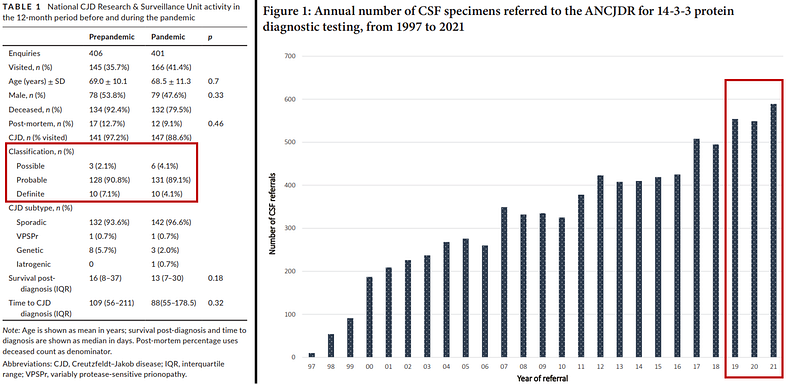
Sources: Stehmann et al. (2022) and Watson et al. (2022). Table 1 (left; see red box): A total of 148 individuals were diagnosed with probable/definite CJD (the most common prion disease) during the pandemic, compared to 141 before the pandemic — no significant differences. Figure 1 (right; see red box): No obvious pattern in changes in prion disease incidence from 2019 to 2021. An overall upwards trend in prion disease incidence from 1997 to 2021 is likely due to the increasing ageing population.

But so far, at least four case reports from Italy, Iran, and the U.S. have been published describing the possibility of Covid-19 triggering or facilitating prion diseases, mainly based on the close temporal association; i.e., the short time interval from Covid-19 to prion disease onset.

Looking at all the four case reports, none provided convincing evidence suggestive of cause-and-effect. So, these cases of post-Covid-19 prion disease could be nothing but a coincidence, or they may not.

Prion diseases are incredibly rare, affecting only one in a million people annually. So, it’s possible that Covid-19 may at least contribute to the development of prion diseases in certain cases, which may be a signal rare enough that surveillance studies can’t detect easily.

Covid-19 vaccines and prion disease

Once Covid-19 is linked to prion diseases, it’s only a matter of time before Covid-19 vaccines are linked to the same, usually by the anti-vaccine community. Several scientific papers (all not published in reputable journals), as well as questionable sites, have written on this topic.

In one of the papers, “COVID-19 RNA Based Vaccines and the Risk of Prion Disease,” the author looked at the genetic sequence of the Pfizer mRNA vaccine, writing that “the vaccine RNA has specific sequences that may induce TDP-43 and FUS to fold into their pathologic prion confirmations.”

Basically, this study claims that the mRNA code in the vaccine has certain sequences capable of causing prion protein aggregation. But this claim is merely based on looking at the mRNA sequence of the vaccine. No actual analyses were done. Specifically, such sequences were claimed to be the UG tandem repeats, but nowhere in the literature are such repeats shown to be related to prion diseases.

Another notable claim by the author is that “the spike protein, created by the translation of the vaccine RNA, binds angiotensin-converting enzyme 2 (ACE2), a zinc-containing enzyme. This interaction has the potential to increase intracellular zinc. Zinc ions have been shown to cause the transformation of TDP-43 to its pathologic prion configuration.”

But by this logic, it also means that anything that binds to ACE2 (including Covid-19) or anything that increases intracellular zinc (including eating zinc-containing foods) would also cause prion diseases.

In the end, the author’s interpretations were purely observational and speculative with no actual analyses or experimental findings, as several other experts have pointed out.

In another paper, “Towards the emergence of a new form of the neurodegenerative Creutzfeldt-Jakob disease: Twenty six cases of CJD declared a few days after a COVID-19 “vaccine” Jab,” the authors examined 26 cases of prion diseases occurring across Europe in 2021.

The cases began to show symptoms after a mean of 11.4 days after Covid vaccination. And 20 of the cases died, with a mean of 4.76 months after vaccination (Figure 2). The remaining 6 cases also died a year after.
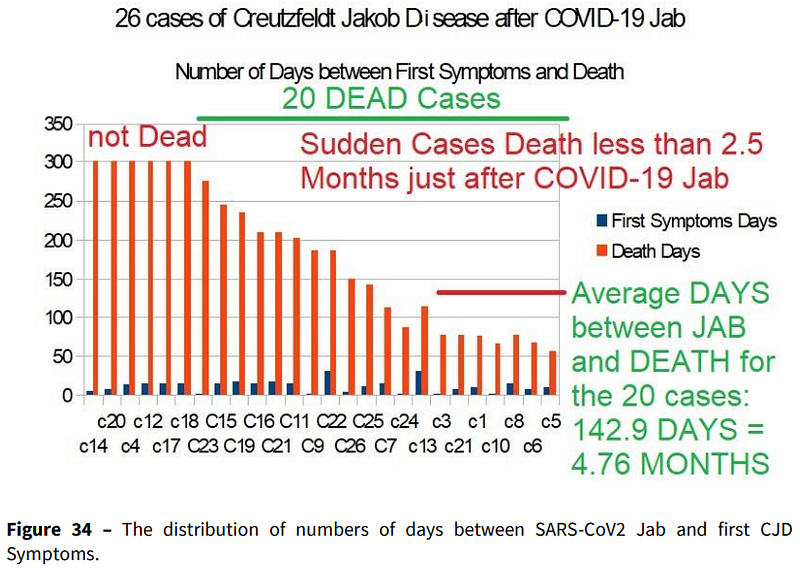
Source: Perez et al. (2022). Figure 2: 26 cases of Creutzfeldt Jakob Disease (CJD), the most common form of prion disease, occurred shortly after Covid-19 vaccination.

“All this confirms the radically different nature of this new form of CJD, whereas the classic form requires several decades,” the study authors wrote. “Usually this disease takes decades to manifest itself. Why and how can this same fatal disease declare itself so quickly following these injections? It is very likely that we are dealing here with a new form of Creutzfeldt-Jakob disease [the most common form of prion disease].”

But claiming causation merely based on temporal association — i.e., the time interval between vaccination and CJD/prion disease symptom onset — is unconvincing. It’s similar to the case reports describing cases of post-Covid prion diseases, where causation cannot be inferred.

However, at least the post-Covid prion disease case reports are formally published in credible journals. Data on post-vaccine prion diseases, in contrast, are based on electronic records, mostly from the Vaccine Adverse Event Reporting System (VAERS) that relies on voluntary, anecdotal reporting. In fact, some of the 26 cases described in the paper were not even formally diagnosed with prion diseases or CJD; they were only assumed so based on symptomatic resemblance.

Furthermore, the authors claim that cases of post-vaccine prion diseases are a new form of prion diseases due to the quick symptom onset. Usually, prion diseases have an incubation period —i.e., the time from infection or exposure to symptom onset — of years:

  • For variant Creutzfeldt-Jakob disease (vCJD), the incubation period is 10–20+ years from the time of exposure to contaminated meat or brain tissues to symptom onset.
  • For iatrogenic CJD that stems from exposure to contaminated medical devices or intervention, the incubation period is 1-30+ years, depending on the route of exposure. But due to the current advanced medical practice, iatrogenic CJD almost never occurs.
  • For sporadic CJD, the most common form of CJD/prion disease, there’s no incubation period as the symptoms occur spontaneously. Sporadic CJD usually occurs among older adults over 60 years. And the disease progress rapidly, often leading to death within 6 months.

And nearly all of the 26 post-vaccine CJD cases occurred among people aged 60 and above. These cases also showed rapid disease progression. So, it’s rather reasonable to classify those post-vaccine CJD cases as sporadic CJD rather than a new form of CJD. And disease occurring post-vaccination doesn’t necessarily mean that the vaccine caused the disease. For instance, everyone who got vaccinated will face post-vaccine death eventually.

As follows, those 26 cases of post-vaccine CJD might just be sporadic CJD that occurred spontaneously due to old age, regardless of vaccination. Given that the majority of older adults are vaccinated, it’s expected that some of them will get CJD/prion disease, purely by chance.

Not to mention that the paper performed no statistical analyses to compare rates of prion diseases or CJD in the vaccinated vs. unvaccinated population to prove or at least support their claims. Although this analysis has not been done explicitly, we can infer some hints from the Australian and U.K. surveillance studies described above, where rates of CJD/prion diseases remain similar pre-pandemic and now. And pre-pandemic is a good sample size representative of the unvaccinated population.

If you have made it this far, thank you. Subscribe to my Medium email list here. If you want to become a member to get unlimited access to Medium, you can use my referral link, and I will receive a small commission at no extra cost to you. You can also tip me below if you are feeling generous today, and I’ll appreciate it. Paying bills with science writing isn’t easy, so I’ll appreciate any help I can get.

Coronavirus
Prion
Mrna Vaccine
Science
Creutzfeldt Jakob Disease
Recommended from ReadMedium