
What Potential State Is and Why You Have to Have It
You need a refuge state that will revitalize you — especially during the outbreak.
One of the main ideas that has shaped my life is that of Potential State. It is a concept that I believe can change your life as well. Let me share my understanding of this concept with you and show you how I use it in my personal and professional life.
What is Potential Space?
Potential space (or transitional space) is a concept coined by British psychoanalyst and pediatrician Donald Winnicott.
All babies are born into a subjective, fantastic, omnipotent world. They believe that the world revolves around them. Their every need is immediately met by their caretaker.
Yet over time, “the good enough” parent (another Winnicott concept) frustrates the baby when all of their needs are not perfectly met. This slowly moves the baby from the fantastical world to one of objective reality. But in between reality and fantasy lies the Potential Space. That space is essentially a sense of an inviting and safe interpersonal field between parent and child, in which the child can be spontaneously playful while being connected to others.
When their surroundings are safe and dependable (without abuse, violence or danger), most children naturally develop a potential state with their caretakers and themselves.
Why I use the term Potential State (PS)?
I use the term Potential State, because I believe that the intra-psychic dimension of Potential Space is the ability that people can develop and take with them through life.
As adults, Potential State is where we experience love, wonder, imagination, creativity, and vitality.
Too much fantasy can turn you towards madness.
Too much reality can turn you into a rigid, dull “worker bee.”
A short example
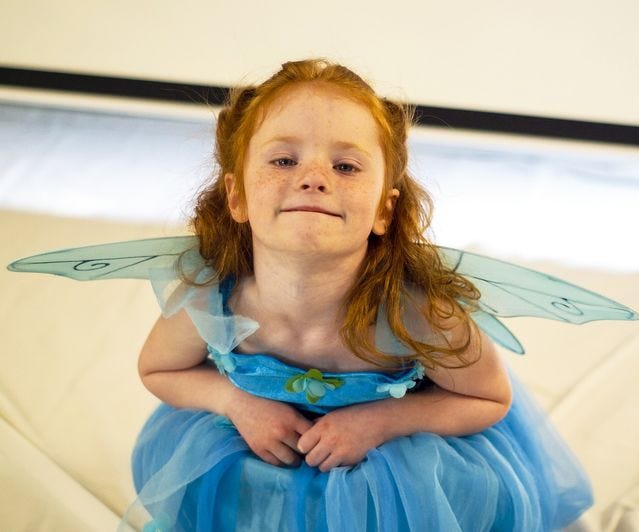
When my 5-year-old daughter, Lila plays with her dolls (which Winnicott calls transitional objects), talking to them, dressing them up and carrying them around — she is in Potential State. She knows they are just dolls (reality) but she also endows them with character and feelings (fantasy). Lila is able to maintain a space that holds both reality and fantasy, full of emotion, vitality and creativity.
Some characteristics of Potential State
Below are the most important elements within Potential State:
- A main component of Potential State is Play. I have written extensively about the importance of Play here.
- Potential State needs boundaries of time and space. This is not like a psychotic episode where you don’t know who you are.
- Potential State is a visceral experience with a wide range of emotions. Just like Play is not always happy, within Potential State one feels a wide range of emotions. It is a visceral experience, filled with different sensations, emotions, and feelings.
Potential State in adulthood and work
As we grow older, we may lose access to our Potential State. This is due to a variety of circumstances including violence, abuse, poverty, ridicule, or simply, the lack of opportunity with our caretakers and surroundings. Losing Potential State leads to a more rigid and concrete personality with little imagination, play, or creativity.
Those In the helping professions (therapists, educators, clergy, social workers, and so on) can better serve their clients if they have access to their Potential State. And as a parent, it is our responsibility to aim to interact more playfully and to be more in a potential state with our children and the people we work with. Allowing children and others to enter Potential State, gives them permission to play, reflect, learn, and grow.
How do we create Potential States in our lives?
- Set a time and space for Potential State. Start small, 10 or 20 minutes with your kids, with your partner, with your friends or colleagues.
- Mistakes are welcome. Choose to believe that “there are no mistakes, only learning.” Create settings that encourage exploration, trial and error, improvisation, and some madness.
- Playfulness and silliness. Give yourself permission to not take yourself or the situation so seriously. Model Play so you and others can be silly, serious, vital, emotional, and playful.
- Make sure that the space is not judgmental and people agree to match your playfulness. Communicate implicitly and/or explicitly that this is a place where there is no judgment for every word that is spoken (in theater improvisation this is referred to as the “Yes, And…” rule).
- Play with little children. Children naturally have Potential State, so learn from the masters of Play, and surrender to their Potential State. Play with your own children or your grandchildren.
- Surround yourself with people who don’t take life too seriously. Surround yourself with people who can imagine beyond what they see.
- Do art. Art is an interpretation or reflection of reality and invites into a Potential State. Join an improv troupe, take a dance or music class, Join the local choir, or an art class. These activities will help you maintain a sense of wonder, curiosity, and excitement.
We all have the potential to create and maintain a basic level of Potential State. It is important for our own mental health, to lower anxiety, to prevent burnout and cynicism, to maintain wonder, awe, belief, love, creativity, and curiosity. Even more importantly, Potential State is a gift to the people around us, especially our children. I believe that by creating and manifesting more Potential State in the world, we will be able to bring more peace and love in the universe, one relationship at a time.
References
Winnicott, D. W. (1971). Playing and reality. London, UK: Penguin.
Originally published at https://www.psychologytoday.com.


