
What Norah Discovered by Disguising Herself as a Man for 18 Months
Do women have it better than men?
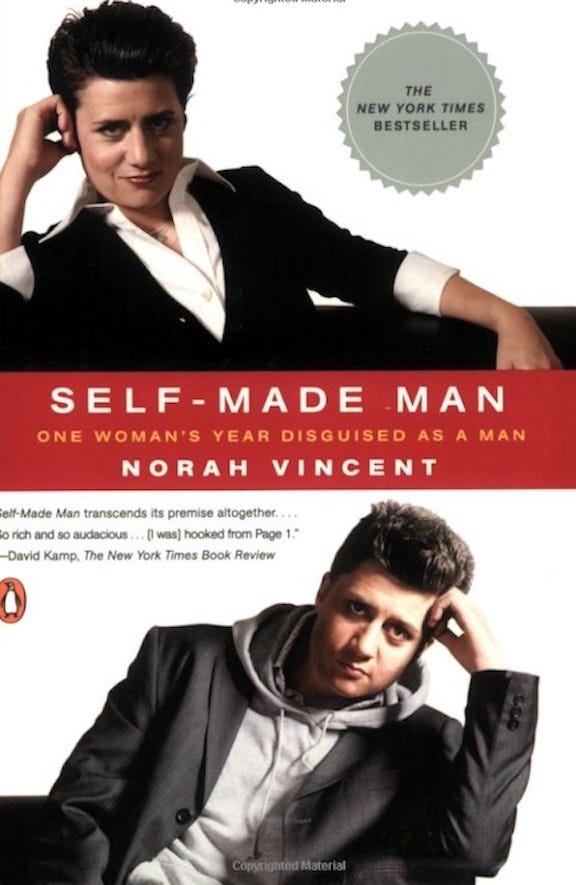
In the early 2000s, Norah Vincent, a 35-year-old journalist, disguised herself as a man.
She hired a make-up artist to create a stubble by shredding braided wool into bits and gluing it onto her face.
She bound her breasts with two small sports bras and weight-trained to build muscles in her back and chest.
She wore a prosthetic pen*s. To sound and move like a man, she trained with a Juilliard coach for months.
Then in 2005, she chronicled her 18-month journey as a man in her book, Self-Made Man. It became an instant best-seller.
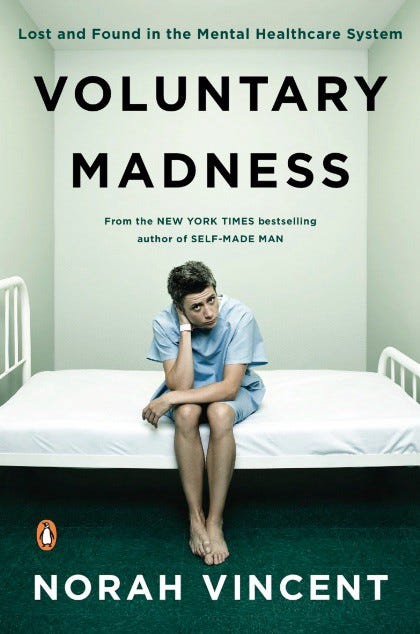
But something was happening to Norah. A week after her last stint as a man, she had a depressive breakdown and checked herself into a mental institution.
She wrote about it in her next book, Voluntary Madness. There she detailed her decade-long history with “treatment-resistant depression.”
Then July of last year, Norah died via assisted suicide in Switzerland.
Becoming a man
Did disguising as a man drive her to suicide? Some think so. But she died 15 years after being a man, so it’s doubtful.
But it’s possible it acted as a catalyst. She ended her disguise in 18 months rather than the planned two years.
She couldn’t take the pressure of being someone she wasn’t and the “fear of discovery and deceit” was reaching “critical mass,” she said in an interview with 20/20.
In that year and a half, she put herself in “stereotypical, hypermasculine situations,” as quoted by the New York Times.
She joined an all-male bowling club, attended a men’s therapy group, went to a strip club, and dated women.
Norah, a lesbian, was 5ft 10in, weighed 155 lbs, and wore men’s size 11 shoes. People easily believed she was a man. However, interestingly, most thought she was gay.
Her first act was to join a men’s bowling club. She sucked at it and feared the men would mock and reject her. To her surprise, the working-class men she met welcomed her with open arms.
“I felt as comfy as I could feel right away. They just took me in. No questions asked,” she said in an interview with 20/20.
She learned that cussing and good-natured ribbing is how men show affection for one another.
Once she told them she was actually a woman, one of the guys started talking emotionally about his wife’s cancer. Norah found that “there’s tremendous potential for tenderness between men and I’m not sure it’s always realized and it’s terribly sad.”

Strip clubs
Norah said she discovered that female s*xuality is mental and male s*uality is a “bodily function,” a necessity, at a strip club where hypers*xualized women entertained men.
Men want intimacy and some seek it in places where physical intimacy is possible like at strip clubs, but leaves them emotionally frustrated.
“I saw the men there. I saw the looks on their faces. I saw them sitting alone nursing their bourbon,” Norah said.
Men have testosterone surging through them, which women don’t understand. It makes having s*x a requirement, she added.
Men are also very bad at expressing their feelings, which is no surprise to anyone.
“Men have had the tears and emotional expression sort of pounded out of them from an early age, and so by the time they’re men, they don’t even have the vocabulary anymore or the emotional awareness to really say what they’re feeling,” she said.
As a man, Norah dated many women but “rarely” had any fun. She said having to prove herself was grueling.
In addition, the way women scoffed at her when she tried to talk to them felt hurtful. Men are expected to make the first move, which puts tremendous pressure on them.
Add to that women’s desire for a manly man, not a soft, vulnerable man.
Norah admitted to some of her dates she was a woman. Some were pissed off. Others said they wanted to continue dating because they felt a “connection.”
Would men do that? No. That’s proof that for women, it’s all about connection, Norah concluded in an interview with 20/20.
Men’s therapy group
Next, Norah joined a wilderness group where men come together to bond and reconnect with the deep masculine parts of themselves.
“One guy chopped up a log pretending it was his wife. I was terrified,” said Norah.
Men don’t get to show their weakness and affection, especially with each other, and their emotions are seen as rage.
“They would talk about fantasizing about chopping up their wives or something. It’s not that they would ever do that, but it was a way to get out the blackest thoughts,” Norah said.
As she hung out with this crowd of men, she began to empathize with the fear and stress men felt for always having to be the strong provider.
Her conclusion?
Men are as vulnerable as women. They don’t show it because they’ve been nurtured and raised to hide their feelings.
In conclusion
Norah’s view about identity changed during this whole process. She learned identity is not something to screw around with.
“When you mess around with that, you mess around with something you need that helps you to function and I found out that gender lives in your brain and it’s something much more than costume,” she said.
But what changed forever was her view of her own femininity.
“I’m so much closer to myself than I ever was…I really like being a woman. Being a woman is a privilege,” she said.
RIP Norah ❤
June is the editor of Bitchy, a Medium publication that explores gender, identity, and culture through the feminist lens. Bitchy is also on Facebook, Twitter, and Substack.


