
What My Afghani ESL Students Taught Me
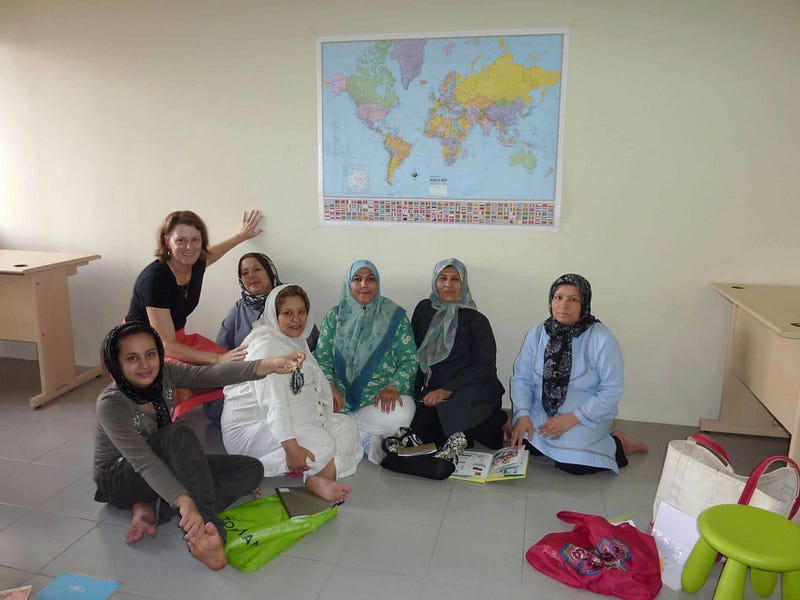
“This is elbow.” The speaker was a short, plumpish woman whose very round face was encircled by her dark headscarf. She peeked up at me, giggling when I clapped to show approval.
“Excellent,” I said and pointed to the joint of my leg. “What is this?” “Knee,” several voices replied. Group applause this time. We continued naming parts of the body until I pointed to my lower abdomen. “How about here?” Startled eyes darted side to side. In a human murmuration, every head bowed as the women stared at the floor. Nobody answered.
I’d been warned about Afghani modesty by the fellow ex-pat who recruited me to volunteer at a refugee camp on the edge of Kuala Lumpur. She urged me to put aside my worries. So what if I wasn’t an educator? The goal was to teach the women their refugee identification numbers and basic vocabulary for things like grocery shopping and going to the doctor. Hasn’t every mom taught her children phone numbers and life skills? These women deserved help. They had survived eight years of war, practically walked from Afghanistan to Malaysia. What else was I doing on Tuesdays and Thursdays, she asked me. Just try it.
For almost a year, in 2010, I volunteered to teach English to Dari-speaking Afghan women. Twice a week, I boarded a train from central KL to the last station on the line, then took a taxi to the cement-block apartment building where my students lived. The landlord provided us with an empty un-airconditioned unit, equipped with two tables and a map of the world. I bought myself a bright green plastic stool at a local market. My students sat on the floor.
Our classes at first were difficult. I knew no Dari and the women knew no Bahasa. I relied on a combination of photos cut from magazines and my inadequate acting skills to convey words. The women tonelessly repeated the words back to me. Hello, goodbye. This is my ID card. Banana, rice, oil. I have four children. Only the teen girl in my class would volunteer to speak. Everyone else agreed that pretending to go to the store and buy a mango was a good idea, as long as it was someone else who play-acted the dialog.
We stumbled along for weeks. The UN refugee staff wanted me to teach the women how to go to the doctor, so my teen translator and I began to work on parts of the body. Using hand-drawn diagrams, the women learned the words they needed to identify a source of pain: stomach, womb, intestine, bladder. The women soon knew the words. The problem was, they wouldn’t say them out loud. I tried to explain that an actual doctor would have zero patience for a guessing game that involved pointing at a diagram to make a diagnosis. The women insisted that any part of the body between the neck and the knees was called the tummy.
In exasperation, I exclaimed, “Ladies, the food and the baby do not go in the same place!” Everybody burst out laughing. They knew that. We were all mothers and knew what happened to make a baby. That funny moment was our breakthrough, our first real connection. After that, the women treated me the way they treated each other. They sat close by me, sometimes held my hands. They told me about their families, the small jobs their families did for cash wages, like tailoring, gardening, or cooking. They dreamed of permanent resettlement into Australia or Canada and worked on English as a way to demonstrate commitment.
As I watch the terrible spectacle of Afghans fleeing before the Taliban this week, I’ve been thinking about my former students. We had so much in common. We wanted the same things: a safe place to live, decent clothing, money, and food. We treasured our friends. We enjoyed girly things: freshly washed hair, bead bracelets. We wanted our children, especially our daughters, to get an education.
My students were brave, modest, and generous with the little they had. Of course, they were sad to leave their birthplace, but they were determined to better their situation. Thanks to them, I developed the courage to walk into a dilapidated room and get to work. Whether teaching English or charting baby weights, for my next nine expatriate years, whenever I started a new volunteer project, I remembered my Afghani friends.
Today, from a safe distance, I see a new wave of refugees longing for the things my students and I talked about: safety, friendship, education. I wonder if my students achieved permanent resettlement. I hope so.