
What Marriage Means to Me.
I am a teenager.
I am an unmarried teenager.
Marriage is an interesting concept to me. We see it as essential to life, with the average adult American participating. In a world where we value secularism, marriage is religious. In a country that values individual freedom, marriage is legally binding. Marriage runs so deeply in our culture that most of us expect it or take it for granted. I spent my childhood watching Four Weddings, perfectly planning my wedding when the day came. I even put together the ways my bi-racial cultures would intertwine. I came up with the optimal age, venue, and season that my wedding would take place. As young girls, many of us are taught to fantasize about the occasion as if it’s going to be the best day of our lives.
And yet, it fails 50 percent of the time.
I was watching a video of divorce attorneys that advocated this risk stated “If you had a 50 percent chance of getting shot, would you?” I was shocked at the comparison of such a physical, violent injury is compared to the end of the marriage contract, but then I also thought about it from a psychological perspective. Psychology tells us that breaking up with someone is equivalent to losing someone to death mentally, as we break away from the attachment of the other person. Is divorce this on steroids? Would these same relationships fail under the same circumstances without a legal contract, or is that an added level of commitment that contributes to the end?
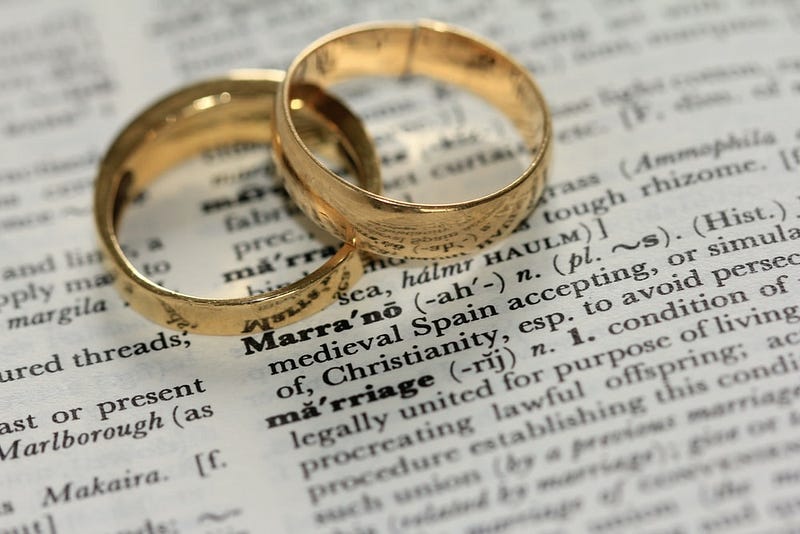
Perhaps no one knows the answer. I am fascinated at marriage, its commitment, it’s every day. I am curious about the nuances that come with it, and how societal structures do and do not play a role. I currently intern at a female company to train women to win elected offices, and it was almost impossible to find women who had changed their names due to marriage. Their careers often went unnoticed. Their husbands spoke for them, in 2020.
And yet, in 2020, it has only been a mere five years since we legally permitted same-sex couples to enjoy the same rights of the legally bounding contract. That one is confusing too. We allow any heterosexual couple to get married, take that 50 percent risk of divorce, and go through the commitment of being married but did not allow any other couples to experience the same commitment at its highest and riskest level.
There is little data on how same-sex married couples interact. Their rates are little known. The same can be said for Black Americans as well. Black women who are married are known to make less than their counterparts, being that the gender wage gap is again exaggerated for women of color, due to systemic racism. Even in marriage, stats continue to drop in success for minorities.
Perhaps though, I see the beauty in marriage. It is at the end of the day, a commitment ceremony. In my generation, where hookup culture and dating apps are normal, that level of traditional commitment is something that I long for. It is the intertwining of two people, and in my spiritual belief, two souls. Once in a while, I see an elderly couple that still holds hands in public and I can’t help but smile. That long-term love is something that many of us desire.
I also see the benefits of our culture of marriage when it comes to children. Our society has built up our walls that have normalized married people. Last fall, I spent hours configuring married and individual tax deductions and benefits in my college class. Point being, marriage is convenient. It works well with American society in all legal terms and conditions. It makes everything easier in regards to children, and unfortunately, with custody battles if the couple splits up. Health decisions rely on marriage. Immigration relays on marriage. Our taxes rely on marriage.
My parents are married. They celebrated their 27th wedding anniversary last week. My father was one of the first to participate in love marriage, the first to marry outside his culture to an American. They had a courthouse ceremony and a pizza to celebrate. I have seen the problems that specifically relate to bi-racial marriages. I have also seen joy. I have seen problems. I have also seen my family members’ marriages unfortunately crumble.
I am not sure if I will marry, although it is something that I desire. I do conclude though that my view and perspective on marriage are different. I am keeping my name. My children will have hyphens. My wedding will involve no “giving away” from the father to the spouse. I will be keeping my career, and expect my partner and me to support each other equally. I might get proposed to, or I might propose. I am a feminist and believe strongly that gender roles are no longer needed. If I get married, It will be different.
I’m not in a rush.


