
What Makes Kids Interested in Other Cultures?
Genetics, early exposure or both?
Why would some people show an early interest in other cultures, while others retreat into an us versus them mentality? Your narrator looks into his own past….
In the weird way that personality or physical traits can re-manifest in alternate generations, I’ve long thought I owe a lot to a grandfather that I never met. My father didn’t have an academic neuron in his body. But he was well read in history, specifically South African history. Dad was South African, and an enthusiastic supporter of apartheid. Go figure (that’s a story for another day). My mother (at least until the mishaps of the past few weeks) has always been a voracious reader of science, theology and anthropology. She did extra mural university courses and curated an insect collection. But it was her Dad, who died when she was just ten, who somehow seemed to express in me.
For instance, I’m a geologist. When I took Geology at University, I was so enthralled by ‘Plate Tectonics’ (the study of how the continents have moved around the Earth) that I tried to spin every exam essay question into something about the topic (it seemed to work). The funny thing here is that my mother has a little cork globe of the world, on which she remembers her father pointing out how the east coast of South America fits the west coast of Africa. This would have been the 1930s, just a few years after Alfred Wegner had proposed continental drift, and long, long before the broader concept was accepted as ‘plate tectonics’ (in the 1970s).
I’m also something of a botanist (I research fossil plants and climate, which manages to combine both geology and botany) and my mother can remember her father teaching her the Maori names of native plants.
Archaeology has also been a life-long passion of mine. Ever since I was a kid, I devoured anything I could find about the prehistory of New Zealand’s indigenous people, the Maori, and archaeology is always a theme when I travel. Which brings me to a model house…
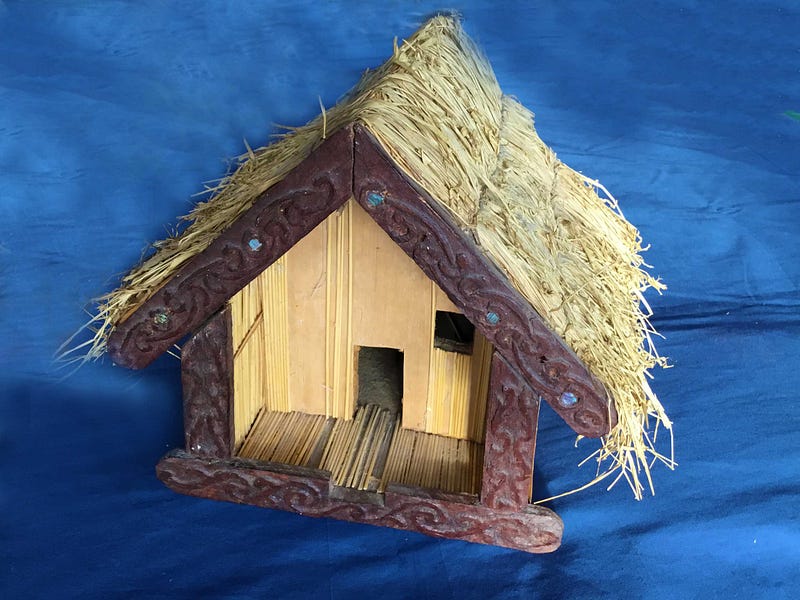
The object in the featured image of this post was made by my mother’s father back in the 1930s. It’s a representation of a traditional Maori house – A ‘’Whare’ (You can read a paper on the construction of Maori houses here and a photo of one here). It’s about a foot long, with a softboard frame, hidden below a thatched roof, walls that have been covered with individually glued on bits of grass stem, and carved wooden gables.
My mother can remember him discussing what he should do with those gables. Should he ornament them with pieces of paua (abalone for American readers) shell? In the end he did, but I guess that his worry was that this wasn’t truly authentic — but he may have been aiming at a broader point.
It’s the purpose of that model house that’s really surprising. He built it as a prop to teach Maori culture to his school pupils. When I asked my mother about the house just now, she proffered that’s her Dad was “mad-keen to teach Maori words to his class”. My mother thinks this teaching and model building will have been while he was stationed at Popotunoa, a place so small, most New Zealanders will never have heard of it.
My grandfather was certainly a maverick (an Irish Dad, Scottish Mum). He was eternally doomed by his society, so I’m told, to only teach in small, isolated, one or two teacher schools. This was on-going punishment, because he had refused service in the First World War as a Conscientious Objector. So in the broader New Zealand society that was physically punishing Maori children who were caught speaking their language at school, my grandfather was at a tiny school, teaching that language and painstakingly building models of their culture. Way to go granddad – stick it up them!
Yes, my grandfather has long figured as a hero in my imagination. But he died because his religion (Christadelphian) told him he should refuse medical intervention after he pricked his finger pruning a rose. For the shit that went down after that, I can’t forgive him.
So maybe my interest in our indigenous Maori culture — and by extension, other cultures around the world, is that it’s somehow ‘in my DNA’. If so, I’ve long wondered what the ‘core’ trait was that the DNA was coding for. Of course, it won’t be for anything so specific as ‘Maori culture’, but perhaps an inclination towards some broader topic, like … ‘archaeology’?
Archaeology was a very early interest of mine — and because I grew up in New Zealand, by default, local ‘archaeology’ meant Maori culture. I lapped it up. I was enthralled, not only looking at artifacts in museums, but chasing up what the Maori words were for rivers and mountains in my area, and penciling them onto maps. They were often the names of people, and where I could, I laboriously wrote out their genealogy. This interest led me to absorb a good deal of Maori words, though I never learnt the grammar to put it together.
But it doesn’t really explain ‘why’ I was interested in the first place. As a non Maori (Pakeha) I could have ignored New Zealand archaeology and hunted down that of Saxons and Vikings where ‘my people’ come from.
Or was it early exposure to other cultures? Alan Duff is a contemporary New Zealand author, and with a Maori background via his mother. His book, ‘Once Were Warriors’ hit the jackpot (and the national nerve), as a movie. In his latest book, ‘A Conversation with My Country’ he wrote:
“Yes, the school curriculum in the 1950s and ’60s was totally skewed in favour of Great Britain. We were part of the British Empire, the world map had great splotches of British red, every classroom had a world map and often a globe depicting British dominance. Students were taught mostly British history and absolutely zero Maori history; no mention of great voyages to this land, which should be our First Story.”
This surprised me, because it contrasted with something in my experience at the same age, although a decade later than Duff’s (and at the other end of the country).
And that experience was…… Weetbix!
For non New Zealanders, this is basically a type of breakfast cereal, made by the company Sanitarium. Back in them days (ah, you young whipper snappers!) breakfast cereal manufacturers made an effort to supply us kids with useful educational information (as compared with the stunningly limited imagination of today, that doesn’t seem to extend past idolising sporting heroes).
In those days, what I eagerly looked forward to with each new box of Weetbix, were a couple of ‘cards’ that the manufacturers slipped into the cereal box. These were glossy images that you could paste in to their appropriate spot in a album (which you could get from the shop) and which had corresponding information. To get the full set, you had to either swap with your friends, or of course, buy more Weetbix in the hope that missing cards would turn up.
In 1969 the Weetbix card series was ‘The Maori Way of Life’. And not just inside those boxes of Weetbix. On the outside of the cardboard boxes they came in, you could cut out patterns of buildings. By folding and gluing these together, you could build up a model of an entire fortified Maori village (a ‘pa’).
I lapped it up. And maybe I did because I already had an ‘innate’ interest. But looking back, highlighting Maori culture in cereal boxes was damned enlightened. For sure, the images on those cards were basically a summary of Maori culture as it was around European contact, and I guess with a certain romanticism, and certainly not life as it was right then. But it was something.
Remember the broader context of this. New Zealand by then had long passed the era of beating pupils for speaking Maori at school, but according to Duff, an education system that was, just a few years before, basically ignoring the culture. So, much as my grandfather was a hero to me, if there’s a real hero in this story — it’s whoever it was in Sanitarium marketing who decided to enlighten New Zealand kids about the culture of their indigenous people.
I wonder who he or she was?
Take home point? I can’t help but think there are proclivities for things that you are just born with. But at the same time — these can then be nurtured. In this case — by the early exposure of a child to the culture of the ‘Other’. It may make all the difference…
***
Oh, and talking about how I sense that my unmet grandfather somehow manifests in me, I ripped my finger on a rose this week (bloody self-propelled lawn mower from hell dragged me into it). Blood all over my hand.
Medical treatment? Nah…. (:
References
Duff. A. 1990. Once Were Warriors. Tandem Press.
Duff. A. 2019. A Conversation with my Country. Random House, NZ.
Williams, H. W. 1896. The Maori whare: notes on the construction of a Maori house. The Journal of the Polynesian Society, 5: 145–154.


