
What Makes Humans Unique? Fiction.
The emergence of fiction was a turning point for our evolution…
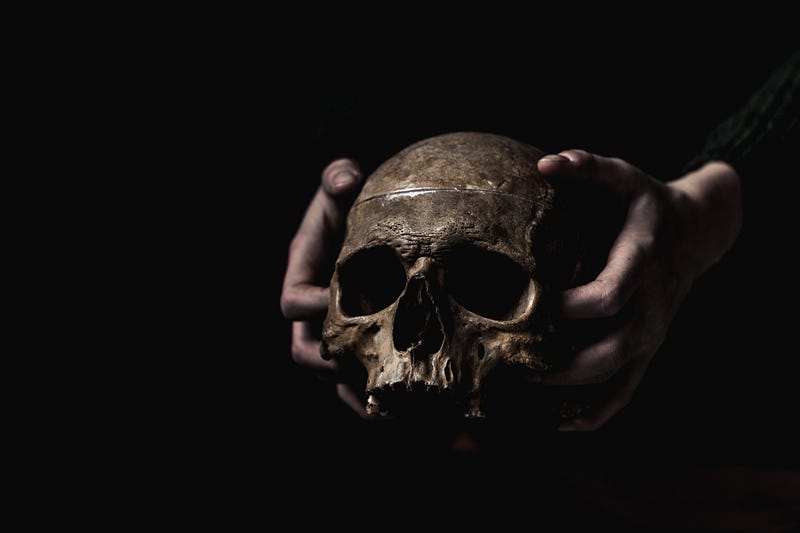
Homo sapiens have been already present in Africa around 250,000 years ago. Yet, it differed little from the rest, contemporary species of humans living elsewhere on the planet [1]. Those archaic Homo sapiens were living in small family bands and were incapable of building and producing extremely sophisticated tools and art. They were a rather insignificant group of animals in terms of population and impact.
Just a few millennia later, the very same species builds monuments of extreme sophistication and scale (e.g. the Pyramids), achieves some unprecedented feats (e.g. landing on the Moon) and its activities become the dominant force of influence on climate and the environment.
What was the driving force behind this dramatic change which enabled humans to dominate the Earth? The answer may surprise you.
Changing the Brain
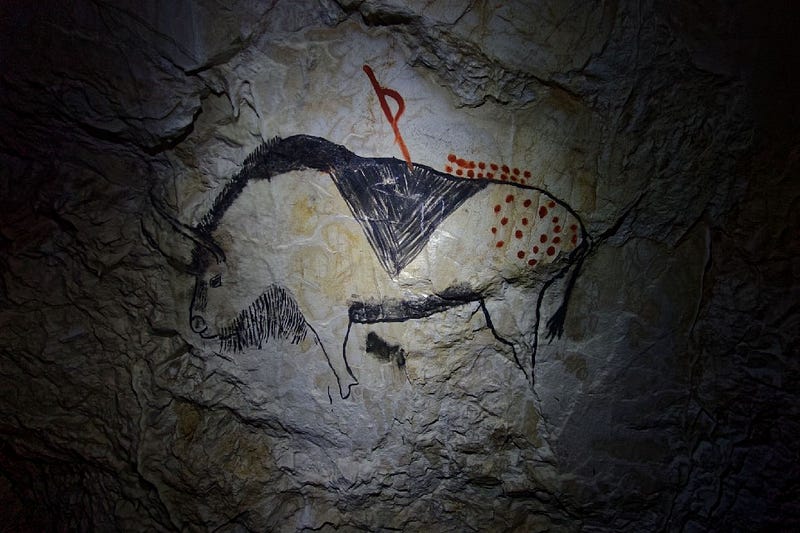
The oldest evidence of artistic and religious expressions of our species dates between 70,00 and 30,000 years ago. During this period, scientists observe a marking transformation in our thinking abilities. Possibly, accidental mutations led to our inner wiring of the brain to change, enabling modern humans to think in unprecedented ways using more complex language. We often name this fundamental change ‘The Cognitive Revolution’.
The Fiction Age
The most important outcome of the ‘Cognitive Revolution’ was probably the ability of our species to transform information about things that cannot be seen, heard, or touched. Contrary to other animals, our species can conceive entities that don’t exist. Put it differently, the ‘Cognitive Revolution’ enabled Homo sapiens to invent fiction. But why believing in fiction is a positive adaptation?
One may claim that, in evolutionary terms, believing in non-existent things is probably a poor adaptation for survival. People who waste time chasing down spirits are probably less likely to survive than the ones who prefer to invest the same time in search of food and other valuable resources.
Yet, conceiving fiction enabled our species not only to imagine non-existent things but to do so collectively. By believing the same fictional myths, Homo sapiens could cooperate flexibly in large numbers in a way unlike any other found in the animal kingdom.

Hanging out with Strangers
Of course, many animals live in groups, herds, or colonies. Effective co-existence in groups requires some kind of hierarchical structure.
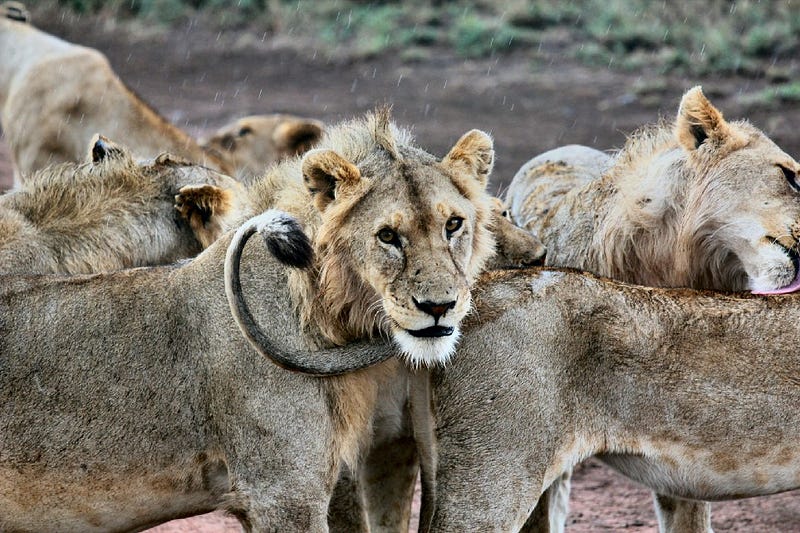
For example, lion prides consist of a few dozen individuals, with a dominant male, few females, and juvenile animals of both sexes. Members of the herd need to know each other intimately to function properly. If the number of individuals increases more than usual, the group destabilizes, and social order is lost. That happens because each member can know intimately only a few individuals.
During the first millennia of its existence, our species was also susceptible to these limits. After the ‘Cognitive Revolution’, mutually conceived fictions enabled us to overcome this problem and cooperate orderly in huge numbers. Humans will orderly be confined with thousands of strangers on various occasions today (just think of the last time you joined a sporting event or a concert), whereas an equally large number of lions in a confined area would cause absolute pandemonium.
Socially Flexible
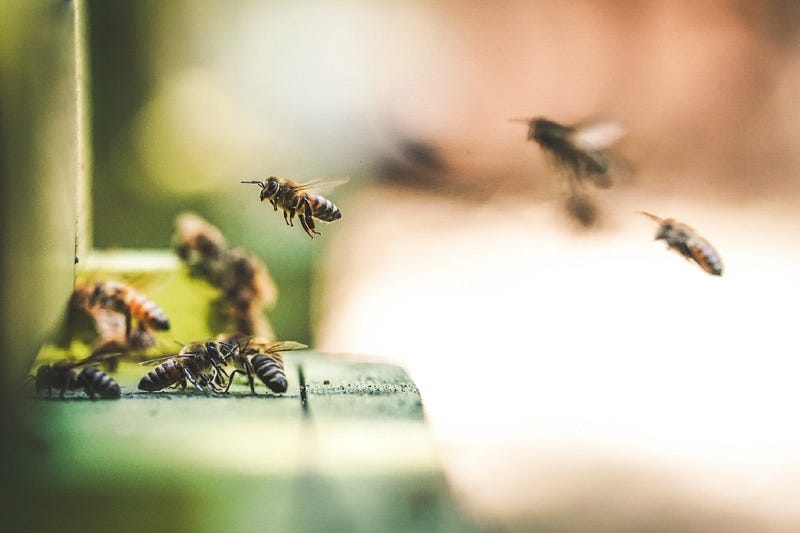
Yet, the ability to cooperate in large numbers is not enough to justify our dominance. After all, several species of insects live in multi-million populated colonies and cooperate with amazing efficiency. So why they don’t rule our world? Well, the social structure that allows these animals to cooperate effectively in millions is predetermined by their DNA. Such a structural organization is inflexible and unable to change.
Humans, in contrast, can change hierarchical structures much more flexibly. Take Louis XVI, for example, the last King of France before the outbreak of the French Revolution (1789–1799). His reign in power was not the result of DNA information transformed by one generation to the next, but the outcome of the fictitious institution of monarchy. When Louis XVI failed to comply with the needs of his subjects, he was violently dethroned and executed.
Unfortunately for bees, they cannot dethrone an impotent queen and a male ant will never rise socially no matter how efficiently and hard it works.
A Vivid Imagination
Fiction freed Homo sapiens from the intimacy limitations and made them capable of cooperating flexibly with strangers as long as they believed the same imagined myths. These myths became even more complex and sophisticated as time went by. The human mind invented cultures, religions, political ideologies, and nations.
Being Muslim, Communist, or Mexican may define the identity of many individuals today, but we need to have in mind that these mutually conceived fictions are not as legit as people often think they are. Instead, they change over time or even disappear entirely when they do not fit current trends [2].
Mutually believed fictions are important to study and observe in a sociological context because they motivate people to act in specific and sometimes negative ways.

Ideas Worth Dying for?
The human mind conceived many religions, cultures, political governments, ideologies, etc, and those conflicting fictions compete for influence. Fanatic believers and followers of a certain fiction tend to be hostile against supporters of a fiction that contradicts their beliefs.
Hostilities of this kind are familiar to all of us. One can think of many instances where religious differences are the primary cause of conflict between two otherwise similar populations. Wars in the name of nations are numerous too, while right and left-wing political extremists hope someday to exterminate each other. When fictional concepts become an indispensable part of one’s identity to the point, they come to define one’s meaning in life, negative outcomes emerge.

Epilogue
The ‘Cognitive Revolution’ enabled Homo sapiens to rise from its humble beginnings and eventually dominate the planet. The emergence of fiction was a turning point in our history and had both positive and negative outcomes. Humans achieved magnificent feats like going into space, but they also entered a vicious cycle of warfare because of their various conflicting ideas.
Fictions are so much an integral part of our society today that it’s impossible to imagine a world without them. That’s not necessarily a bad thing, provided that we stop define our lives in relation to those myths. We should not forget that fictions are mainly an invention of our human brain. Therefore, we’d better treat them as such.
Notes
[1] By the time Homo sapiens evolved in Africa around 250,000 years ago, different human species such as the Homo neanderthalensis, Homo floresiensis, and the Denisovans were also extant.
[2] Change occurs more often than most people think. Consider the fiction of nation-states. Today we are familiar with this type of political government. Yet, nation-states represent just one of the many forms of political government our minds invented during our history.
Imagine a girl born in Ljubljana in 1917. Suppose the girl lived 80 years and never left the city. During the time of her birth, the region would have been under the rule of the Austro-Hungarian Empire. The same girl would have spent her adolescence under the Kingdom of Serbs, Croats, and Slovenes, her adulthood under the Socialist Federal Republic of Yugoslavia, and her old age under the newly founded nation-state of Slovenia.
During her lifetime this woman would have been a member of four different sociopolitical systems, each of which was originally thought legit and not possible to change.
References
Harrari Y. N.,(2014), Sapiens A Brief History of Humankind, Vintage Publications
Harrari Y. N., (2017), Homo Deus A Brief History of Tomorrow, Vintage Publications
Wayman E.,(2012), When Did the Human Mind Evolve to What It Is Today? Link: https://www.smithsonianmag.com/science-nature/when-did-the-human-mind-evolve-to-what-it-is-today-140507905/
Gerson M., (2015), Myths, meaning, and Homo sapiens, Link: https://www.washingtonpost.com/opinions/myths-meaning-and-homo-sapiens/2015/06/11/28660902-106f-11e5-a0dc-2b6f404ff5cf_story.html?utm_term=.77cf15aaf672
Panos Grigorakakis is a journalist, particularly interest in history, evolutionary biology, anthropology and…ocean liners! Connect with him on Linkedin or say hi on Twitter.


