
What Makes a Good Writer? (originally written by Zadie Smith)
Imagining better readers, better writers
But if the real duty of writers is to themselves, how can they ever fail? Are we advocating a new “nice” criticism, where all writers get off the hook just because they tried hard, were in good faith? No. What I am imagining is, I hope, a far more thorough reader. My reader holds writers to the same account as the rest of us, my reader does not allow writers to transcend the bounds of the human, because my reader recognises that writers exist like the rest of us, as ethical individuals moving through the world. One critic-practitioner, Iris Murdoch, understood this well. She insisted on the idea that art-making was a test not only of a skill, but of one’s entire personality. Here she is making a high-wire connection between what it takes to make good art and what it takes to live well: ‘The chief enemy of excellence in morality (and also in art) is personal fantasy, the tissue of self-aggrandising and consoling wishes and dreams which prevents one from seeing what there is outside one . . .’ This is not easy, and requires, in art or morals, a discipline. One might say here that art is an excellent analogy of morals or indeed that it is in this respect a case of morals. For a writer, that’s a fascinating, terrifying idea. What if the personal qualities we need to recognise the Good in life do indeed bear some resemblance to the literary tools we need to write well? It is, Murdoch once said, incredibly hard to make oneself believe that other people really exist in the same way that we do ourselves. It is the great challenge of art to convince ourselves of this fundamental truth — but it’s also the challenge of our lives.
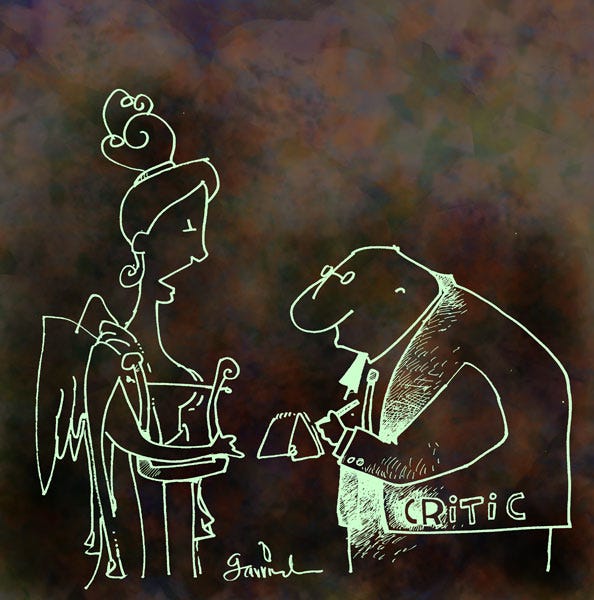
Writers, just like everyone, are prone to the belief that all the world’s a movie, in which they are the star, and all the other people, merely extras, lingering on set. To live well, to write well, you must convince yourself of the inviolable reality of other people. I believe that, and I believe further that this relationship can be traced at every level — a sentence can be self-deluded, can show an ulterior motive, can try too hard to please, can lie, can be blind to anything outside itself, can believe itself to be of the utmost importance. To see things as they really are . . . to me this is always and everywhere, in writing, in life, a matter of morals. But that’s just me. I’m sure there are many other, more radical ways to trace the relationship between our experiences and the demands that narrative makes on us as many ways as there are shapes of narrative. Wouldn’t this be an interesting project for a new generation of critics to undertake? Every critic is an artist in this fantasy literary republic I’m envisioning, every critic is doing as much imaginative work as the novelist, probably more. A great critic is, in the end, imagining the novelist . He is piecing together, retroactively, the beliefs and obsessions and commitments that powered the novel into existence in the first place. And as he does so he reveals his own beliefs, obsessions, commitments. He speaks the truth about an individual experience with a novel.
I have said that when I open a book I feel the shape of another human being’s brain. To me, Nabokov’s brain is shaped like a helter-skelter. George Eliot’s is like one of those pans for sifting gold. Austen’s resembles one of the glass flowers you find in Harvard’s Natural History Museum. Each has strengths and weaknesses, as I apply them to the test of my own sensibility. I can slide down Nabokov, but not slowly, and not fully under my own control. I can find what’s precious with Eliot, but only hidden among mundane grey stones of some weight. Austen makes me alive to the Beautiful and the Proportional, but the final result has no scent and is cold to the touch.This is my private language for a private understanding. It is the critic’s job to formulate a public language that comes close to their own private understanding, and which, if it is acute enough, will find its companions in a community of like-minded readers. And if you read with the wideness and flexibility Murdoch describes, with as little personal fantasy and delusion as possible, you will find fiction opening up before you. To read The Virgin Suicides followed by The Idiot followed by Despair followed by You Bright and Risen Angels followed by Bleak House followed by Jonah’s Gourd Vine followed by Play it as it Lays is to be forced to recognise the inviolability of the individual human experience. Fiction confronts you with the awesome fact that you are not the only real thing in this world.
Click here to carry on reading the rest of the essay.
Cuban, Immigrant, and Londoner, on sale now.
You can buy me a coffee here.
This series of articles were first published in The Guardian Review and later on my blog, A Cuban in London.