
What Makes a Good Writer? (originally written by Zadie Smith)
The tale of Clive
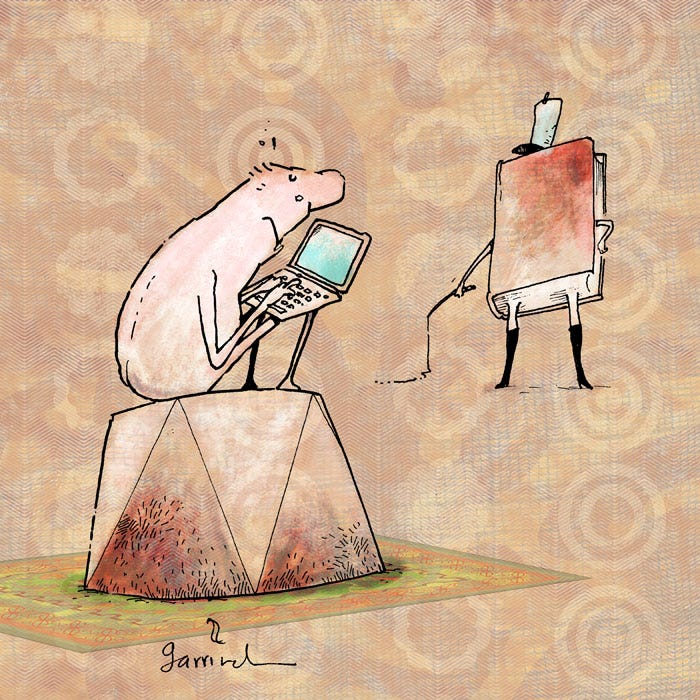
I want you to think of a young man called Clive. Clive is on a familiar literary mission: he wants to write the perfect novel. Clive has a lot going for him: he’s intelligent and well read he’s made a study of contemporary fiction and can see clearly where his peers have gone wrong. He has read a good deal of rigorous literary theory — those elegant blueprints for novels not yet built — and is now ready to build his own unparalleled house of words. Maybe Clive even teaches novels, takes them apart and puts them back together. If writing is a craft, he has all the skills, every tool. Clive is ready. He clears out the spare room in his flat, invests in an ergonomic chair, and sits down in front of the blank possibility of the Microsoft Word program. Hovering above his desktop he sees the perfect outline of his platonic novel — all he need do is drag it from the ether into the real. He’s excited. He begins.
Fast-forward three years. Somehow, despite all Clive’s best efforts, the novel he has pulled into existence is not the perfect novel that floated so tantalisingly above his computer. It is, rather, a poor simulacrum, a shadow of a shadow. In the transition from the dream to the real it has shed its aura of perfection its shape is warped, unrecognisable. Something got in the way, something almost impossible to articulate. For example, when it came to fashioning the character of the corrupt Hispanic government economist, Maria Gómez, who is so vital to Clive’s central theme of corruption within American identity politics, he found he needed something more than simply “the right words” or “knowledge about economists”. Maria Gómez effectively proves his point about the deflated American dream, but in other, ineffable, ways she seems not quite to convince as he’d hoped. He found it hard to get into her silk blouse, her pencil skirt — even harder to get under her skin. And then, later, trying to describe her marriage, he discovered that he wanted to write cleverly and aphoristically about “Marriage” with a capital M far more than he wanted to describe Maria’s particular marriage, which, thinking of his own marriage, seemed suddenly a monumentally complex task, particularly if his own wife, Karina, was going to read it. And there are a million other little examples . . . flaws that are not simply flaws of language or design, but rather flaws of . . . what? Him? This thought bothers him for a moment. And then another, far darker thought comes. Is it possible that if he were only the reader, and not the writer, of this novel, he would think it a failure?
Clive doesn’t wallow in such thoughts for long. His book gets an agent, his agent gets a publisher, his novel goes out into the world. It is well received. It turns out that Clive’s book smells like literature and looks like literature and maybe even, intermittently, feels like literature, and after a while Clive himself has almost forgotten that strange feeling of untruth, of self-betrayal, that his novel first roused in him. He becomes not only a fan of his own novel, but its great defender. If a critic points out an overindulgence here, a purple passage there, well, then Clive explains this is simply what he intended. It was all to achieve a certain effect. In fact, Clive doesn’t mind such criticism: nit-picking of this kind feels superficial compared to the bleak sense he first had that his novel was not only not good, but not true . No one is accusing him of so large a crime. The critics, when they criticise, speak of the paintwork and brickwork of the novel, a bad metaphor, a tedious denouement, and are confident he will fix these little mistakes next time round. As for Maria Gomez, everybody agrees that she is just as you’d imagine a corrupt Hispanic government economist in a pencil skirt to be. Clive is satisfied and vindicated. He begins work on a sequel.
Click here to carry on reading the essay.
“Cuban, Immigrant, and Londoner”, on sale now.
This series of articles were first published in The Guardian Review and later on my blog, A Cuban in London.


