
What Living “Off the Map” Can Teach You
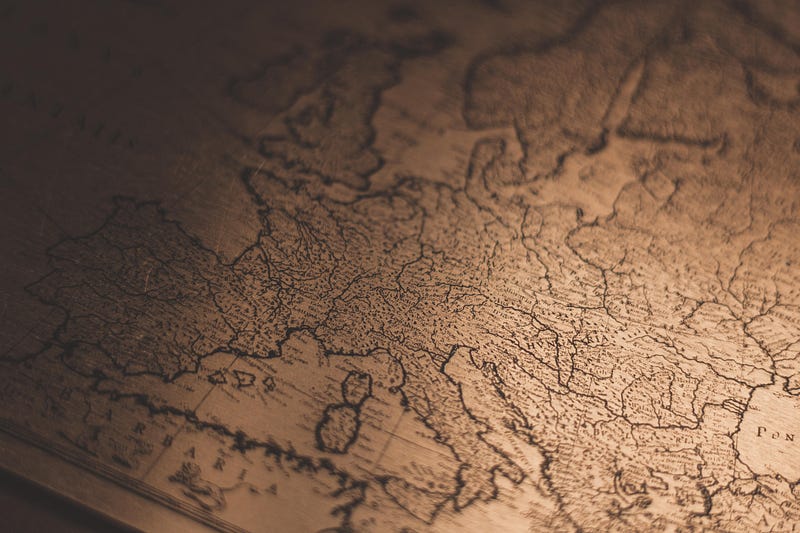
Five years ago I moved to a country called Serbia (not Siberia). It’s the one that used to be part of Yugoslavia. And no, there’s not a war here anymore — but thanks for asking.
You might have heard of it (or, maybe you’re confusing it with Syria, common mistake) but even so, perhaps you aren’t sure where it is. I would show it to you on a map, but then I’d be forced to make my own judgement call on Kosovo; as an American I’m supposed to tell you that’s its own country now; but, having married a Serb, pa znaš kako je.
So let’s do it like this: Picture Italy on the map… then picture Turkey. Now, try to picture the area in between.
It’s foggy, right? That’s the Balkans. It’s a cool place, but difficult to put into words. The Turks tried, that’s where the name Balkans comes from, which some translate as “wooded mountains” while others will tell you it means “blood and honey” — two extremes which the world has come to recognize here, even expect.
Writers have spilled a lot of ink trying to capture the mystery of it, or just the monstrosity as far as Western media goes. Have in mind that popular vacation spots like Greece and Croatia are also in the Balkans, but they don’t count for all intents and purposes today; in fact, for once, for just five minutes, let’s consider any part of the EU irrelevant.
Now let’s return to your mental map: I like this exercise, because there’s revelation in that fog; it reveals just how Western-centric your world view probably is. I mean, Serbia’s right in the middle of everything — literally, in the middle of the map, as well as figuratively, in the overlapping tides of history’s great Empires. So how the hell did you miss it? Why is it just fog in your brain?
Don’t beat yourself up too much, it’s not your fault; it’s been kept off the map as much as possible — physically, intellectually, and politically. But, that doesn’t make this place insignificant; in fact, that’s why you ought to take a closer look.
Let’s start with the basics: What is Serbia today was once part of a country called Serbia and Montenegro until 2006, which was part of a country called the Federal Republic of Yugoslavia until 2003, which was the Socialist Federal Republic of Yugoslavia until 1992, which was the Federal People’s Republic of Yugoslavia before that, and Democratic Federal of Yugoslavia before that, and the Kingdom of Yugoslavia before that, which was first formed as the Kingdom of Serbs, Croats, and Slovenes in 1918. Any of those ring a bell?
Probably not, but the point is I’m sitting in a country which wasn’t technically on the map 15 years ago. Meanwhile, people my parents’ age who were born here have passports from a country that started disappearing from the map another 15 years before that.
You might be thinking, “Wow, what a mess,” but regional conflict and shifting borders are just one part of it. In the meantime, you’ve grown up subscribing to a version of world history where this part of the Balkans was largely missing, too.
You’ve heard all kinds of stories about World War I and II, but do you have any clue where exactly they began? It was in Sarajevo, Bosnia that the Archduke Franz Ferdinand wound up assassinated, an event notorious for sparking the first World War. And some say it was here in Belgrade, Serbia that the Holocaust began, not only for Serbia’s Jewish people but also many Roma and Serbs themselves.
And then there are endless accounts of the Cold War later, when the world was divided between East and West; but do you know about the Non-Alignment Movement at that time, or have any clue that one of its founders was Yugoslavian President Josip Broz Tito?
Chances are you don’t. Maybe you learned some of it here and there, assuming you don’t happen to be obsessed with this place (and assuming, of course, you aren’t from here), but for the most part this entire region has been overlooked in your history books. It doesn’t fit into the narrative you know and love. And, honestly, that doesn’t make a lot of sense.
Sure, the Balkans are a small region and Yugoslavia was a small country, if we’re comparing it in geographic size to Russia and the US, but it really is at the crossroads of this world and her superpowers. It’s prime real estate! So has it escaped your attention despite the fact, or, somehow, because of it? Is it really by accident that such a place has been treated like an addendum to the map, the history books, and global politics?
Let’s revisit the 1990s for a moment: Yugoslavia was falling apart; things like civil war and ethnic cleansing — even the word “genocide” — were making international headlines. Suddenly, this little corner of the world was in the spotlight. Now, I’m not going to delve into the details or start pointing fingers or even make some broad, sweeping, ignorant statement about “religious and ethnic differences” because there’s already plenty of literature dedicated to that if you feel like going down a rabbit hole; what I’m here to remind you of is how the West intervened. More specifically how my country, the United States, intervened.
In our usual charming manner, the US led a series of NATO bombing campaigns here in order to put a stop to the violence. Having identified Serbia’s government at the time as the main culprit, Belgrade was one of their prime targets (yet by no means the only one, nor even the most decimated one).
But, it wasn’t just about dropping leftover ammo from the Vietnam war, it was also about facilitating peace talks, where some of the new borders in this region were allegedly drawn on a paper napkin in Dayton, Ohio. Have in mind that inserting ourselves like this didn’t mean we were at war, too; it was just a tidy little intervention, a casual bit of peace building, some routine democracy transmission — you know, global housekeeping, which Western politicians and journalists like to say “worked.”
If you were alive at the time and living in the States, maybe you remember how it looked. Names like Serbia, Bosnia, Croatia, and Kosovo probably popped up in the morning news report, maybe there was a photo-journal account here and there to put faces to the conflict, and you might have read some detailed accounts of entire families perishing and thought, “How sad.” But, did you know exactly where all that was happening? …Did you care to know?
You probably didn’t, not seriously. As far as you were concerned, peace bombs were falling somewhere half a world away because crazy, warmongering people with a tribal mentality in the backwaters of Europe couldn’t get along. And that’s all your government really needed you to know, because the foggier it was, the less likely you would question it. They knew most Americans couldn’t point to Yugoslavia on a map.
It sounds laughable, that last part, but it’s the most important part. That’s what you have to watch out for: those holes in the map, whenever and wherever they’re digging them, because those are the places where dark and dirty politics thrive. That’s where bigger powers displace all kinds of shadow markets like slave labor, environmental abuse, weapons trades, trafficking and, yes, violence (that was branded as a “proxy war” during the Cold War).
If you’re a cynic like me you can imagine how well it suits those superpowers to keep a place like this off the map; its irrelevance is the very thing that enables foul play — and, if they’re ever done with it, the very thing that makes it disposable.
It’s not just politicians, by the way, but big corporations too; and they don’t just come from the US, but other places like Russia, China, the UK, and the UAE. Right now you might be wondering, “Are people really so nefarious?” Of course I’m merely giving you my interpretation of events (I get to do that since I’m a blogger and not a journalist); in reality it could all be coincidence or one big misunderstanding. But if it sounds totally absurd, you might want to check out movies like War Dogs or Wag the Dog — Albania, another Balkan country, has a cameo in both plots.
I’m not saying the fate of this region has been one big conspiracy all along; simply, isn’t it convenient having this hole in the map that they can use to their advantage so long as nobody looks too close?
It’s so convenient, in fact, that they use it to justify digging more holes. When the ’90s were over global media moved on; the shards of a self-imploded nation faded into the background once again. Yet, every so often, politicians in Congress or the Senate still invoke Yugoslavia’s name to advocate a similar intervention somewhere else — Syria, Libya — usually a small country with an exotic-sounding name in some region which you’ve implicitly learned is prone to conflict and so it’s really no surprise when another one pops up. You think, “Oh well, the world is a perilous place,” while the cycle of interventions and ignorant stereotypes continues.
I’m not just talking about the Balkans anymore, I’m talking about holes in Africa, the Middle East, Asia, and South America…
And while those interventions might last only a matter of months, the stigma surrounding such nations will persist for decades. Because even as those superpowers are butting heads and making passes at each other under the table, the local, troubled communities are cast in an unforgiving light. They’re the ones made out to be barbarians. I’m not referring to the smaller governments — they often make some sort of plea bargain or flee the country with a royal inheritance — but regular people like you and me who are left behind to suffer the consequences. Even the worst bombing campaigns don’t always land in capital cities (those ones are for show); the real damage happens off camera, in some town miles away where civilian lives may or may not hang in the balance as collateral damage.
The real kicker is when those people escape to Western nations and we find ourselves reluctant to take them in because we assume that refugees must inherently be as violent as the holes in the map they crawled out of — so we beat them back with the very same shovel.
Maybe now you’re starting to remember where you’ve heard of this place before: Was it a Bosnian or Serbian bad guy in one of your favorite movies growing up? Or maybe you studied international affairs, like me, and the Yugoslav Wars were a choice example on the syllabus? Or, I know, it was an online exposé about something tragic and twisted in this part of the world like unexploded landmines, another mass grave, drug trafficking, rigged elections, or the looming threat of Radical Islam.
In plain and simple terms I’m telling you that crisis thrives in these holes on the map because someone finds it advantageous, while you barely notice or even care to know because you’ve been taught to believe that crisis is self-inflicted and inevitable in a society perceived less democratic and developed than your own. You don’t know where the Balkans are, you just happen to know they’re violent — and they happen to be violent simply because they are the Balkans.
The prejudice is paradoxical, really. On one hand I have to explain where I live to other Americans (“Isn’t that by Russia?” “Is it cold all the time?”); yet, on the other hand, they somehow have the preconceived notion that Serbia is evil (“Be careful!” “Is it safe?” “Any chance you’re gonna get blown up over there?”). They don’t know where these people live or what language they speak or possibly even the color of their skin but, by God, they know that Serbs are “the bad guy.” (If you can’t relate then simply replace the word “Serb” with “Arab” and I bet you’ll have a pretty good idea.)
Stereotypes like that cultivate rich soil for digging, habibi. Digging more holes.
So what are we to do, how do we disarm the metaphorical shovel? Do we take to the streets and protest? Start a gofundme campaign? Post a preachy status on social media?
You can start with some self accountability: Take ownership of the map in your mind and start filling it in. You don’t have to move overseas forever — in fact, you shouldn’t, we’re obnoxious and we drive up rent so that local people can’t even live in their own cities anymore — a well planned trip is a good start.
And I’m not saying to throw yourself into the midst of an ongoing conflict; rather, seek out new points on the map and challenge yourself to understand what’s there, whether you have the means to wander off the physical map or merely expand the one in your mind. You’ll discover what you’ve been complicit in and, though it won’t change the world, it will change the way you think. It will change the rest of the landscape in your own head.
Mind you it won’t always be easy and, for some, it won’t always be safe. I can’t say what would happen to you, because we all treat the world in different ways and get treated by the world differently. I have friends who love it so much they stayed for years, like me; I have friends who visit from time to time; I have friends who value their time here but might never return, because they have deeper connections to build somewhere else; I also have friends who had to navigate intricacies in gender and race that inevitably defined their experience of a new place. And, I’ve known people who came here and made complete asses of themselves. (So no, simply turning up somewhere new on the map is not enough to make you self aware.)
But, here’s what can happen to you: you might realize that you never fell off the map at all, merely your Western-centric, politicized view of it; you might start to hear and see what the world looks like from this longitude and latitude; you might encounter people who know a lot about your own country and speak your language fluently, but you can hardly reciprocate; you might even notice that you aren’t just encountering those people, but they are encountering you, because they have their own life story where you appear as a side character rather than the protagonist.
You might experience warm hospitality, you might experience a side of history that humbles you, you might make lifelong friends or even fall in love. You might also hear views divergent from your own, views that shock you and upset you, including some hard truths about your own country.
More importantly than any of this, you’ll find that day-to-day life off the map is oddly normal and, in some respects, familiar. For it’s not the mystery or monstrosity of a place that will turn your prejudice on its head; it’s the mundane. Don’t just come for a tour of the graves and concentration camps, do something basic and blasé like people watching at the mall. The normalcy of it won’t set in right away, but there may come a day when this place that was once a headline to you is suddenly your home.
And soon you’ll start to wonder about those other holes on the map you read about in the news, when politicians and op-ed writers are pounding the drums of war once again. Those are home to someone, too.


