
What It Actually Took for Me to Build a Full-Time Income as a Content Creator
Normalizing the struggle for success

Get-rich-quick schemes are as old as time, yet it’s like they've been on steroids for the last couple of years. I can barely go thirty seconds on TikTok without my screen getting plastered with text exclaiming, "Make $2000 per week for doing next to nothing!" and "I can show you how to make $1000 per day, but you keep scrolling!"
Of course, these videos typically sell something — usually a course they created or are an affiliate for. And while there's nothing wrong with investing in the right courses (I wouldn't be where I am without them), the sensationalist, misleading language bothers me.
It's not hard to see how these videos became so popular: the cost of living (at least here in Ontario, Canada) has inflated to ludicrous proportions. For many, side hustles have gone from being a way to get ahead to a necessity for making ends meet.
The promise of an "easy way" to make a few bucks is alluring.
But we've got to put an end to this idea that building a full-time business is as easy as watching a handful of TikToks about affiliate marketing and slapping up a few pieces of content each month. Sure, you'll find no shortage of stories about people who build six or even seven-figure businesses in the span of a few months. Some of them might even be true.
But those people are the exception and not the rule.
You hear about those people because they were successful quickly (or at least, they appeared to be). You don't hear from the people who struggled every step of the way because it's not as exciting of a story.
But I am one of those people.
I started building my online business in earnest in 2018. But it was more than three years before I was making what would be considered by most to be a decent full-time income.
So, in an attempt to balance out all the sensationalism out there, I wanted to share the reality of what it took for me to get to where I am now:
Years — Not Days or Weeks — of Implementing Things I Learned
Learning is the easy part. The exciting part, even. After you take a course, watch hours of YouTube, and read hundreds of articles, you may feel like you know exactly what you need to do — in theory.
But theory and practice are two very different things. For example, I learned all the theories behind blogging, from email lists to crafting blog posts and optimizing them for Google Search, but it took me a long time to get good at it.
Likewise, I've known since 2018 how important it is to have an email list, yet it's only within the last two years that I've actually gotten halfway competent at growing and nurturing my subscribers.
For most of us, it takes time and practice for the information marinating in our brains to translate into effective execution.
The Lesson:
If you start a business and you aren't making a full-time income within a few months, don't feel like you've failed because building a business isn't easy; it is hard. You can succeed if you are committed to putting in the time and effort, but there's a good chance that reaching your goals will take longer than you'd like.
This is important to understand because otherwise, these "lazy money" TikToks will make you feel like you did something wrong if you aren't rich in 90 days.
So don't feel discouraged when implementation is harder than you imagined. Just because you're struggling doesn't mean you are failing. I would even argue that struggling is part of the process.
Sacrificing Most Weekends
If you're a nine-to-fiver, it is tough to make strides in your business if you only dedicate an hour per day during the week. I tried it this way in the beginning, but I ended up working three out of four weekends to get ahead.
I'm not saying it's impossible to build a full-time business on the side without working on the weekends, but it certainly wasn't feasible for me.
I'm not going to lie; it can be mentally taxing, which is why taking breaks is important. Working seven days a week will result in burnout, even if you enjoy creating content. It's a delicate and complex balancing act.
The Lesson
If you treat your business like a hobby, it will probably stay a hobby. On the other hand, plan enough time away from work and business to keep your sanity. I try to take one day off a week and one weekend off monthly. And I force myself to leave the house on those days. (We introverts need sunlight, too.)
Investing Earnings Back into My Business
One of the reasons I got into blogging and content creation is because of the low startup costs. I was downright miserly with how I invested in my business because I had to be. But as my business grew, so did my need to invest in it to keep growing.
This was a tough pill to swallow because I had a scarcity mindset for a long time and wanted to keep every penny that I earned for bills and savings.
But I would plateau for months because I couldn't do things efficiently or because I didn't have the know-how to get to the next level. You can access great free resources all day long, but in the end, they will only get you so far. Sooner or later, you have to take a calculated risk and invest in yourself and your business.
There have been months where I've spent most of what I earned on tools and education. Between coaching, email service providers, SEO tools, freelancers, and editing and writing tools, I currently spend five figures a year on my business.
The Lesson
Think of your business like growing a houseplant — it will stop growing if it doesn't have enough room to spread its roots. Your business investments are the equivalent of transplanting the proverbial plant into a bigger pot.
You don't need to spend a lot of money upfront, and there's nothing wrong with bootstrapping in the beginning. But as the money starts to trickle in, it's crucial to evaluate how you can use that money to keep that growth going.
The silver lining is that you get to write off many of these investments on your taxes.
Pivoting, Adapting, and Diversifying to Combat Constant Changes
When you decide to become a content creator, you are at the mercy of the platforms you rely on to grow your audience, whether that's Google, YouTube, TikTok, Twitter, or even Medium. You are playing in someone else's sandbox, and inevitably, the changes its owner makes to accommodate their own goals will be at the expense of your sandcastle.
I can't tell you how many times this has happened to me in my business. My blog has undergone not one but two significant dips in traffic due to Google algorithm updates. I've had seemingly reliable Pinterest traffic suddenly dry up overnight. I've had affiliates that were my bread and butter pull the rug out from under me. And there was nothing I could do about any of it because they make all the rules.
I can't even be mad about it because it's their playground, and they don't owe me anything.
I only survived by changing my strategies and diversifying my income streams as much as possible.
For instance, in addition to blogging, I am now also a YouTuber and a Medium writer. I've also been pouring far more effort into growing my email list and product offerings, which are assets that are safe from third-party meddling.
These days, the platforms I'm on are as much for lead generation as they are for creating income, and most of the revenue I make each month comes from my own offerings and sales I make from my email list.
The Lesson
Avoid keeping your eggs in one basket when running your content creation business via third-party platforms. Grow your email list like your livelihood depends on it because it does. As your audience grows, create courses, digital products, or memberships that serve them and provide a source of reliable income that no one else can influence.
Routinely Wanting to Light my Laptop on Fire and Walk Away
It's hard to admit this, but there have been many, many times in the last five-plus years that I've wanted to throw in the towel and walk away from my business. It felt like one step forward and two steps back for a long time.
It was not a story where each year I made more than the last.
Without going into specific numbers, the below chart of my monthly business revenue since 2018 demonstrates the volatility I experienced, as well as what a slow burn it's been to get to where I am today:
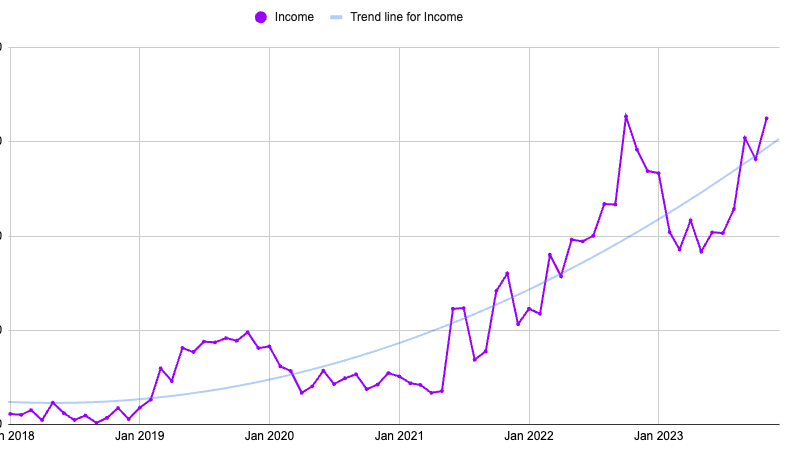
Whenever I had a big dip — especially one that lasted several months or more, I thought about giving up every day. (The end of 2020 was particularly rough.)
Sometimes, I decided that I would quit — only to come back to it a few days or weeks later through sheer stubbornness.
The Lesson
Whenever you have an awful day or an awful month, and you feel like quitting, remind yourself that it's normal for there to be peaks and valleys in your progress.
Take a break, and then get back at it. Perseverance is your greatest superpower in this business.
Final Thoughts
I'm not suggesting that it will take you as long as it took me to succeed — everyone's journey is different! Nor are these insights meant to discourage you.
On the contrary, if you’ve been finding this whole content creation thing hard, then take comfort in the fact that you are in good company, and it doesn't mean you are doomed to failure.
Yes, it is hard. It's also worth it.
Want to learn how to leverage AI to help take your content creation business to the next level? Sign up for my free masterclass.