
What is Your Ikigai and How Can You Achieve Success With It
Unlocking the best in yourself with ikigai
We all want to do the best we can with the gifts, talents, and time we have. To do our best and achieve the best, we need to focus on the areas where we are most competent to make contributions. That is what ikigai is all about: living a life of value.
What is the concept of Ikigai?
Ikigai is a Japanese expression 生き甲斐. 生き (iki) means life and 甲斐 (gai) means reason. Roughly translated then, ikigai is the reason for living or your life purpose. Living with ikigai equates to doing what best suits your skills, interest, and abilities for the betterment of society and also yourself.
What are the benefits of ikigai?
Living with ikigai means that you are at peace with your environment. Grateful for your life and ability to provide value. Embracing your ikigai also is at the heart of connecting to your universe: the people in your life, the work you do, and your interaction with the environment.
For me, living my ikigai is waking up grateful every morning. Reflecting and expanding my mind once up. Making contributions throughout the day that positively impact the world around me, and celebrating that day as I lay my head on the pillow at night. This kind of life is a blessing and creates a sense of happiness that never goes away, regardless of how bad things appear.
What are the 4 components of ikigai?
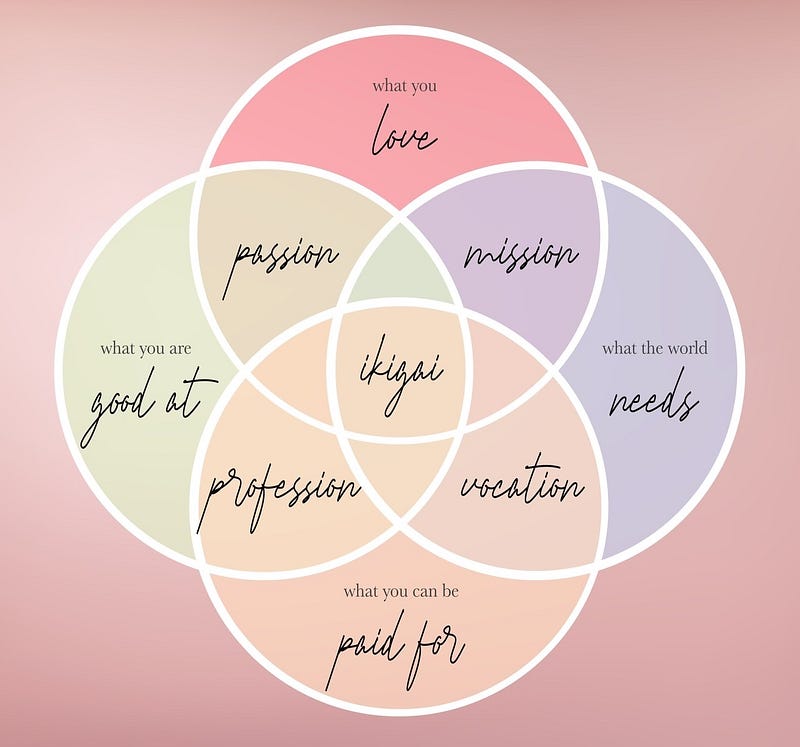
Your ikigai, or reason for living, can be found at the intersection of your personal evaluation of four key questions: What are you good at? What do you love? What can you be paid for? And what does the world need?
What are you good at?
Consider all the things you are good at now or have ever done well. It doesn’t matter if you like them or not. Hobbies, professional skills, technical abilities, chores, for example; make a list of everything that comes to mind.
What do you love?
What are the activities or things that you love? This question asks for your interests, so you do not necessarily have to be good at these things. For example, I love playing basketball, but I am not very good at it. In this area, also reflect on things. Do you have a spiritual connection, a love of music, or something else that makes you happy?
As with every one of these questions- document everything.
What can you be paid for?
Here, consider everything you could do to make a living. I know people with PhDs that are janitors. Anything and everything you could personally do to earn money goes here.
One caveat: these income sources need to align with your values and sensibilities. If you don’t like small children, you probably wouldn’t be able to make a living working at a nursery school.
What does the world need?
Apart from the other questions, this one focuses on your perception of areas that need attention in your community and the broader world at large. Consider the benefits of service in this section and the gaps you perceive in the types and quality of products and services.
OK, you’ve done the evaluation. What comes next?
Now that you have lists for each of the four areas, look for how they merge. What are the similarities between what you can are good at and what you love? Those are your passions. Make a list of those. The things you are good at and can be paid for are your possible professions; the types of work you will continue to improve in by enhancing your skills. The confluence of what you love and what the world needs is your mission. And the overlap between what the world needs and what you can be paid for is your vocation: the kind of contribution you feel you are destined to make.
Your detailed lists should have a convergence of these four areas. Find that, and you’ve identified your unique ikigai.
What is an example of ikigai?
My life mission is to leave people better than I found them (I love educating, and the world needs that). That guides me as a teacher, trainer, and coach. A profession I love. Over the years, I have become an accomplished instructor, and have been able to make a living at it as well. I moved from teaching English as a foreign language, to coaching, and now am developing an education-based business with courses that help individuals to achieve. However, I couldn’t live within my ikigai if I didn’t take the time to reflect every day and celebrate the ability to live another one, making others’ lives better in the process. The opportunity to impact lives is my reason to wake up every morning and get out of bed. Even when it’s cold or I don’t feel so great, I wake up excited to serve the world.
A butcher who can talk about the difference in cuts of meat all day long and slices of the most beautiful steaks every time you visit him is also living his ikigai. Similarly, the salesperson who finds joy in providing solutions to their customers’ problems and aiding their success has found where the elements of ikigai merge for her.
What do you get lost in and get a sense of contribution from? These are elements of what comprises your ikigai.
How can you apply ikigai to your daily life?
These six tips will help you live your ikigai not just in the work you do, but also in your everyday life.
Smile
Your life will definitely be better if you choose to smile.
Live in the moment
The past is behind you. The future is unwritten. All we have is this moment, so do your best with it.
Take it slow
When you rush, you create two problems:
First, you can not fully embrace the moment. If you eat your meal too quickly, you may not even remember the taste, for example. If you spend an evening out with friends and are constantly checking your phone, you are not giving your friends the pleasure of your company.
Secondly, rushing through an activity inevitably means you are not giving your best effort. You will miss details, and the sense of pride you feel from a job accomplished expertly will never materialize.
Surround yourself with good people
You will be more optimistic and create a sense of accomplishment when you choose to be around people who lift you up rather than finding faults. These people generally value life a great deal and want to be part of the solution rather than the cause of the problems.
Have gratitude
Being thankful for what you have in life, no matter how insignificant, will make your life fuller and more noteworthy. You do not need to have the biggest house or the nicest car to feel gratitude. It’s better to celebrate your health, the people in your life, and your opportunity to serve.
Connect with nature
We are all animals and part of the larger environment that surrounds us. Working in an office building all day and then commuting home creates a disconnect from the natural world. However, we can regain that sense of connection by taking a walk in the park or a hike in the woods. Even listening to the sounds of the sea or a mountain stream on YouTube will take you closer to nature and help to recalibrate your connection to the world around you.
Embrace imperfection
In Japanese, embracing imperfection is referred to as wabi-sabi. What this means for us in everyday life is to be ok with our efforts. Things will never be exactly as you would like them to be. If you’ve done your best, be content with that. No ifs, ands, or buts.
You may be making a meal for your family, and the vegetables come out overcooked while the meat got cold because it was finished too early. While your family will be perfectly happy with the meal, you find many reasons to complain about it. Instead, looking at the smiles on their faces, enjoying the conversation, and knowing that you are providing energy for their minds and bodies can give you a sense of accomplishment from your work.
Summing it up
Applying ikigai to your life will give you a heightened sense of purpose. You will meet each morning with joy and go through your day with a feeling of accomplishment, knowing that you have made a difference in the world and to yourself.
Want to discover your ikigai and live in balance with your environment? Join my course here.


