avatarZafar Ivaev

Summary

The article discusses the value-binding pattern in Swift, demonstrating its use in matching and comparing values within a switch statement through the case let syntax, and illustrates its practical application with code examples.

Abstract

The article provides an exploration of the value-binding pattern in Swift, which is a powerful feature for pattern matching. It explains how this pattern enables developers to bind matched values to constants or variables within a switch statement using case let. The author guides readers through a practical example by defining a Coordinate structure, creating an array of coordinates, and then using the value-binding pattern to match coordinates to specific cities. The article includes code snippets and a final output, offering a hands-on approach to understanding the concept. It concludes with an invitation to explore other Swift features through additional articles and promotes an AI service for those interested in further enhancing their programming knowledge.

Opinions

  • The author believes that the value-binding pattern simplifies the process of checking and comparing values in Swift.
  • The article suggests that using the value-binding pattern can lead to more readable and maintainable code.
  • The author endorses an AI service, ZAI.chat, as a cost-effective alternative to ChatGPT Plus (GPT-4), indicating a positive opinion about the service's performance and value for money.
  • By providing a series of related articles, the author implies that there is a wealth of Swift's features to explore and that continuous learning is beneficial for developers.

What Is the Value-Binding Pattern in Swift?

Match and compare values easily

Photo by Sergey Zolkin on Unsplash

Today we will explore the value-binding pattern in Swift by quickly implementing it in an Xcode Playground.

The value-binding pattern allows you to bind matched values to constants or variables in a switch, using a case let statement.

Let’s Start

Consider the following simple structure called Coordinate :

We have a named tuple containing the latitude and longitude Double values.

Let’s instantiate an array of Coordinates:

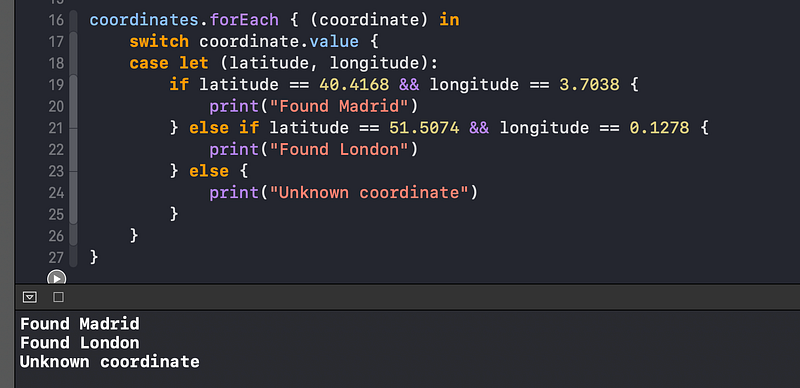
Now say we want to check whether a particular Coordinate matches to a city. We use the value-binding pattern for that:

The case let statement allows us to deconstruct each coordinate’s value property into two constants, called latitude and longitude. As a result, we can easily and conveniently check and compare these values.

We have the following output:
Full source code:

Wrapping Up

Interested in other Swift features? Feel free to check out my other relevant pieces:

Thanks for reading!

Swift
Programming
iOS
Mobile
Xcode
Recommended from ReadMedium