
What is the Soul of Painting?
Historical clues about Contemporary Art.
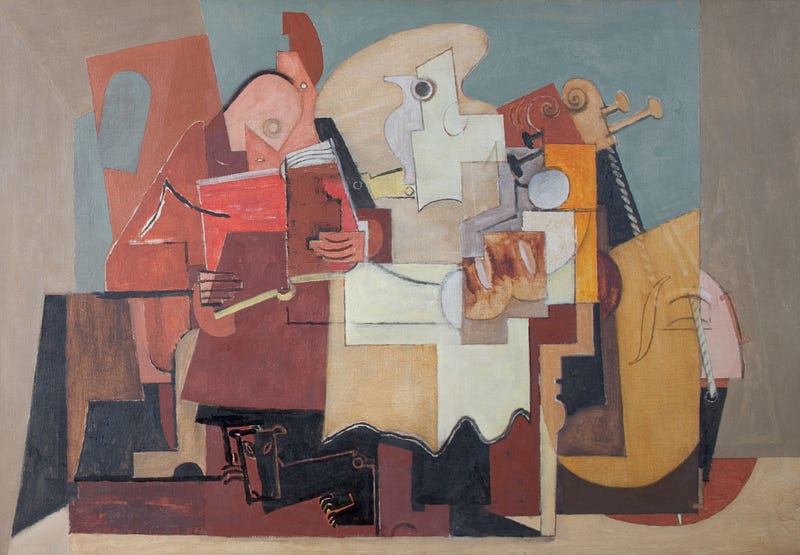
Stepping into a museum, you’re immediately struck by paintings from the past. These are highly detailed representational works, whether still life or landscapes, portraying nuances even a camera can’t replicate. The artists behind these were devoted to faithfully imitating nature as it met the eye. They operated under the belief that art’s primary purpose was to mimic nature.
However, as the 20th century dawned, profound shifts in physics, technology, and art began to emerge.
What transformed the world of art?
In this pivotal period, a little-known book entitled “The Rise of Cubism” [35 pages] by Daniel-Henry Kahnweiler, written in 1915 and published in 1920, provides the best explanation. Although out of print and hard to find, this book is a gem, and you can get it on www.ForgottenBooks.com.
Kahnweiler was a Parisian art dealer in 1907 and shared close friendships with Pablo Picasso and George Braque, two of the most celebrated Cubist painters.
In his account, Kahnweiler acknowledges the emotional struggles these painters endured while venturing into these new artistic expressions.
Parallel Paradigm Shifts: The Copernican Revolution of Art
Much like how Copernicus shattered the geocentric worldview by revealing the earth’s orbit around the sun, artists like Picasso and Braque revolutionized art by asserting that artists aren’t merely reflectors of their surroundings. Instead, they are inventors exploring an unknown territory, akin to setting sail on a vast, uncharted sea.
Kahnweiler describes the deep anguish Picasso and Braque experienced in the process of creating Cubism. They feared that people might perceive it as decorative, rather than revolutionary. The emotional toll of presenting a concept that challenges established norms can be immense. It demands courage to withstand potential criticism, skepticism, or misunderstanding from peers, critics, or the public. This process necessitates immense emotional fortitude and resilience.
Intellectual and Artistic Revolution
Copernicus’ heliocentric theory sparked a revolution in astronomy, transforming humanity’s understanding of the cosmos. Similarly, Picasso and Braque’s departure from traditional representation initiated an artistic revolution, forever altering the trajectory of visual expression. Both instances exemplify how a single insight can reshape an entire worldview and a time-honored practice such as painting.
In the world of art, as in the cosmos, paradigm shifts are not just moments of revelation, but continuous processes of evolution. Picasso, Braque, and their contemporaries didn’t just paint; they embarked on a journey of self-discovery, forever altering the course of art.
Today, as we stand before abstract canvases and intricate installations, we witness the legacy of these pioneers. The soul of painting, once bound to imitation, now dances through the realms of inner subjective expression. It’s a testament to the enduring power of human creativity, forever seeking new forms of self-actualization on the canvas of existence.