What Is The Simplest Definition Of Agile!
I have been pondering about the simplest definition of Agile! This is my take on the topic!

I recently talked to a group of young people about what they thought Agile was. They have never worked in a non-SAFe setup and have only read about waterfall/watched other teams do it. The below was the interpretation they had (this is based on actual events, but fiction added for dramatic purposes).
There was once a thing called Waterfall, and it was huge and scarily complex. It has created all the software stuff in the world so far, but its time to evolve has come. And then came another beautiful thing called Agile.
A bunch of people went into a room and brainstormed until they all came out with something called an Agile Manifesto. It changed the world, tilted the earth’s axis by just the right degree, and it was suddenly, summer everywhere. When we just leave it to people, they trust each other, and the team moves like a self-guided missile to achieve any ‘mission impossible.’
All that any organization has to do to acquire such superpowers and move from the software hell to heaven was just to take on that agile transformation.
While they used different words, this is what they meant and the conversation made me think about the simplest definition of Agile·
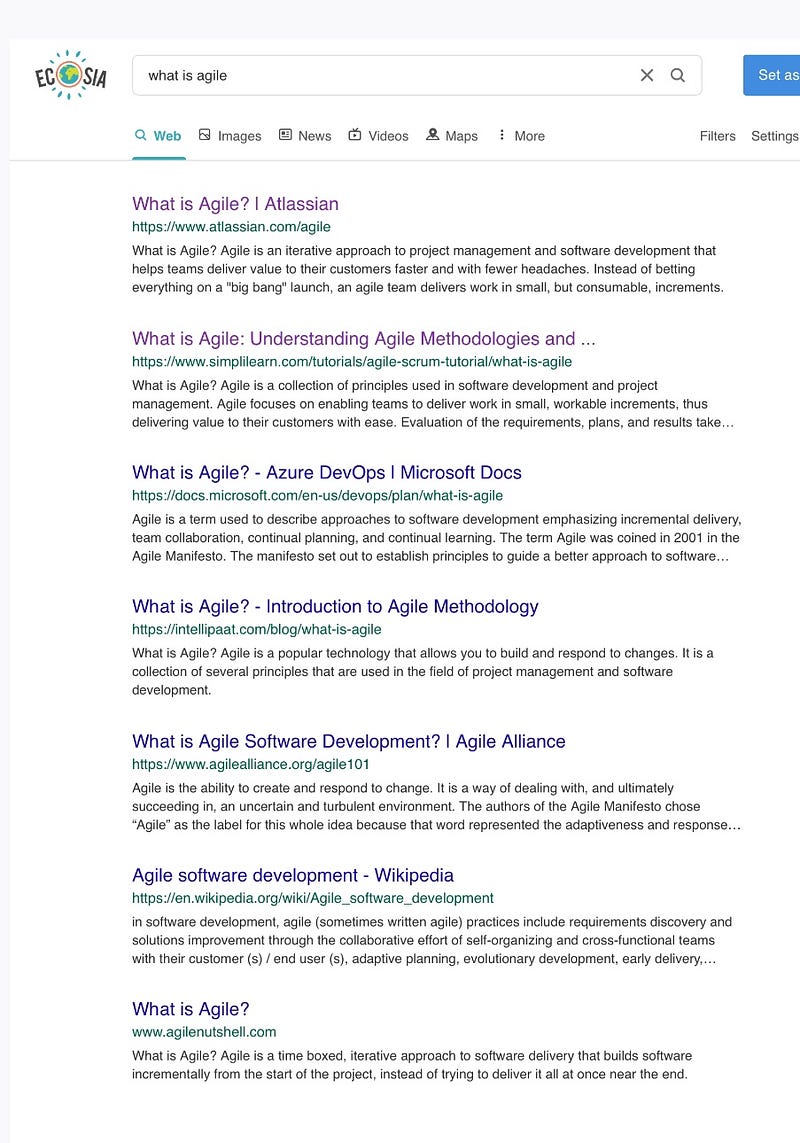
I have been working in some agile setup for the last 6+ years but couldn’t land on a simple version of this definition. Like any wise person would do, I looked to the internet for answers. A simple search showed me that the top 10 results have a common theme, but they don’t say the same exact words (screenshot at the end). This leads to the fact that you either make up your own definition or align to the one that is closest to your understanding/belief of what Agile is.
So I decided to create my own version. It needed to be simple, fit inside ten words, without using any complex vocabulary! Here it is!
Being Agile is creating & reacting to change, fast!
I consciously do not include these words – predictability, trust, manifesto, methodology, practices, scrum, kanban, planning, learning, servant leadership, etc. They all matter, but I do not want to include them in the simplest form of definition!
There are no frameworks necessary to be agile; you can just be! You can be agile at building software, or making a cake, or walking your dog. It is the mindset to react to change and find the best next step quickly that makes one agile! (Note: We are still talking about my definition!)
Can you think of another thing where change has been constant, and people had to think of finding a way forward? I’m sure there are dozens of good examples, but the one that springs to my mind is human history. We always had changes forced upon us and found ways to overcome them by building/changing/avoiding these.
Look how far humanity has come in the last few millennia (it’s a blip in the radar when we compare it to the age of homosapiens as a species).
Is being Agile too different from this? One is given a set of circumstances and then has to make the best of it. And stuff keeps changing around them, and they have to find ways to move forward constantly. They make mistakes, move backward sometimes, but learn and move forward overall.
Ok, enough of me now! I’m keen to hear your views; please drop in a comment or two on what you think is the simplest definition of Agile (or point me to somewhere if the ideal version already exists)!
Edit: There are some fantastic additions in the comments section! Thank you wonderful people, I write to learn as much as I do to share!
By the way, I write on a lot of other topics. More about what I write here!
Please follow me and subscribe to emails so you’ll know as soon as my next post is out. You can join in and get access to the work of thousands of writers, use the link here!