
What is the Purpose of Transitions?
Building bridges to connect ideas

In writing, a transition serves the purpose of creating a smooth and easy to follow chain in ideas. Their addition to writing increases understanding as well as the pleasure of reading. Think of a transition as a bridge linking ideas. Without transitions in writing, the reader is required to leap from one idea to the next and can then fall into the chasm of misunderstanding.
Transitions create links
They can be placed between parts of sentences, connect sentences together and attach paragraphs. Notice how one word unifies the following sentences.
Example without transition
The three-year-old girl swam and giggled as she played in the wading pool. Her shrieks provided evidence of the pleasure with each splash of the water. Her mother watched cautiously from the lawn chair positioned within inches of the edge of the pool. She wanted to protect her daughter from any harm that might turn the laughter into tears.
Example with transition
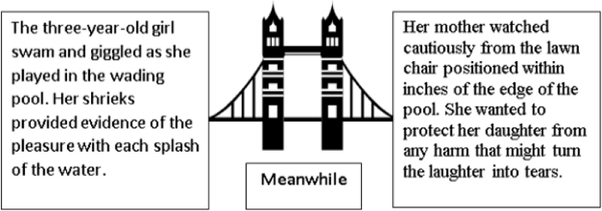
The author’s choice to use “meanwhile” as a transition informs the reader that the two events occur simultaneously. Writers who understand the purpose of words, choose transitions to accomplish their goal.
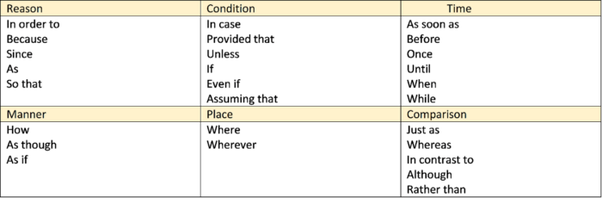
Basic transitions
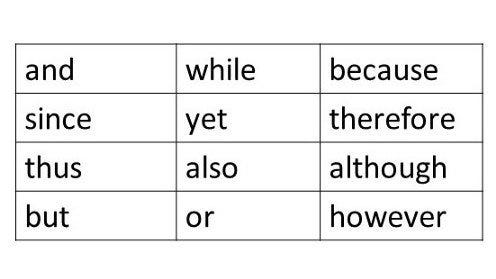
Transitions create smooth movement in the narrative by joining sentences together. Notice how the following sentences are created by joining two independent clauses together.
- Children slept calmly in their beds while barking dogs howled at the moon.
- A police officer arrived with lights flashing because a car crashed through the fence and flipped on the grass.
Transitions in description
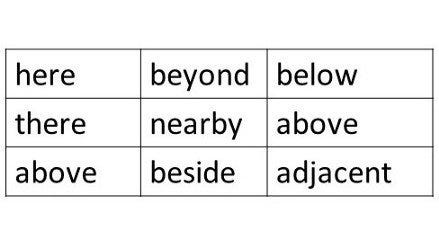
Example without transitions
A sculpture with open arms welcomed guests as it stood in the vestibule. It signaled reverence. Two pale green walls relaxed visitors. A chandelier, brilliant in appearance, illuminated the portraits of past leaders. One chair sat empty and uninviting. A small yet colorful floral arrangement graced a small, round table. The room remained void of furniture other than this.
Example with transitions
In the middle of the vestibule stood a sculpture with open arms like a steward welcoming each guest yet so ominous it signaled reverence. Two pale green walls on either side relaxed visitors. The décor of the room was arranged around the statue. Overhead a similar a chandelier, brilliant in appearance, illuminated the portraits of past leaders that hung adjacent to the door on the far wall. Near that door, one chair sat empty and uninviting. A small yet colorful floral arrangement graced a small, round table. Otherwise, the room remained void of furniture.
Transitions show a sequence of events
Example without transitions
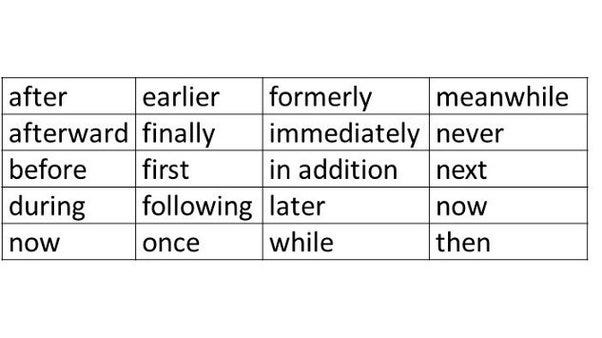
The girl awoke. She heard her mother in the kitchen. The girl crawled out of bed. She went into the bathroom to take a shower and get dressed. The girl sat at the table and ate breakfast. Her mother handed her lunch. She walked out the door for school.
Example with transitions
Once the girl awoke, she heard her mother in the kitchen. Soon, she crawled out of bed. When she went into the bathroom, she first took a shower and then dressed. Afterward the girl sat at the table and ate breakfast. Finally, her mother handed her lunch as she walked out the door for school.
Transitions using pronouns
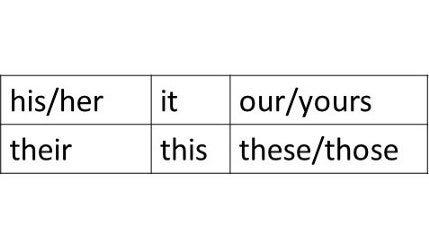
A pronoun is a word that replaces the noun in the sentence. They work as transitions to reduce redundancy.
Example without pronouns as transitions
Don and Sue walked the dog. Don and Sue went along the sidewalk. The sidewalk circled the neighborhood. The dog saw a cat and chased the cat into a tree. Sally came out of the house to get the cat. Don apologized for the dog’s behavior.
Examples with pronouns as transitions
Don and Sue walked the dog. They went along the sidewalk as it circled the neighborhood. Their dog saw a cat and chased it into a tree. Sally came out of her house to get her cat. Don apologized for his animal’s behavior.
Transitions in cause and effect
Example without transition
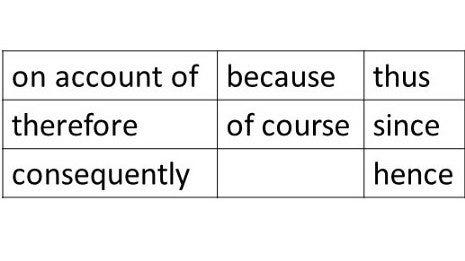
There was an earthquake. The buildings fell to the ground.
Example with transition
Since there was an earthquake, the buildings fell to the ground.
Transitions in conclusions
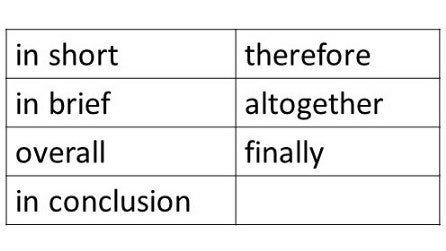
These words and phrases signal the reader the end is approaching. They are not always necessary; however, when the conclusion works to unify information or emphasis a key idea, it helps to alert readers.
In conclusion
Transitions work as signposts function along roadsides for travelers. They indicate approaching turns, notify of essential data, share information for a smoother ride and understanding.