
What is the Probability that the Sun will Rise Tomorrow?
It’s not 1 according to Laplace’s Rule of Succession!

Readers may think that the question on the subject line is a trick question as the sun will always rise. I argue not, please read on!
Problem Re-defined
Now if the readers can bear with me, I’m going to re-define the problem as follows:
Imagine you have 5 stones in a bag. The stones can be either black or white. Drawing the stones with replacement (i.e. stone is put back into the bag after being drawn), you had drawn a black stone 5 times in a row. What is the distribution of the stones by colour?
You should easily see that the question on the subject line is essentially a transformation of the same problem, with the exception that the ‘black stone’ (i.e. the event that the sun rises) had been drawn consecutively everyday for at least the last 5,000 years.
The Maximum Likelihood Estimator
To make the problem more general, let p denote the true proportion of black stones in the bag (which makes the true proportion of white stones in the bag (1 - p)). Further, let n denote the total number of times a stone is drawn, and let k denote the number of times the black stone is drawn (with replacement).
The probability of drawing k black stones out of n draws, or P(n, k) is then given by:

Now we have an observation of n = 5 and k = 5, what does this tell us about the distribution of the black and white stones in the bag? In other words, what’s the maximum P(n, k) given actual observations of n and k?
The question above can be answered by seeking the derivative of Equation (1), or alternatively, by seeking the derivative of the logarithm of Equation (1). The derivative is given by:
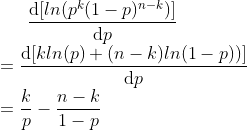
Equating the derivative to 0 for the maxima and solving for p gives p = k/n.
In plain English, this is saying that given the black stone has been drawn k times out of n times, the most probable true proportion for the black stones given the observations is k/n. If the black stone has been drawn 5 out of 5 times, then the most probable true distribution of the black stone is 5 out of 5 (corresponding to p = 100%).
The concept of “most probable” is critical here. From another perspective, if the true distribution of black stones is 4 out of 5 (or p = 80%), there is still a chance that the black stone can be drawn 5 out of 5 times. In fact, this probability is 32.8% (or 80% to the power of 5). By the same logic, this probability is 7.8% if the true distribution of black stones is 3 out of 5. However, these are not the most probable events.
Now, given the observation that the sun had risen everyday for at least the last 5,000 years, or n = k = 5,000 x 365 days, the most probable conclusion given this observation is that the sun will continue to rise tomorrow, and thereafter.
Laplace’s Rule of Succession
The above presents one way of estimating the true proportion/probability of an event. However, according to Laplace’s Rule of Succession, p as defined above is given by:
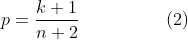
The proof of this can be found in this link.
Although p under Laplace’s Rule of Succession appears only slightly different from k/n, the implication is profound in the context of the problem at hand. It suggests that there is a chance that the sun will not rise tomorrow!
Mathematically, there are 5,000 x 365 days in the last 5,000 years, putting this into Equation (2) gives a probability of 99.999945%. That is, there is a 0.00005% chance that we won’t see the sun tomorrow!
If you are interested in articles such as this one where the writer forcefully relates real-life observations to the invention of maths, you may be pleased to find more enjoyable reads by following or visiting the writer’s Medium profile.
Similar articles you may like:
99¹⁰⁰ and 100⁹⁹, which number is bigger?
What’s the Probability of “1” Appearing as the First Digit of a Number?


