
What is the one quality which Muhammad Ali had but wasn’t talked about enough?
I know this aspect of Ali does get talked about but, to me it is often understated or misrepresented. I’d like to discuss Ali’s ability to change his fight plan and make adjustments on the fly within the match. Ali truly was a genius in the ring during his best years. His ability to measure his opponents up on the fly is illustrated best during the Ali-Foreman fight in ‘74.
People love to comment on the ‘Rope-a Dope’ as Ali coined the strategy after the fight, but they often misunderstand where the true genius was within that technique. Often, people believe that the Rope-a-dope was Ali putting his gloves up in a guard position while being unable to leave the ropes while Foreman thundered punches relentlessly against him, which is a perspective that lacks a lot of insight.
Here is one such quote from the Center for Strategic International Studies which reflects the sentiment:
“Muhammad Ali, probably the greatest boxer of all time, adopted a signature strategy in his 1974 fight against George Foreman in Kinshasa, Zaire. During the so-called Rumble in the Jungle , Ali allowed himself to be pushed against the ropes, absorbing blow after blow, round after round. Most observers thought the hard-punching Foreman was winning the match. But Foreman began to tire by the fifth round, and he was exhausted by the eighth. Then, Ali unleashed a punishing barrage of punches to Foreman’s head that sent Foreman reeling. He stumbled to the mat, and the bout was over.’ [1]
If that fight strategy were true, there would be no way that Ali would have won that fight for two really big reasons:
- No man could have taken a constant thunderous barrage from Foreman for that many rounds and still have been standing. Even when your guard is up punches will be getting through and either your body or your face are going to be showing drastic signs of wear very quickly.
- The ref would have stopped the fight after a consistent amount of rounds went by where Ali was unable to fight back for the fighters safety.
The truth is the Rope-a-dope was so much more than just blocking and waiting. The Rope-a-dope was a shining example of Ali’s true ring prowess which made him so dangerous to fight. Coming into the fight Foreman was seen as a near sure win due to his unstoppable power and due to Ali’s increasing age. The bookies had the fight set at 4:1 odds against Ali. [2]
Ali’s fight plan which he confirmed after the fight was for him to beat foreman with his ‘fly like a butterfly sting like a bee’ approach that he is so famously known for. In the first round Ali came out looking to make an impression and he used his speed and agility to thunder at Foreman methodically and relentlessly for the entire round. [3]
Cus D’Amato told Ali the night before the fight to get in there fast and throw his punches with ‘bad intentions’ because Foreman was a bully and he needed to have some fear put into him. By the end of round on, Ali knew that his first round fight plan was not going to work through the fight’s entirety, and he knew that he needed to change things up on the fly in order to win this thing.
Ali simply was unable to really effect Foreman with a direct assault as Foreman’s guard wasn’t easy to get through and Ali was expending energy at an unsustainable rate for having any chance at lasting through the entire fight. [4]
It was in the second round that you could see that Ali’s new fight plan was being hatched. It wasn’t from him getting beat on against the ropes but it was from him doing what he did best which was utilizing his speed and dexterity to make his opponent miss. Yes, you heard that right. The Rope-a-dope was successful not because it tired foreman out from beating on the man but because Foreman kept missing the man.
There is a strategy in place by the end of the second round which would see Ali come out with the victory. It started with foreman throwing a left.
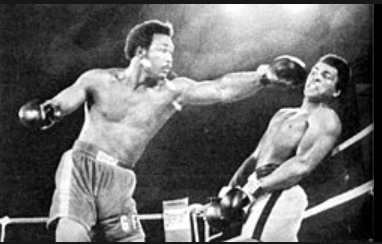
The genius of the rope-a-dope came when Ali was trying to use his speed and agility but Foreman was pressing him hard and he found that when he leaned back on that top rope the rope had the effect of bending and allowing him to escape the punch as we see in this picture above. The rope also had the effect of providing him with a small amount of spring back which would allow Ali to come back to an over extended Foreman and clip him with a hard right.
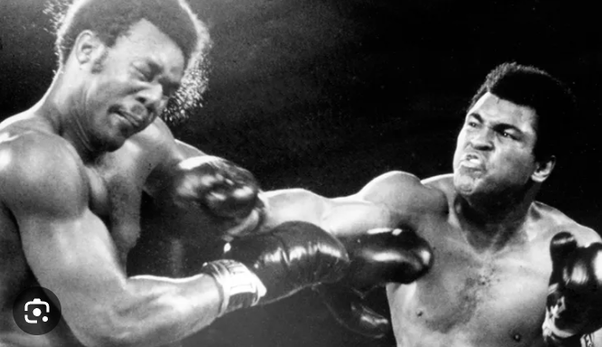
So the rope-a-dope strategy was not about letting him play himself out simply by punching Ali, it was an intelligent, strategic, boxing master doing an on the fly adjustment from an ineffective tactic to one that worked in order to win the fight. It was about making Foreman miss and counterpunching not about being a punching bag.
On that note, Ali also used his strategic assessment to turn one of Foreman’s ‘tricks’ against him. foreman liked to get his gloves in the face of his opponent to blind them and to cause them to throw blind punches thus creating openings he could capitalize on.
Ali found a way to use Foreman’s arm as a distance gauge where he would throw a calculated punch blindly but in such a way as to catch Foreman with his guard open almost each time he tried to use the trick.
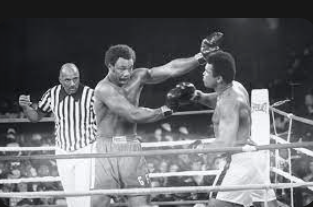
Ali would go under the glove and see an open foreman he could clip with his right. This trick of Foreman’s foiled many fighters he fought against, but on the fly Ali found a solution which turned the tables in his favor.
References:
- https://www.csis.org/analysis/muhammad-alis-foreign-policy-lessons#%3A~%3Atext%3DMuhammad%20Ali%2C%20probably%20the%20greatest%2Cafter%20blow%2C%20round%20after%20round.
- https://www.britannica.com/sports/Rumble-in-the-Jungle
- https://time.com/4637842/muhammed-ali-george-foreman/
- https://nationalpost.com/sports/how-muhammad-ali-won-the-rumble-in-the-jungle