
What is the Federal Reserve and how is it fighting inflation?
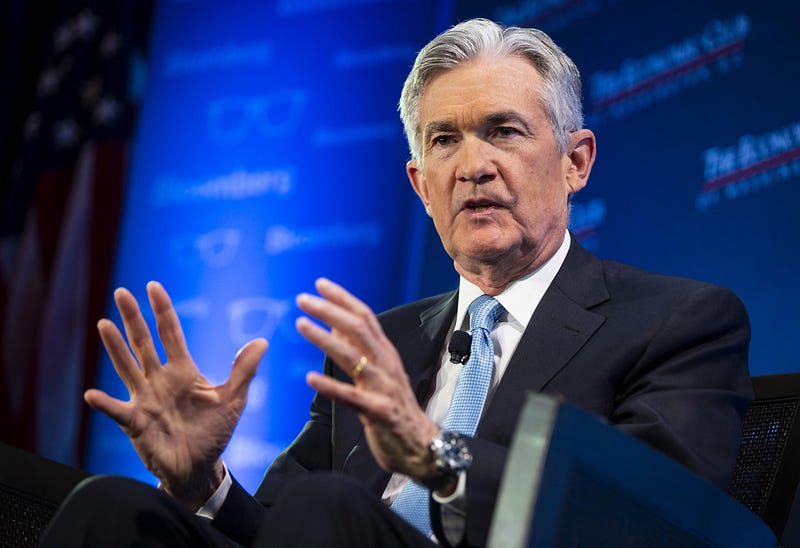
So you’ve probably seen this guy on the news a lot.
He’s one of the most important people in the world right now. This is Jerome Powell, the head of the Federal Reserve, who’s facing a ton of pressure.
With inflation threatening the economy and fears of recession rising, what is Jerome Powell and the Federal Reserve doing right now?
What Does the Fed Do?
The Federal Reserve, commonly referred to as the Fed, is the central bank of the United States. It’s considered one of the most powerful financial institutions in the world.
The Fed performs five general functions in order to ensure the effective operation of the U.S. economy and the public interest.
- The Fed conducts the nation’s monetary policy in a way that promotes maximum employment and stable prices in the U.S. economy.
- The Fed helps maintain the stability of the financial system. This just means they help get the overall system in a place where financial institutions and financial markets can provide people and communities with the resources they need to invest, grow, and take part in the overall economy.
- The Fed supervises and regulates the financial institutions to make sure that they employ safe and sound business practices and comply with all applicable laws and regulations. The Federal Reserve oversees over 5,000 financial institutions, mostly banks, and works to ensure these institutions use safe and sound business practices and comply with laws and regulations.
- The Fed fosters payment and settlement system safety and efficiency. The Fed helps keep cash, checks, and electronic transactions moving throughout the economy by providing liquidity and services to banks such as transferring funds, collecting checks, and distributing currency and coins.
- The Fed promotes consumer protection and community development. Nearly all Americans are involved in the financial system in one way or another. In fact, the Fed found that over 98% of households have a checking or savings account. So whether it’s a checking or savings account, a mortgage, a credit card, or student loans, you’re definitely involved in the financial system.
The Federal Reserve’s unique structure allows them to effectively implement monetary policy. But how?
Because the Fed is independent from the federal government, politicians focused on winning elections can’t directly influence policy in a way that benefits their re-election bid over the Fed’s primary goal.
In summary, the Fed’s goal is to make sure that the American financial system is safe, stable, and operating in a way that promotes both maximum employment and price stability. To accomplish this goal, the Fed uses economic data from regional banks to make independent decisions about monetary policy.
Max Employment + Price Stability
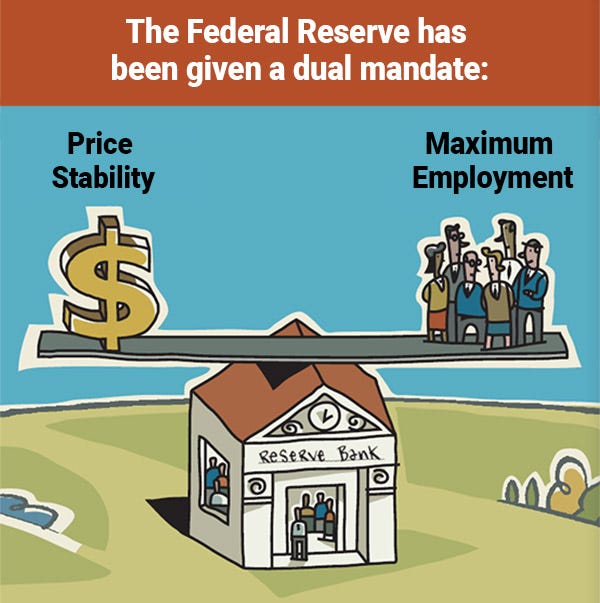
So in the overview of what the Fed does, I wrote the phrase “maximum employment and price stability”.
This phrase is extremely important and is known as the Federal Reserve’s dual mandate. Everything that the Fed does must effectively promote this dual mandate of maximum employment and stable prices.
According to Investopedia, maximum employment, also known as full employment, is the highest level of employment that the economy can sustain over time. During max employment, almost everyone that wants a job can get a job. Measuring what max employment actually can be quite hard and can also vary. Because of this, the Fed doesn’t have a set target for the ideal level of employment and will just use data to make policy that seems best for the current environment.
Price stability is less arbitrary and more intuitive compared to max employment. Price stability simply means that inflation remains low and stable over the long run. When inflation is low and stable, people can hold cash without having to worry too much that high inflation will destroy its purchasing power. As the chair of the Federal Reserve, Jerome Powell, said in 2020:
In conducting monetary policy, we will remain highly focused on fostering as strong a labor market as possible for the benefit of all Americans. And we will steadfastly seek to achieve a 2 percent inflation rate over time. (Source)
So why is the Fed ok with 2% inflation? Did they just pick 2%?
This is a great question, and one that is actually unclear to some economists. Here’s the best explanation I could find.
Starting in 2012, the FOMC began talking about an inflation target of 2% as they decided that this was the most consistent over the longer run with the Fed’s mandate. They explained that 2% would “foster price stability and moderate long-term interest rates” as well as “enhancing the Committee’s ability to promote maximum employment.”
While the benefits of having a 2% inflation target have been debated, the Fed believes that having this target can prevent deflation and keep inflation expectations steady.
Keeping inflation expectations stable is actually important because expectations can determine real inflation. As the St Louis Federal Reserve Bank President, James Bullard, wrote in 2016:
Firms and households take into account the expected rate of inflation when making economic decisions, such as wage contract negotiations or firms’ pricing decisions. All of these decisions, in turn, feed into the actual rate of increase in prices. (Source)
How the Fed Implements Monetary Policy
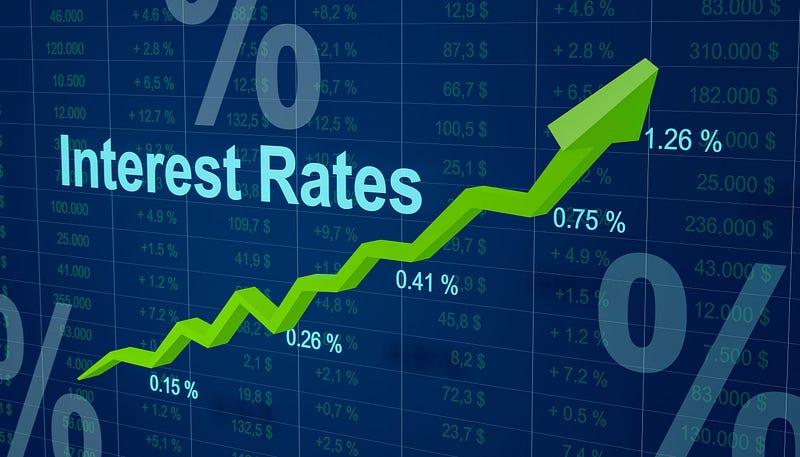
So this dual mandate of price stability and max employment sounds great, but what tools does the Fed actually have to ensure this mandate is achieved?
The first is interest rates. By lowering interest rates, the cost of borrowing money goes down, and there is less incentive to save, which encourages people to spend.
Therefore, lowering interest rates results in higher spending and lower savings, leading to higher overall economic activity.
However, lowering interest rates too much could increase inflation. Since the total supply of goods and services is finite in the short-term, if there is more demand for that finite set of products and services, prices will go up.
If there is high inflation, the Fed raises interest rates in order to increase the cost of borrowing and raise the incentive to save, which discourages people from spending.
But if you raise interest rates too much and the cost of borrowing and the incentive to save both increase, you could end up with a recession as economic activity comes to a halt.
Raising and lowering interest rates is a very complex task and can have massive implications on the economy.
The other tool the Fed uses is called open market operations.
Open market operations refers to the practice of buying and selling U.S. Treasury securities, along with other securities, on the open market in order to regulate the supply of money that is on reserve in U.S. banks. This strategy can be used to either stimulate the economy or tighten the economy.
If the Fed’s goal is to stimulate economic growth, it buys treasury securities to put more cash into the banks. This then puts pressure on the banks to lend that money out to consumers and businesses. As the banks become more flush with cash, interest rates gradually decline and borrowing becomes cheaper.
On the other hand, if the Fed’s goal is to slow down an overheating economy, it’ll sell treasury securities to pull money out of the banking system. The cost of borrowing will increase as consumers pull back on their spending and business growth will slow down as the overall economy tightens.
Similar to raising and lowering interest rates, increasing and decreasing the cash supply in the economy is a very delicate situation. Pulling too much money out of the system could cause an economic slowdown leading to recession, while increasing the money supply by too much could cause rampant inflation.
Overall, the Fed’s job is really tough. Overtightening could drive the country into recession but being too loose could lead to persistent inflation. Over the coming months, we’ll see if the Fed is successfuly with it’s objective of bringing down inflation without causing recession.
Thanks for reading! I hope you found this to be insightful.
Sources:
- https://www.federalreserve.gov/aboutthefed/files/the-fed-explained.pdf
- https://www.federalreserve.gov/aboutthefed/structure-federal-reserve-system.htm
- https://www.federalreserve.gov/aboutthefed/the-fed-explained.htm
- https://www.investopedia.com/terms/f/federalreservebank.asp
- https://www.stlouisfed.org/in-plain-english/the-fed-and-the-dual-mandate
- https://www.investopedia.com/articles/investing/100715/breaking-down-federal-reserves-dual-mandate.asp#:~:text=Maximum%20employment%20is%20also%20referred%20to%20as%20full,a%20job%20can%20secure%20one%20during%20maximum%20employment
- https://www.federalreserve.gov/newsevents/pressreleases/monetary20120125c.htm
- https://www.investopedia.com/ask/answers/111414/how-can-inflation-be-good-economy.asp
- https://www.federalreserve.gov/faqs/economy_14400.htm


