avatarMichael Dalton

Free AI web copilot to create summaries, insights and extended knowledge, download it at here

1415

Abstract

4 grams.</p><p id="5412">So the mass of the universe is 3.57 * 10^80 * 6 * 1.67 * 10^–24 grams = 3.58 * 10^54 kg.</p><p id="933a">Other <a href="https://hypertextbook.com/facts/2006/KristineMcPherson.shtml">estimates of the mass of the universe</a> vary between 10^53 kg to 10^60 kg.</p><p id="c59a">Dr. Melvin Vopson argues that <a href="https://www.researchgate.net/publication/333751969_The_information_content_of_the_Universe_and_the_implications_for_the_missing_Dark_Matter">information has mass</a>. Based on Landauer’s Principle for each bit of information lost irreversibly, the entropy of a system must increase with an absolute value of heat released per bit lost. When this principle is combined with Einstein’s equation E = mc², the mass of a bit of information can be calculated from the equation:</p><p id="3ec8">Massᵇᶦᵗ = mᵇᶦᵗ = kᵇ * T * ln(2)/c²</p><p id="b529">where:</p><p id="0810">kᵇ = Boltzmann’s constant = 1.38 * 10^–23 J/K</p><p id="0e6e">T = Temperature at which bit of information is stored (current temperature of universe is 2.73 ᵒK)</p><p id="3354">c = speed of light = 2.99792458 * 10^8 m/sec</p><p id="4c92">Hence: mᵇᶦᵗ = 2.9 * 10^–40 kg</p><p id="1c2d"><a href="https://arxiv.org/pdf/quant-ph/0110141.pdf">According to Professor Seth Lloyd</a>, the number of bits that can be registered by the universe requires a calculation of its maximum entropy. In his estimate, Lloyd ignores the

Options

value of several terms when calculating the number of bits. He also assumed there was one hydrogen atom per cubic metre of space. Consequently, his estimate of the number of bits in the universe i.e. 10^92 needs to be adjusted by a factor of at least 20.4.</p><p id="4c1e">With 20.4 * 10^92 bits of information in the universe, stored at 2.73 ᵒK, the total mass of the universe would be 20.4 * 10^92 * 2.9 * 10^–40 = approximately 10^54 kg. This estimate is the same order of magnitude as the mass of the universe estimated using the mass of a hydrogen atom and the volume of the universe (3.58 * 10^54).</p><p id="140d">In summary, estimates of the mass of the universe seem to be reasonably consistent with the hypothesis that the universe is made out of bits of information.</p><p id="8ec2">The question for this article is:</p><p id="d15e"><i>Does our universe compute what events will happen in our future?</i></p><p id="39aa">To view the headings of all the articles to be published in this series please click on <a href="https://readmedium.com/orbiting-stars-and-origin-of-our-universe-338906930f51">https://readmedium.com/orbiting-stars-and-origin-of-our-universe-338906930f51</a></p><p id="5f78">To obtain a copy of the book ‘Orbiting Stars’ which contains the first drafts of all these articles, please visit <a href="https://www.amazon.com/dp/B09L6VK75K/">https://www.amazon.com</a></p></article></body>

Astrophysics

What is the computational capacity of our universe? (# 23)
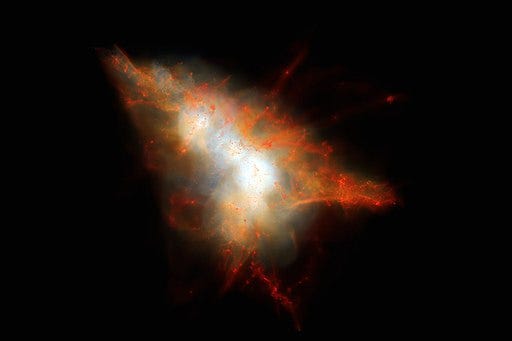
Computer simulation of a huge concentration of gas in space by J.Geach/D.Narayanan/R.Crain

Circumstantial evidence supporting the hypothesis that our universe behaves as if it is a quantum computer comes from comparing the mass of the universe estimated with the mass associated with bits of information and the mass of the universe based on the mass of hydrogen atoms.

The volume of the observable universe according to Wolfram Alpha is:

3.57 * 10^80 cubic metres.

Recent research suggests:

“if all the matter in the universe were spread out evenly across space, it would correspond to an average mass density equal to only about six hydrogen atoms per cubic meter.”

The mass of a hydrogen atom is 1.67 * 10^–24 grams.

So the mass of the universe is 3.57 * 10^80 * 6 * 1.67 * 10^–24 grams = 3.58 * 10^54 kg.

Other estimates of the mass of the universe vary between 10^53 kg to 10^60 kg.

Dr. Melvin Vopson argues that information has mass. Based on Landauer’s Principle for each bit of information lost irreversibly, the entropy of a system must increase with an absolute value of heat released per bit lost. When this principle is combined with Einstein’s equation E = mc², the mass of a bit of information can be calculated from the equation:

Massᵇᶦᵗ = mᵇᶦᵗ = kᵇ * T * ln(2)/c²

where:

kᵇ = Boltzmann’s constant = 1.38 * 10^–23 J/K

T = Temperature at which bit of information is stored (current temperature of universe is 2.73 ᵒK)

c = speed of light = 2.99792458 * 10^8 m/sec

Hence: mᵇᶦᵗ = 2.9 * 10^–40 kg

According to Professor Seth Lloyd, the number of bits that can be registered by the universe requires a calculation of its maximum entropy. In his estimate, Lloyd ignores the value of several terms when calculating the number of bits. He also assumed there was one hydrogen atom per cubic metre of space. Consequently, his estimate of the number of bits in the universe i.e. 10^92 needs to be adjusted by a factor of at least 20.4.

With 20.4 * 10^92 bits of information in the universe, stored at 2.73 ᵒK, the total mass of the universe would be 20.4 * 10^92 * 2.9 * 10^–40 = approximately 10^54 kg. This estimate is the same order of magnitude as the mass of the universe estimated using the mass of a hydrogen atom and the volume of the universe (3.58 * 10^54).

In summary, estimates of the mass of the universe seem to be reasonably consistent with the hypothesis that the universe is made out of bits of information.

The question for this article is:

Does our universe compute what events will happen in our future?

To view the headings of all the articles to be published in this series please click on https://readmedium.com/orbiting-stars-and-origin-of-our-universe-338906930f51

To obtain a copy of the book ‘Orbiting Stars’ which contains the first drafts of all these articles, please visit https://www.amazon.com

Cosmology
Universe
Physics
Information
Computation
Recommended from ReadMedium