
What Is The Buffet Indicator Telling Us About The Market
And some of us already knew
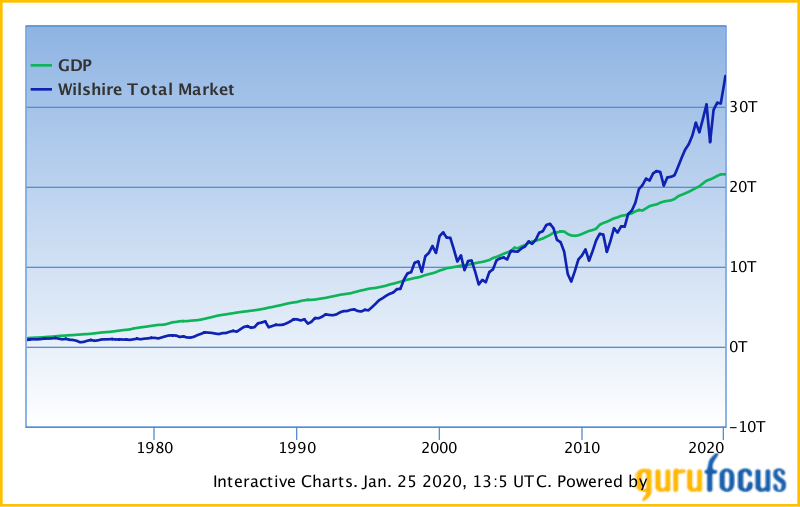
What is often called the “Buffet Indicator” is telling us that the current market is significantly overvalued. Not a surprise in my perspective.
As far as I see, the more it keeps going up without any sort of correction, it just makes me guess that when it comes, it will be an ugly one.
I confess that buying the current market condition is leaving me uncomfortable.
As a long term investor, I should not worry too much about it but it makes total sense that I become more cautious when deploying new money.
The Indicator Message
According to Warren Buffett, the percentage of total market cap (TMC) compared to the US GNP is:
“probably the best single measure of where valuations stand at any given moment.”
The current market cap is overvalued by 157%. This is an astonishing number!
And the highest value since the “Tech” bubble in 2000…
What history tells us, is that stock market valuation tends to revert to its mean. By being overvalued, the likelihood is that soon we will have an inversion.
And by inversion, it means the stock market expected returns are likely to be lower in the short term future.
What Can We Do
In my perspective, we can prepare for a near term correction, pullback or even a crash.

Instead of deploying new money in full to the equity market, we can select alternative assets as a preventive measure.
In other words, do not go all in…
Storing some cash in what is generally called safe heavens like the US Dollar, the Swiss Franc or the Japanese Yen can be a strategy.
US treasuries might be another option as well.
This tactic would bring some diversification to the portfolio and the effect of a possible “crash” would not be as severe as if we were 100% equities.
More advanced strategies would include shorting large-cap stocks, the biggest contributors to the US indexes.
Buying the inverse market ETF can also be another way to make some money with declining markets.
The shorting element should always be used with caution, as bear markets tend to shorter than bull markets. Timing is important in this scenario.
My Personal Take
Coming out of 2019, with surprisingly amazing results does not leave me overconfident.
What might have worked last year, might not work in 2020!
Only the future will tell.
At the moment, I am accumulating cash and deploying only 25% of what I normally add to my ETFs and individual picks.
As a millennial, a replay of the last crash would not be a bad thing if I am left unhurt out of it. Many people, who today are financially independent were the ones buying as much as they could when the market collapsed.
I want to be ready to do the same without walking away from the markets.
If you like my content, please check my other stories:
Disclaimer: I am not a financial advisor. Always do your own research when investing.
This article is for informational purposes only, it should not be considered Financial or Legal Advice. Not all information will be accurate. Consult a financial professional before making any major financial decisions


