
Blogging Guide Presents:
What is Substack?
Substack and the rise of paid email newsletters
What is Substack?
Substack is an email newsletter platform designed for small publishers hoping to turn their subscribers into paying customers.

Writers get a content management system (CMS) built for publishing email newsletters, integrated payments through Stripe, and a website that can host free and subscriber-only content.
Consequently, Substack makes it very simple for a writer to start a paid or free newsletter.
How Does Substack Help Writers?
Imagine you want to start a website dedicated to covering niche topic.
Maybe you want to make some extra money from this website.
Perhaps you are so passionate about a topic that you want to make a living writing about it.
You are not interested in running ads on your site and you don’t necessarily have your own product to sell.
So you decide to monetize your content by selling subscriptions to loyal readers.
In order to achieve this, you would need:
- to build and maintain a website
- to integrate a payment solution to manage subscriptions
- to develop a funnel by offering limited free content and restrict access to the remaining content in order to get your audience to subscribe
All of this would need to be developed in addition to the stellar content that you would be responsible for as a writer.
Substack provides all these tools through an email newsletter platform, which allows anyone, regardless of their tech savvy, to monetize their content by selling subscriptions to loyal readers.
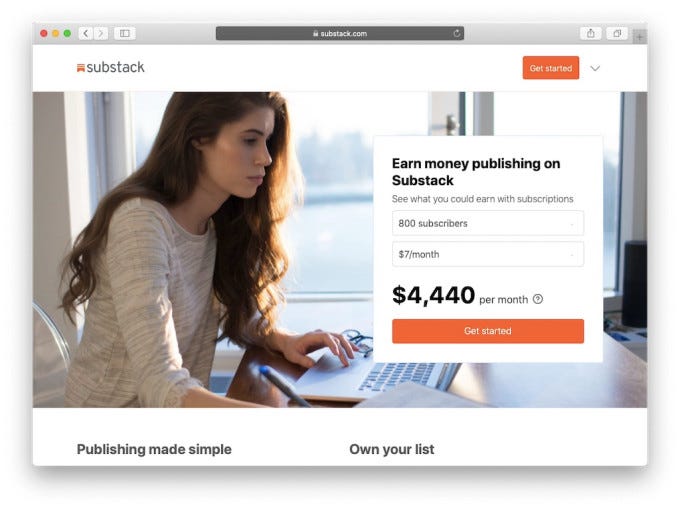
Substack’s business model is simple — in exchange for the tools it provides writers, it makes money by charging a 10% commission of every paid subscriber. Writers who chose not to monetize their content can use Substack for free.
As Substack CEO Chris Best put it:
“The goal is to allow writers and creators to run their own personal media empire.”
Additionally, in Feb 2019, Substack launched audio content support for creators who want to sell podcast subscriptions to their audience.
Substack for podcasts works in the same way as written publications. Creators can choose to give audio content access to everybody, or only to their subscribers.
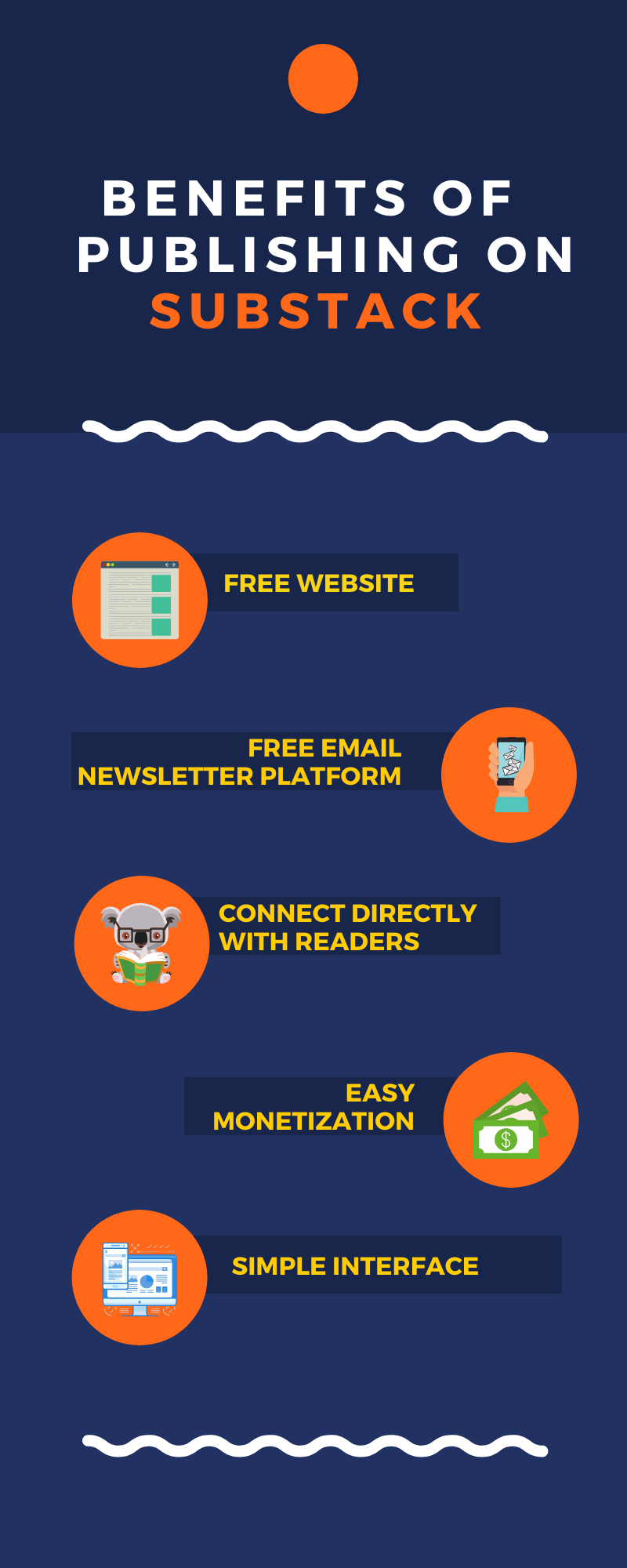
Besides offering the technical infrastructure to support writers, Substack:
- Gives authors a sense of freedom, since they are no longer tethered to the whims of a single social media platform.
- Increases the personal connection between writers and readers, which allows writers to create content that is unique suited for their audience, while still being fairly compensated.
- Allows authors the choice of charging for access to their writing, offering it for free, or some combination of both to their subscribers.
As early Substack investor Andreessen Horowitz stated:
This is where Substack lets writers — of all kinds — directly connect with their readers. Because email is an open platform, it’s durable: It was invented almost alongside the early days of the internet, and is here to stay. It’s also portable: You can take your email addresses with you if you switch providers, offering a degree of control beyond what social media and even RSS offered in terms of audience portability (as I and many other niche content creators on the internet learned the hard way). The timeframe for building relationships over email is practically infinite; it’s not limited by how long a platform survives or switches its business model.
What Are Some Examples of Substack Publications?
Examples of successful niche Substack publications include:
- Sinocism, expert insights and commentary on China
- Popular Information — Judd Legum’s political newsletter
- Heated, a publication that reports on issues in climate change accountability.
- Medium Blogging Guide — while not anywhere close to the popularity of the previous three newsletters — my newsletter certainly demonstrates that it is possible to build and monetize an extremely niche community (in this case, Medium writers looking to boost their earnings and master the platform).
Thanks for reading this article! Leave a comment below if you have any questions, and if you want to learn more about blogging, content marketing, or subscription newsletter strategy, be sure to sign up for the Blogging Guide Newsletter!
If you liked this article, here are some other articles you may enjoy:

Casey Botticello is an internet entrepreneur and the founder of Blogging Guide, an online community of writers with an award-winning newsletter. He is also the creator of the popular Medium Writing Course and the Substack Newsletter Course.
Casey previously worked at several tech startups, a lobbying & strategic communications firm, and has created several businesses of his own. He is a graduate of The University of Pennsylvania, where he received his B.A. in Urban Studies.
You can connect with him on LinkedIn, Twitter, Facebook, follow his Medium publications, Digital Marketing Lab and Medium Blogging Guide, or reach out to him directly on his personal website.


