
Politics | Prejudice | Violence
What is Stochastic Terrorism?
Sticks and stones may break my bones, but words put me in the grave.
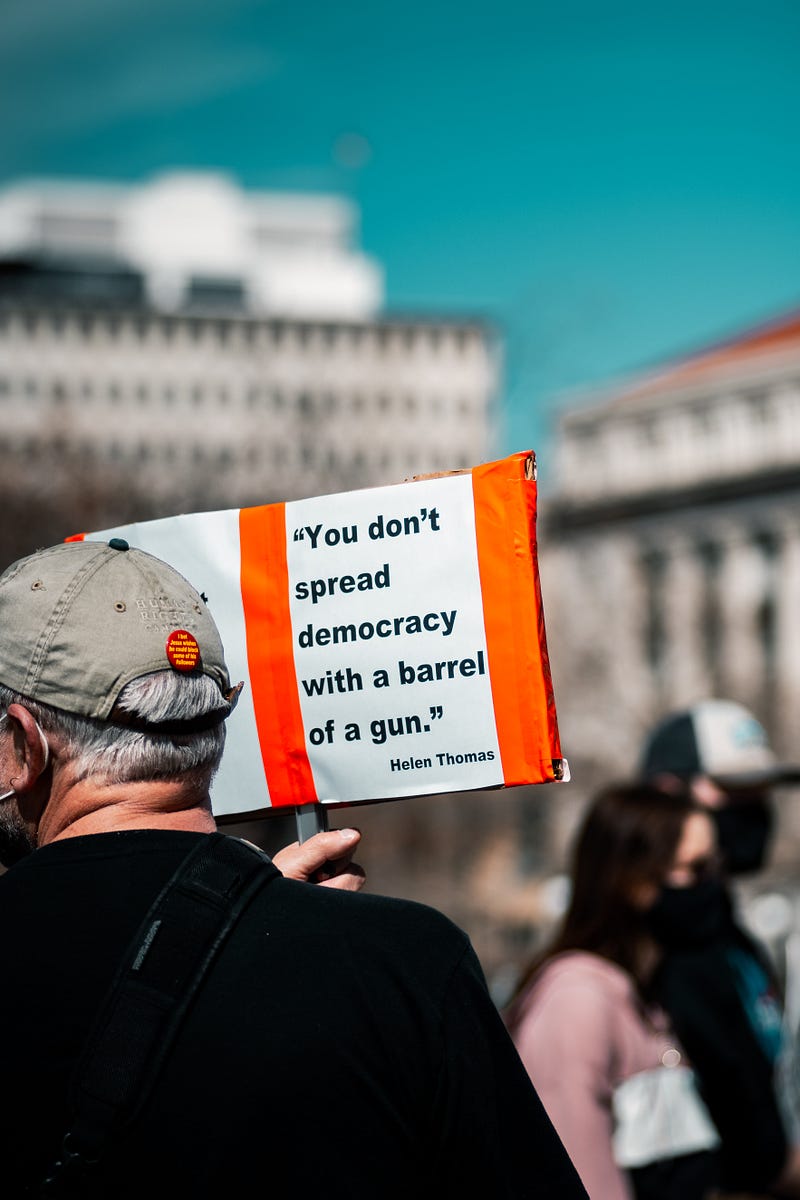
One of the highest ideals of the United States is the freedom of speech. The freedom to speak your mind and share your opinions out loud. Even as an outsider, it’s part of the country’s constitution that I wholeheartedly support.
It’s truly a great value. The ability to speak your opinions and hold your government accountable, the ability for the press to remain independent of government control and spread information to the people, that’s the bedrock of democracy. You can’t have freedom at all if people aren’t free to speak.
There is the obvious exception, of course; if what you say is directly harmful, such as inciting violence or if it can be classified as hate speech or discrimination, then it is not protected under the constitution. This is because your rights cannot conflict with the rights of others.
Your right to throw a punch ends at the tip of my nose.
It’s a reasonable exception. You can’t yell ‘fire’ in a crowded movie theater because when it’s happened in the past, people were trampled to death by panicked patrons scrambling to escape. The same idea holds true elsewhere- you can’t incite a riot and escape consequences…unless you held public office, apparently.
Unfortunately, more and more often the full-throated bellow of ‘Free Speech!’ has been used as a cloak to try and escape those consequences. People have completely forgotten the above restriction, feeling that they have the right to say whatever they want no matter the pain it causes.
You have the freedom to say whatever you want, yes. You don’t have the freedom from facing consequences when people get hurt.
But are words really that harmful? Is it really a reasonable restriction on someone’s rights? To answer that question, let’s take a look at one possible way that words can cause damage. Stochastic terrorism.
You’ve probably heard that term thrown around a lot over the past few years, and for good reason. It has become an incredibly common way to target marginalized groups and political enemies while maintaining a veneer of respectability.
Direct hate speech is still a no-no. Yelling slurs at the top of your lungs gets the public to retreat from you as quickly as they can, unless they belong to the fringe minority that still thinks it’s okay or funny to use those words. They’re loud, so the crowd looks bigger than it is.
You can’t go out there and directly tell people to physically assault somebody. A very big no-no, that’s a threat of violence. Not a good look, and also very illegal. So if you’re a particular kind of horrible person who wants to see violence done, but can’t publicly call for it, what do you do?
You perform stochastic terrorism. The basic idea is twofold.
Step one, dehumanize your targets.
This one is a little bit tricky, as you have to be careful about how you do it. It has to be just subtle enough to not trip the ‘hate speech’ trap, but there has to be an easily recognized dog whistle that your base will catch.
Over the past few years this has started to become a lot more blatant and overt. There’s less ‘just asking questions’ and a lot more ‘I’m telling you the answers’. Just look at the evolution of how the right wing talks about immigration if you want to see it an action.
It used to be ‘protecting American jobs’. Now it’s ‘Mexico is sending crime.’ I won’t complete that entire quote, because it’s atrocious. Anyone following American politics already knows it off by heart.
The basic idea of dehumanizing people has been part of human life since we decided war was a thing we would do. To get ordinary empathetic human beings to turn their guns on other ordinary human beings, you have to convince them the other side is evil. You must get them to believe they would be doing the right thing.
They aren’t regular people just like you, just trying to live a good life and have families and build something better for their children. No, you have to get your base to not even see that. You have to get them to see only bad things and treat any good person as the exception rather than the norm.
Anybody can be a jerk. Every human being has the capacity to do something wrong. The goal of dehumanizing a group is to convince you that they are all bad. They’re bad because they belong to the group. They don’t even need to have done anything wrong. If you get it right, people will assume they have. Just because.
You give them a label. You spread stories and rumors and misinformation. Your base won’t fact check it anyway. You do everything you can to boil them down and strip away their basic personhood and replace it with the idea of ‘Enemy’. You make them into the ‘Other’. Us versus them.
We have to protect ourselves from them. They’re so different from us there is no common ground. They hate us because we’re different. They’ll hurt us if we don’t hurt them first. They’re dangerous. We have to keep them away from our children.
Does that sound familiar?
It should. It’s the rhetoric of bigotry, thrown around today like candy at a Yuletide parade. Dividing people up into in-group and out-group. With a tiny adjustment in word choice, you can make the formula fit any marginalized group. It’s very versatile, and outrageously effective.
Once you’ve managed to dehumanize the Other, you’re ready for the next step.
Step two, convince your base that something needs to be done.
This is where atrocities come from.
You’ve got your base riled up. They’re angry, they’re scared, and they’re desperate to hear solutions to this imaginary problem you’ve cooked up.
You’ve got them crossing the street any time part of the out-group walks past, you’ve got them sick with disgust when they see them just living their lives. You have them convinced that they’re dangerous just by being around.
And then you give them permission.
You graduate from the slow and steady escalation over years and years, and you make the leap to telling people that something has to be done. They need to be stopped.
But you have to be careful here, you can’t explicitly say what you mean. You can’t outright say that you want to see people get hurt. You have to imply it.
And if someone who is just angry enough, just scared enough, just suggestible enough catches your quote…they might decide to take you up on it.
Look at the manifesto left behind by the Charleston church shooter. He shot up a church full of innocent human beings who were just attending a Bible study. He murdered people he didn’t know, who he had never met, who had never done anything wrong to anybody.
He was convinced they needed to be killed because they were a threat. They didn’t belong to his in-group. His manifesto was full to bursting with propaganda, internet sites created by hate groups. He had completely disconnected from the reality of what he was doing, and who he was attacking.
In his mind, they weren’t human beings. They were monsters, and he had to protect people from them. In his mind, he was being a hero.
Nobody sees themself as the villain of their own story.
Stochastic terrorism is insidious. It has become the go-to tactic of public figures who ascribe to extremist views. You can keep your hands totally clean and still get your desired outcome.
Charleston church. Pulse Nightclub. Club Q. Charlottesville.
Over and over again, we see dehumanizing rhetoric thrown around, we see thinly veiled racism, homophobia, transphobia and sexism pitched around social media and even right in front of the press at political rallies.
And every time someone acts on that rhetoric and does something violent, the people perpetuating hate want to blame it on a lone wolf with mental illness. Unless, of course, it was carried out by a person of color. Then it’s because they marched for Black Lives Matter, or they’re a terrorist. In the minds of some public figures, that means the same thing.
Because the in-group can do no wrong, but the out-group is guilty until proven innocent. It’s got to the point where murder victims get demonized, and their death made to seem like it was their own fault. Or that their death didn’t matter because they ‘were no angel.’
The cruddy part is that holding people accountable for stochastic terrorism is really, really hard. By its nature it is designed to be difficult to slap a charge on. It can be subtle, or overt, but there is no obvious statement of intent that would count as illegal.
It’s one of those times where it’s obvious what’s going on, but there’s no direct evidence.
All we can do is educate ourselves and others about this, and about how it works. We have to train ourselves to spot the red flags, and we have to be willing to speak up and call it out. It can’t be allowed to fly under the radar.
Right now, it’s hard to hold them legally accountable for inciting violence. But the court of public opinion is a lot less difficult to turn.
Let’s make hatred a bad thing again. Let’s drive bigots back into the closet. Let’s take our countries back. We have free speech too, so let’s use it.
Democracy can still win. We just have to believe it’s worth standing up for.


