
What is Stakeholder Overload?
And are you suffering from it?

Adapted chapter from Growing Happy Clients. Growing Happy Clients focuses on growth consultants but many of the lessons are applicable for growth hackers within a company so the chapter has been adjusted to speak to both.
The struggle… just one browser notification
You’ve finally got your client or team so far: ready to test browser notifications. You’ve been gathering opt-ins for the last few weeks, and now it’s time to run a test, the first automated notification to reduce checkout drop-off. Now all you need is approval to go live.
So you send it over to your contact person or colleague, Ashley, for a quick check, optimistic that you can put it live later that day. Only Ashley emails back the next day that she also wants Dan, the Brand Manager, to have a look.
You should have known better, of course, the brand manager would like to see it too. Not to worry, you wait for Dan to email back that the notification is approved. I mean their designer made the image after all so how off-brand could it be? Just a simple yes and you can go live.
Come on Dan… You send him a reminder the following day and then finally two days later Dan gets back to you.
“Could the image be a bit lighter? Right now, it doesn’t meet brand guidelines.”
Okay, Dan, no problem. You lighten the image yourself and ask Dan if that’s what he had in mind?
“Yes, but has Mary-Ann checked the copy?”
Um no. It’s 150 characters in total, follows the tone of voice guidelines and crafted to convert. Well, apparently Mary-Ann has to check every single bit of copy that goes live.
You sigh, it’s Friday afternoon already, you’ll have to wait until next week to get it live. You are going to miss all the individuals who will drop off in the checkout over the weekend which, as luck would have it, is when the most sales occur.
At least your Monday starts well, kind of. Mary-Ann has emailed back that the copy looks good, only could you change two words. You think her new copy makes it fluffier and vaguer, but okay, you are past arguing.
You change it and immediately email Ashley:
“Dan and Mary-Ann have approved the browser notification, can I set it live?”
But Ashley is a fickle one. Whilst she’s enthusiastic about the experiment, she wants to make sure everyone is on board about it. So she forwards it to her boss, John, and her CRM colleague, Winston. Ah great, once more, you are waiting for approval.
Finally, on Thursday, they email back that they are happy with the experiment and are looking forward to seeing the results. Yes, you are too… You are about to go-live when you get an email from Patrice:
“Hi, Winston forwarded me the experiment we are running. I was thinking, shouldn’t the image be a bit darker?”
All you can think is about Robin from How I Met Your Mother, “NOBODY ASKED YOU, PATRICE!”. With gritted teeth, you explain that the image was made lighter, as per the request of Dan, so no you can’t change it.

You’re almost two weeks down the line because of two minor tweaks, but you can finally go live.
Wasn’t that exhausting? Now imagine this happens for every single one of your experiments. You’ll need five people to approve each experiment, sometimes even more.
The bigger the organisation grows, the more opinions there are. The more you have learnt the risk of not getting approval, and the organisation can get slow and scared to move.
“There is a saying in the UK, too many cooks spoil the broth. The same can be said when you’re faced with too many stakeholders and opinions — it spoils progress, productivity and can lead to procrastination. It cooks up a pretty stodgy soup of indecision and disgruntlement, simmering away with discontent and sprinkled with croutons of misery.” — Abi Hough, CRO Consultant, uu3.co.uk
There you have it, said in every way possible, too many stakeholders kill results and speed. Now it is time to narrow it down and get rid of some of those cooks. But how on earth do you subtly kick a few individuals out of the kitchen?
Techniques to reduce stakeholder overload
Too often I have seen clients or organisations behave in the way described above. It isn’t just large organisations, even small organisations can get stakeholder overload disease. Luckily, there are a few simple techniques that can help:
- The Approval Matrix
- Mass Approval
- Thinking Ahead
I’ll walk through each one in turn, in far less time than it took Ashley to approve the browser notification.
1. The Approval Matrix
You need to understand how approval works within the company to work with the process rather than against it:
“The biggest piece of advice I can give here really surrounds how well you understand the company makeup and processes of approval from the outset. There is no point just diving in head-first and expecting everyone to follow you into the murky depths of growth and testing with wild abandon, throwing all caution to the wind.” — Abi Hough, CRO Consultant, uu3.co.uk
To build upon that frame of approval, it all comes down to trust within the organisation. Who do people trust in to check something and ensure it meets the organisation’s standards? Or the more pertinent question is who should they trust? When the branding manager says it’s okay, why would anybody else need to look at the design? You leverage the trust to reduce the number of required approvals through an Approval Matrix. The Approval Matrix is a simple table with the following:
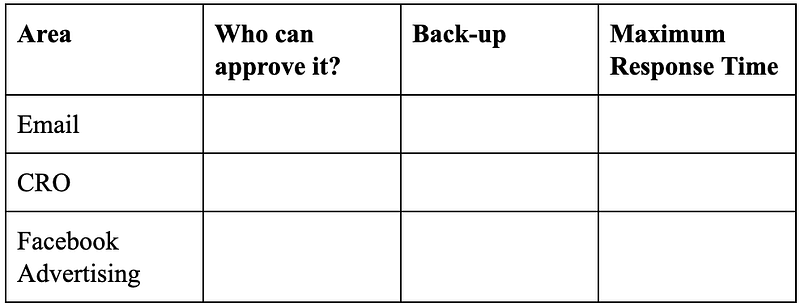
For each area, you have someone who can approve the experiments. Sometimes this can be the same person for several areas, but it always has to be a maximum of one per area.
You often also need to double-check with the brand manager and the copywriter as well. That already brings it up to three individuals which is more than enough.
Most of the time, your contact person or boss will love to help you with this, since they also prefer to get results quicker and get more ‘bang for their buck’ instead of having every experiment delayed.
You can agree with the client or your team regarding who is the right person per area and what would be a suitable response time. The back-up field is alternative individuals you can contact if the primary contact is on holiday or sick. It’s crucial to agree on the response time collectively.
Focus on highlighting the importance of speed in experimenting but also agree on something fair, e.g. two days. If your contact person or boss wants to check off with ten other people within those two days, that’s up to them as long as they get back to you in time.
I like to set this up at the beginning of the collaboration with a client or a new project, especially when I notice that there is a high number of stakeholders involved.
It’s never too late to set this up though, and I’ve found clients and managers to be very open and supportive of the matrix as it gives them peace of mind. They know that quality and speed will be upheld. That way, you can use the trust existing within the organisation before building up the trust they have for you.
“You need to build trust with each person who may be involved, expand their understanding of what you are doing and why, and then preempt any possible feedback by covering all of your bases. By doing this, you build trust, and trust is the single most valuable asset you can obtain when it comes to working efficiently. If people trust you to do your job, and they believe and understand the logic behind your decisions, then the easier it will be to bypass the nitpickers, jobsworth and pixel perfectionists.” — Abi Hough, CRO Consultant, uu3.co.uk
The next two techniques are focused more on how you plan things. They sound simple, but I don’t see them in practice enough.
2. Mass approval
Some tasks take more time to be approved. That’s why, when possible, we send a few smaller items for approval in one go, such as when the items are similar and need the same stakeholders to check them, e.g. different copy, several images. I do always state they can get back to me one-by-one if that’s quicker and sometimes they do.
The goal is to build a deck of approved material to be able to act quickly when needed. If you check three browser notifications one-by-one, it takes far more time than getting three checked in one go.
Another form of Mass Approval is checking off experiments or ideas in a planning meeting as that’s a moment when everyone is there and involved. I often walk through several experiment ideas at once with the whole group. Discussing this in the planning meeting often results in additional ideas on how to improve the experiments.
Be strict, though, such as setting a maximum of five minutes of discussion per experiment; otherwise, you risk an endless debate about one experiment alone.
3. Planning ahead
This sounds so simple but it is often the simplest things that are the hardest to do in practice.
Some areas will almost always take more time, such as development and legal. Whilst we love agility in growth hacking, it isn’t always possible. The fact remains that, at times, it’s best to plan.
Getting a pixel on the website can be tricky, or if there is not enough design capacity, that can be a blocker. That is why we would challenge you to start preparing specific experiments 2–3 sprints ahead of time.
Try to get in place what you need to make them happen. Quarterly planning meetings are also a great time to think about precisely what you’ll require.
This will allow you, in the end, to move far quicker when you run the experiment.
Time for Action
Without action there is no change.
Choose a client if you are a consultant (or a project if you are inhouse) that tends to have too many approval rounds. Probably the project that you immediately thought of in our example at the start of this chapter. Then set up an Approval Matrix for them.

Fill it in with your client or manager and be strict! No, they can’t add three names per area. No, it really is not an option. Challenge them to consider who they trust to make that end call if no one else would be available.
Key Takeaway
Stakeholder overload kills the momentum, which in turn kills growth. The Approval Matrix can be a big lifesaver in decreasing the number of stakeholder rounds. Create one and use it regularly to keep things moving forward.
Find more information on stakeholder overload, how to best deal with different stakeholders and more in Growing Happy Clients.