avatarFaisal Khan

Free AI web copilot to create summaries, insights and extended knowledge, download it at here

2888

Abstract

rinkflation has been most striking in the UK in recent times. Britain’s <a href="https://www.ons.gov.uk/"><b>Office for National Statistics (ONS)</b></a> calculated that between September 2015 and June 2017, there were 206 products that shrank in size and 79 that increased in size. Many economic analysts are of the opinion that this was mostly due the dramatic decrease in the value of Sterling Pound which lost 20% of its value against the Greenback & other major currencies in the aftermath of the Brexit vote.</p><p id="93e2">With the drop in the value of the Pound, retailers in the UK faced rising input costs. With the price competition increasing among the supermarkets, they resorted to reducing pack sizes to increase revenue, low wage growth posts the 2008 financial crisis & government’s push towards healthier products & smaller portion sizes are some of the other reasons shrinkflation has become such an established trend in the UK.</p><p id="e2cd">The Office for National Statistics uses the following formula based on price relatives to calculate the effect of shrinkflation on the unit price of the related items. A new base price is computed based on the current price and new & old weight of the item. For this example, we take the unit price of an item to be priced @ 1.00 with the older weight as 100 grams &amp; the new weight as 90 grams.</p><p id="7bd1"><b><i>➥ New base price = Current base price * (New weight / Old weight)</i></b></p><p id="0932"><b><i>➥ New base price = (1.00) * (90/100)</i></b></p><p id="55b0"><b><i>➥ New base price = 0.900</i></b></p><p id="6245">From this new base price, we calculate the new price relative which gives the unit price for this particular item with the shinkage in size from 100g to 90g.</p><p id="cd82"><b><i>➥ New Price Relative = Current price / New base price</i></b></p><p id="1d08"><b><i>➥ New Price Relative = 1.00/0.900</i></b></p><p id="0839"><b><i>➥ New Price Relative = 1.11</i></b></p><p id="a770">As you can see clearly, the unit price of the item has increased from 1.00 to 1.11 with the decreased packaging size thus exhibiting shrinkflation. This concept can be pretty much applied to any item in any economy to calculate the shrinkflation. At the end of it all, the poor consumer pays the price as the corporations find yet another way to make more profits — Capitalism at its best!</p><p id="4069"><a href="mailto:[email protected]"><b>Email</b></a>📭| <a href="https://twitter.com/fklivestolearn"><b>Twitter</b></a>📜<b> | <a href="https://www.linkedin.com/in/faisal-khan-2a3009b/">LinkedIn</a></b>📑<b>| <a href="https://stocktwits.com/trade_nut">StockTwits</a></b>📉<b> | <a href="https://t.me/joinchat/IWzyHBGWCFwPQTe8Tm5H_Q">Telegram</a></b>🔗</p><p id="040d"><b><i>Recent Articles:</i></b></p><div id="88bb" class="link-block"> <a href="https://readmedium.com/mit-takes

Options

-center-stage-with-crypto-projects-unit-e-vault-553a6c9b3fe7"> <div> <div> <h2>MIT takes center stage with Crypto Projects Unit-e & Vault</h2> <div><h3>It is common knowledge now that 2018 saw a resurgence of stable coins & digital securities as the two emerging &…</h3></div> <div><p>medium.com</p></div> </div> <div> <div style="background-image: url(https://miro.readmedium.com/v2/resize:fit:320/1*GjpIPfyD8Uy7D1MASMfeuA.jpeg)"></div> </div> </div> </a> </div><div id="a286" class="link-block"> <a href="https://readmedium.com/blockchain-moving-past-hype-into-reality-2efe19ffe962"> <div> <div> <h2>Blockchain moving past Hype into Reality</h2> <div><h3>While Cryptocurrencies constantly get bashed by the naysayers as the downward spiral in prices continues, the…</h3></div> <div><p>medium.com</p></div> </div> <div> <div style="background-image: url(https://miro.readmedium.com/v2/resize:fit:320/0*p_OzF94QKRRfmOHB)"></div> </div> </div> </a> </div><div id="e09f" class="link-block"> <a href="https://readmedium.com/meet-raspberry-pi-a-revolutionary-computing-device-615b9891d696"> <div> <div> <h2>Meet Raspberry Pi — A revolutionary Computing device</h2> <div><h3>Gone are the days when computers used to be bulky, expensive & difficult to operate. As technology progressed, the…</h3></div> <div><p>medium.com</p></div> </div> <div> <div style="background-image: url(https://miro.readmedium.com/v2/resize:fit:320/0*bSwjsmUWp5ucdFHS)"></div> </div> </div> </a> </div><div id="88dc" class="link-block"> <a href="https://readmedium.com/design-thinking-humanizes-data-science-more-5a666119c8b1"> <div> <div> <h2>Design Thinking humanizes Data Science & more…</h2> <div><h3>Without wasting too much time… here is a list of the most informative Infographics from my Twitter feed last week…</h3></div> <div><p>medium.com</p></div> </div> <div> <div style="background-image: url(https://miro.readmedium.com/v2/resize:fit:320/0*R_0PsyL0EMJag128)"></div> </div> </div> </a> </div><p id="fc0d"><i>Originally published at <a href="https://www.datadriveninvestor.com/2019/01/30/what-is-shrinkflation-its-economic-impact/">www.datadriveninvestor.com</a> on January 30, 2019.</i></p></article></body>

What is Shrinkflation & its Economic impact

We have all heard about Inflation but do you know about Shrinkflation?

Most of us are familiar with the concept of inflation — it is a quantitative measure of the increase in the price of a basket of goods in a given economy. Inflation is measured in terms of percentage increase — this increase generally represents the decrease in the purchasing power of a nation’s currency. Most of the Central banks’ monetary policies around the globe are centered around the premise of keeping inflation in check (usually 1%-3%) so that the economy keeps running smoothly.

However, this is not always the case & other off-shoots of this phenomenon emanate from the inflationary concept — most commonly known as deflation, hyperinflation & shrinkflation. The former two are a little more well-known than the latter. Deflation usually occurs in recessionary periods when the demand for goods & services falls along with the price of the items — Japan’s “lost decade” is the biggest example in recent history when the prices remained under constant deflationary pressure.

While Hyperinflation is a little rarer & almost impossible to control — Germany’s post WWI slump into economic depression was triggered by hyperinflation with Zimbabwe & Venezuela being the two recent examples in the last decade where the former eventually shifted to a foreign currency while the latter is trying to experiment with a digital currency called Petro to come out of the death trap of inflation.
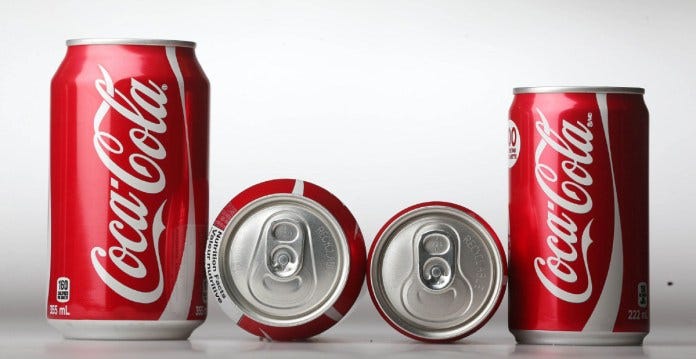
Coming back to the topic of shrinkflation — it is a form of inflation which is usually restricted to a certain segment of the economy, mostly pertaining to the food & beverage industry. In simpler words, the sticker price of a certain item remains the same while the size of the product is reduced, thus increasing the unit price of the item. Most consumers like you & me are much more prone to checking the variation in price.

While a small price change in an item makes us think twice about buying the item, a similar size reduction usually does not have the same effect. The producers, therefore, use this strategy to keep customers buying their product albeit at a higher unit price without them noticing. The “shrink” part pertains to the reduction in the size of the item, inflation, on the other hand, rises still (even with the constant price of the item), as the unit price goes up due to the shrinkage.

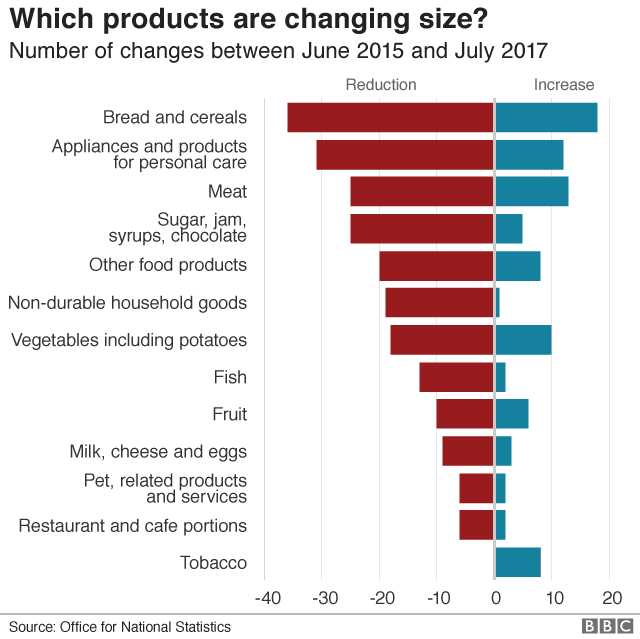
Shrinkflation has been most striking in the UK in recent times. Britain’s Office for National Statistics (ONS) calculated that between September 2015 and June 2017, there were 206 products that shrank in size and 79 that increased in size. Many economic analysts are of the opinion that this was mostly due the dramatic decrease in the value of Sterling Pound which lost 20% of its value against the Greenback & other major currencies in the aftermath of the Brexit vote.

With the drop in the value of the Pound, retailers in the UK faced rising input costs. With the price competition increasing among the supermarkets, they resorted to reducing pack sizes to increase revenue, low wage growth posts the 2008 financial crisis & government’s push towards healthier products & smaller portion sizes are some of the other reasons shrinkflation has become such an established trend in the UK.

The Office for National Statistics uses the following formula based on price relatives to calculate the effect of shrinkflation on the unit price of the related items. A new base price is computed based on the current price and new & old weight of the item. For this example, we take the unit price of an item to be priced @ $1.00 with the older weight as 100 grams & the new weight as 90 grams.

➥ New base price = Current base price * (New weight / Old weight)

➥ New base price = (1.00) * (90/100)

➥ New base price = 0.900

From this new base price, we calculate the new price relative which gives the unit price for this particular item with the shinkage in size from 100g to 90g.

➥ New Price Relative = Current price / New base price

➥ New Price Relative = 1.00/0.900

➥ New Price Relative = 1.11

As you can see clearly, the unit price of the item has increased from $1.00 to 1.11 with the decreased packaging size thus exhibiting shrinkflation. This concept can be pretty much applied to any item in any economy to calculate the shrinkflation. At the end of it all, the poor consumer pays the price as the corporations find yet another way to make more profits — Capitalism at its best!

Email📭| Twitter📜 | LinkedIn📑| StockTwits📉 | Telegram🔗

Recent Articles:

Originally published at www.datadriveninvestor.com on January 30, 2019.

Economics
Finance
Investing
Economy
Business
Recommended from ReadMedium