
What Is Scrum?
An introduction
With this article, I give a short Scrum introduction to people that heard about it and wish to learn what it is. Scrum is a framework to create value in a complex environment. It is a revolutionary approach that moves away from traditional product development.
What is a complex environment?
The nature of a complex environment is that you can’t know upfront what will happen. You may have ideas of what would be the best approach to solve a problem, but you can’t be sure. A very prominent example of a complex environment is the COVID-19 crisis. Many factors influence the spread of the virus. All of these factors make it impossible to know what will happen. Scrum is an approach to deal with complexity.
The world mainly uses Scrum to produce and sustain software, but you can use it in any complex environment. Jeff Sutherland and Ken Schwaber created it in the nineties as a response to the traditional way of building software that assumed that you can plan everything precisely. Jeff and Ken were inspired by a 1986 paper called “The New New Product Development Game” (Takeuchi and Nonaka). This paper coined the term Scrum. It mentioned how product development could resemble the game of rugby where you would “move the Scrum upfield”.
Before Scrum
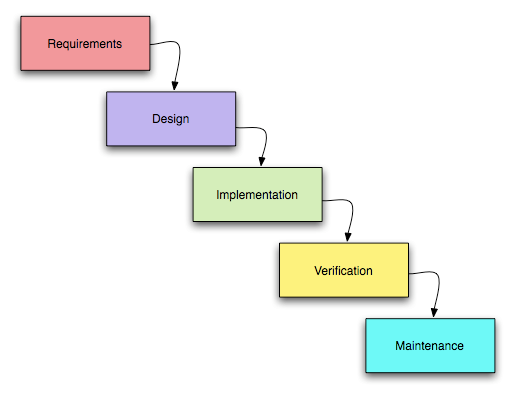
Before Scrum, people would create software in several phases (see below, the Waterfall model). With the Waterfall model, you assume that all requirements are clear upfront and no changes will occur. For a Waterfall model to succeed, a stable environment is key. If you use Waterfall in a complex environment the chances of delivering the wrong thing are eminent.
Scrum’s answer to complexity
The foundation of Scrum is empiricism. Empiricism entails that you make decisions based on what you know, not on what you assume. As a result, a team takes small steps, inspects what they build and then adapts its approach if needed.
A Scrum Team has all skills to accomplish the work, without needing help from outside the team. A team self-organises to allow them to creatively find solutions to complex issues.
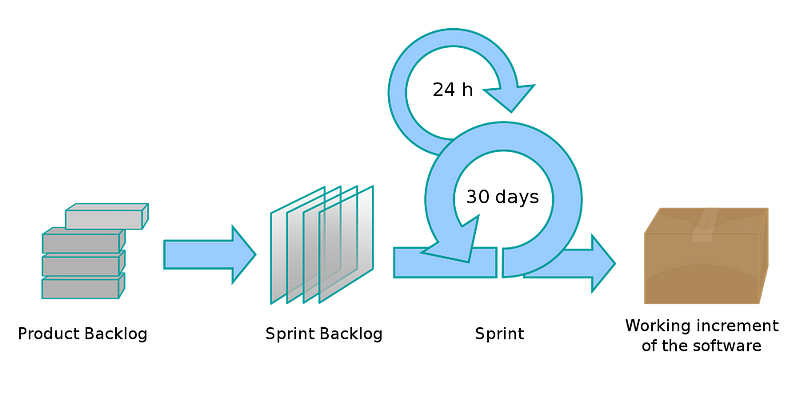
A Scrum Team works in timeboxes which are no longer than a month, but often shorter. At the start of a timebox, the team defines a goal. This goal helps them to create a plan of approach. Daily, the team meets to discuss the progress towards the goal, adapting the plan when new insights require this.
A the end of a timebox the team informs its most important stakeholders about their journey to reach their goal. The team also shows the increment (the sum of all value created up to that point). The stakeholders then provide input that will influence the next steps of the Scrum Team. This input can be feedback on the increment, but also market conditions, actual use of the product and other factors.
After this review event, the team inspects how the last timebox went and plans improvements for the next timebox. The team members empirically improve their way of working.
Below is a simplified overview of Scrum:
Radical change
Scrum is revolutionary because it offers practices that move away from traditional ways of doing business:
- Scrum acknowledges that you can’t create precise long term plans;
- Scrum empowers the team to own the planning of their delivery;
- Scrum empowers the team to find the best way to create a product;
- Scrum works with servant-leaders who help the team to reach its goals.
For Scrum to succeed everyone within the organisation must understand this.
Many flavours
Scrum is a framework that allows many different implementations. Every Scrum Team has a different flavour. As my Serious Scrum co-creator puts it, Scrum is a canvas:
The Scrum canvas allows your team to create a world of their own. — Sjoerd Nijland
You can blend Scrum with all kinds of practices, like Kanban, Extreme Programming and many others.
Suitable for any complex environment
Within the software industry, Scrum is very popular. However, it is a great framework for any complex environment, where what will happen is unknown. As an example, I used it for a management team.
Do you want to know more?
If you wish to know more, then I invite you to reach out to me or read the articles of my Serious Scrum publication, created by an enthusiastic group of people providing no-nonsense Scrum content.


